


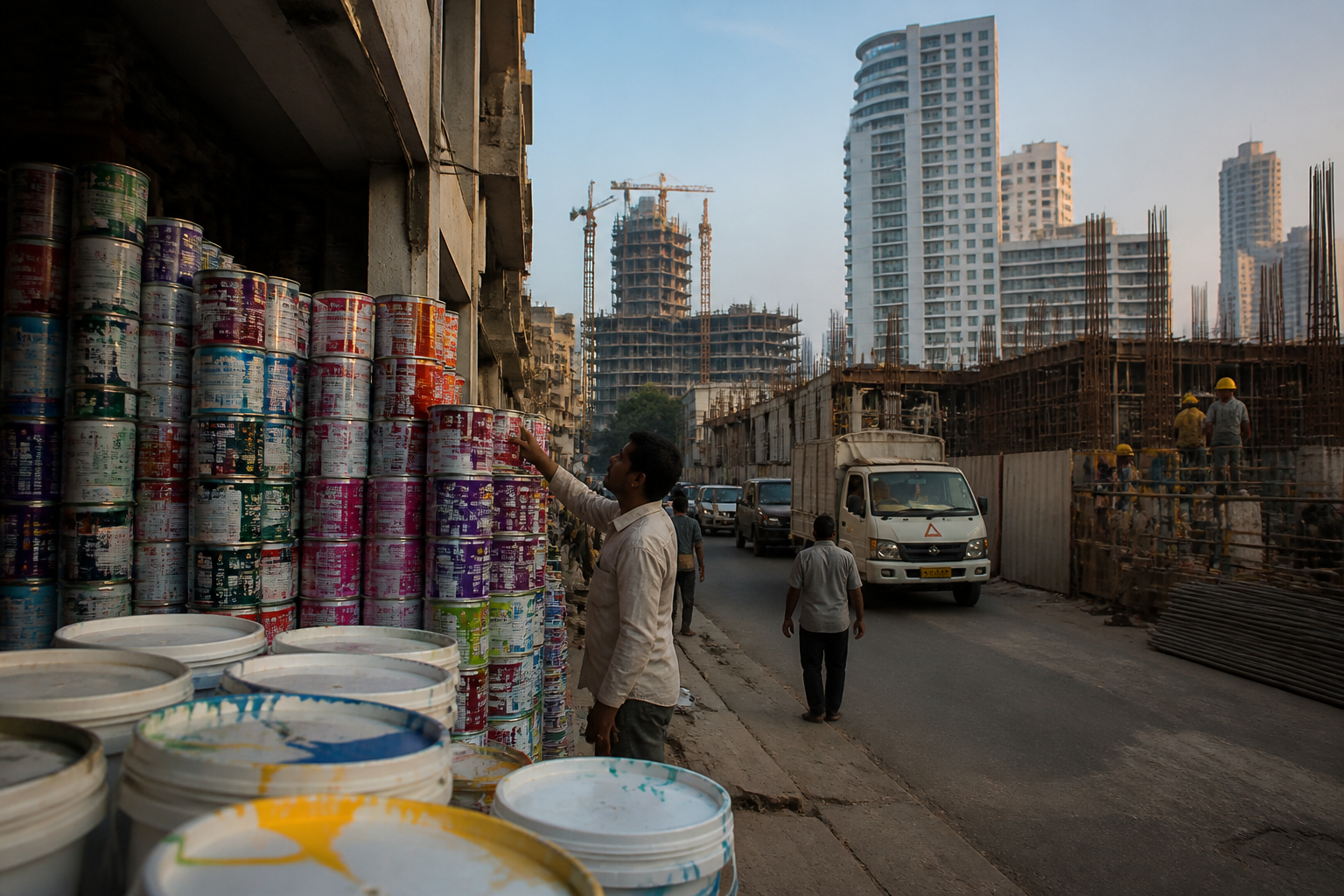
Berger Paints’ expansion plan is more than a defensive response to Birla Opus and JSW Dulux. It shows how India’s paint market is being reshaped by the same forces changing the wider built environment: urbanisation, new housing and commercial construction, distribution-led competition, and pressure to manufacture closer to regional demand.
The Kolkata-based company plans to launch a new luxury-paints line, add as many as 250 mostly exclusive outlets every year and strengthen teams in markets where it is weaker, including Mumbai, Pune, Chennai and Bengaluru. It also plans to invest Rs 20,000 million in manufacturing facilities in West Bengal and Odisha by 2029 and 2030, according to Chief Executive Officer Abhijit Roy, who spoke to Bloomberg.
The plan comes as India’s second-largest paints company faces aggressive competition from Birla Opus, backed by the Aditya Birla Group, and JSW Dulux, backed by Sajjan Jindal. Their entry has intensified discounting in a sector traditionally dominated by Asian Paints and Berger Paints. Brokerage PL Capital said in a September 16 note that the newer rivals were gaining ground.
For Berger, the response combines premiumisation, wider distribution and regional manufacturing. Each element addresses a different weakness. Luxury paints can raise the value of each customer transaction, additional outlets can improve physical availability, and new factories can increase supply capacity while reducing the distance between production and demand centres.
## Why distribution is central to the paint market
Paint is often treated as a consumer product, but its sale and application are closely tied to construction and property markets. Homeowners, builders, contractors, painters and architects influence brand selection, while the product must be available through a large network of dealers and outlets. Berger is therefore offering incentives to painters, builders and architects while widening its distribution network.
The company’s plan to reach 2,500 mostly exclusive outlets by March 2029 points to the importance of access in a fragmented market. A consumer renovating a home or a small contractor working on a project may have limited patience for supply delays or unavailable shades. Distribution can consequently affect which brand is considered, even before price and product quality are compared.
The geographic focus also reflects an uneven competitive position. Berger is strengthening its teams in Mumbai and Pune in western India and Chennai and Bengaluru in the south. These are major urban and construction markets, with large residential, commercial and infrastructure ecosystems. The supplied report does not establish Berger’s exact market share in each city, but the company’s stated focus indicates that regional presence is a strategic concern.
## The manufacturing question behind the expansion
Berger’s proposed facilities in West Bengal and Odisha add a capacity and logistics dimension to the market contest. The company has committed Rs 20,000 million to the projects, with completion targets in 2029 and 2030. The investment will place manufacturing capacity in eastern India, while the company simultaneously works to deepen its presence in western and southern urban markets.
The regional manufacturing strategy matters because paint demand is not generated uniformly across the country. It follows new housing, redevelopment, commercial construction, industrial activity and periodic renovation. Manufacturing locations, warehouses, dealers and application professionals must work together if a company is to convert broad national demand into actual sales.
Berger’s announcement also indicates that competition is no longer limited to brand advertising. The contest is moving across the value chain, from factories and product categories to outlets and incentives for the people who influence purchase decisions. This raises the cost of defending market share, particularly when competitors are willing to use pricing to enter established territories.
## Pricing pressure is changing the economics
Berger’s shares have fallen about 16% this year, compared with a 10% decline in India’s benchmark measure, according to the report. The company was valued at Rs 525.4 billion, while its parent, UK Paints India, owns 64.56% and is controlled by Kuldip Singh Dhingra and Gurbachan Singh Dhingra.
The more important operational pressure is on margins. Aggressive discounts from newer rivals have affected both Berger Paints and Asian Paints, while higher raw-material costs have added to the strain. The report also links a Middle East conflict-led rise in crude prices to a more uncertain outlook for listed paint companies, including Kansai Nerolac Paints and JSW Dulux, formerly Akzo Nobel India.
Paint manufacturers are exposed to raw-material movements because their input costs can change while competition limits their ability to pass the increase on to customers. When companies respond to new entrants with discounts or incentives, volume growth may not translate into equivalent profit growth. Berger’s expansion must therefore deliver not only more sales but also enough operating efficiency and product mix improvement to defend profitability.
## Urban demand provides the growth case
The demand case for the industry remains linked to India’s urban and real-estate expansion. The paints sector is expected to grow about 5% to $11.8 billion by 2030, according to the IMARC Group, with urbanisation, rising disposable incomes and growth in commercial and residential real estate identified as drivers.
That growth is significant for construction-material companies because paint demand arrives at several stages of the urban cycle. New homes require initial finishing, occupied homes generate periodic repainting, and commercial buildings create demand through construction, refurbishment and maintenance. Infrastructure development can also support industrial paints, which Berger expects to receive an additional boost from the country’s infrastructure buildout.
However, sector growth does not automatically protect every incumbent. If the market expands while new competitors capture a larger share of the incremental demand, established companies may need to spend more simply to preserve their existing position. Roy described holding on to Berger’s 20% market share as a solid baseline and said the company would seek an additional 0.5% nationally across categories if market conditions supported its plans.
The distinction between market growth and company growth is central. India may add more housing, commercial space and infrastructure, but the benefits will be distributed through pricing, availability, product positioning and relationships with the professionals who specify or apply paint.
## Festival demand and the construction cycle
Berger expects the festival season through Diwali in November to support demand and lift full-year volume growth slightly to 8%, after a slow start to the year and higher raw-material prices. This expectation places near-term importance on seasonal repainting and renovation activity, but the company’s longer-term investments are aimed at a more structural opportunity.
The proposed luxury range would allow Berger to participate in higher-value segments, while new outlets could improve its reach among consumers in growing urban markets. The manufacturing investments, in contrast, have a longer timetable and are intended to support capacity through the end of the decade.
The report does not provide projected production capacity, investment returns or city-level outlet targets for the new facilities and distribution programme. Those details will be important in assessing whether the strategy changes Berger’s competitive position or mainly raises the cost of defending it.
## The larger built-environment signal
Berger Paints’ response reveals how construction-material markets increasingly mirror the geography of urban growth. Companies are not competing only for national market share; they are building regional networks around cities, construction professionals, factories and changing consumer preferences.
For the built environment, this matters because materials are part of the delivery system for housing and infrastructure. A more competitive market may expand product choice and distribution, but prolonged discounting can also pressure manufacturers’ margins and alter investment decisions. The outcome will depend on whether demand growth is strong enough to absorb new capacity without reducing the financial ability of companies to maintain factories, supply networks and technical teams.
What is established so far is that Berger is responding with a combined plan: premium products, 250 additional outlets a year, stronger teams in four major urban markets and Rs 20,000 million in eastern manufacturing investments. What remains to be demonstrated is whether those measures can protect its market share and improve performance while prices, raw-material costs and competition remain under pressure.
