


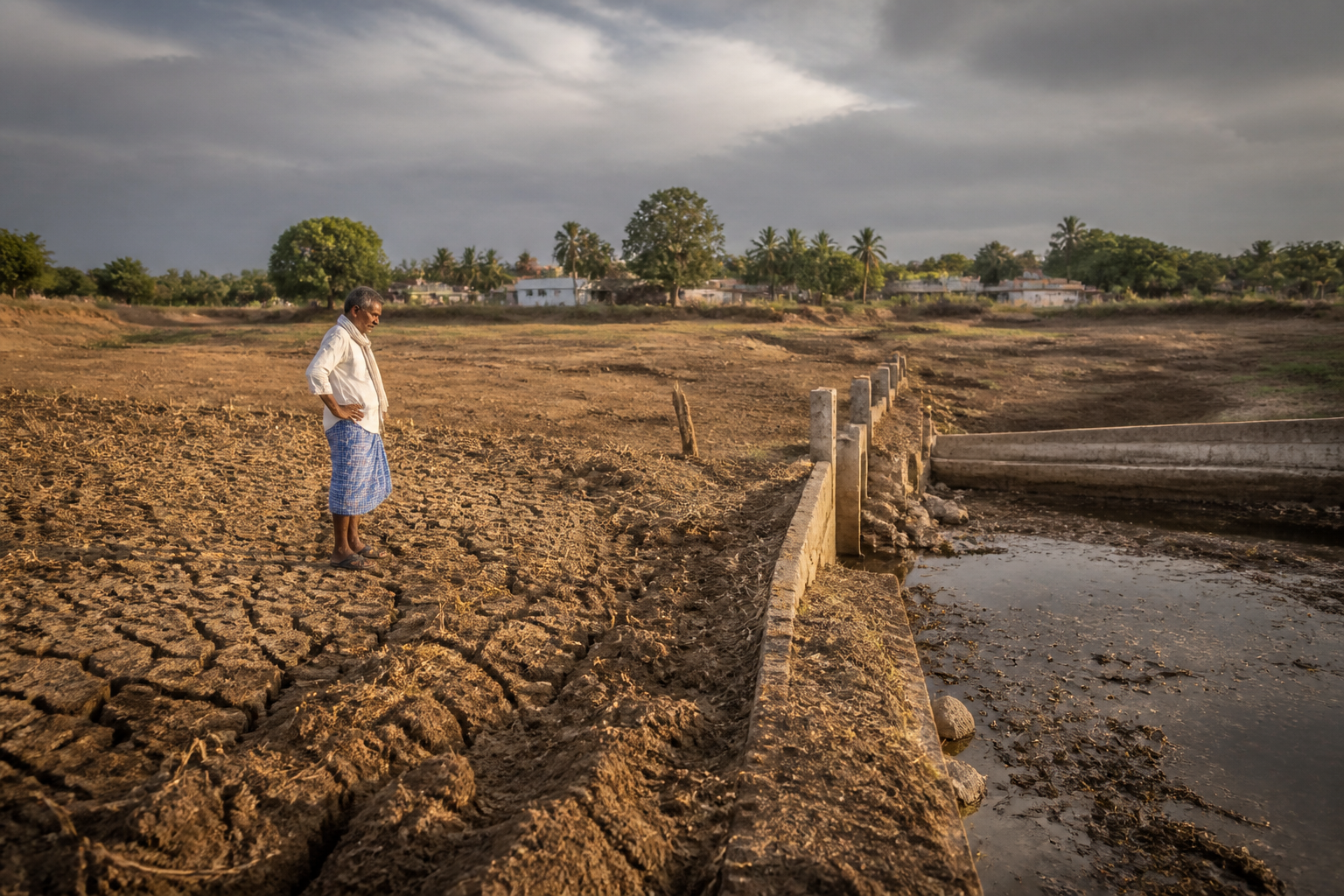
Karnataka’s declaration of drought for the 17th time in roughly a quarter century is not simply another bad monsoon story. It is evidence of a water system repeatedly absorbing the same shock without changing the way rainfall, groundwater, irrigation, electricity and rural livelihoods are managed.
The immediate response to drought has traditionally focused on relief: central assistance, grants, loan moratoriums and support for affected communities. But the recurring drought declarations suggest that relief is treating the consequences of water stress rather than reducing the conditions that make the state vulnerable. Experts and officials cited by the Times of India point to a combination of changing rainfall patterns, urbanisation, vegetation loss, conventional irrigation practices and weak water management.
That combination matters beyond agriculture. Drought affects the state’s finances through rising electricity consumption for irrigation, increases pressure on groundwater, contributes to migration from farming regions and makes the revival of tanks and lakes an administrative necessity rather than a purely environmental project. The question for Karnataka is therefore not only how much rain it receives in a particular year, but how effectively it retains, distributes and uses the water that does arrive.
A repeating geography of drought
GS Srinivas Reddy, former director of the Karnataka State Disaster Management Centre, has tracked droughts in the state since 1990. He told the newspaper that Karnataka’s largest challenge was its reluctance to adapt to changing climate conditions and inconsistent rainfall. Before 2000, he said, drought was treated as part of the weather cycle, and farmers adapted by shifting from paddy towards millets.
Reddy co-authored a 2017-18 paper titled ‘Drought vulnerability assessment in Karnataka: Through composite climatic index’. The assessment identified 176 of Karnataka’s 239 taluks as drought-prone. He said many of these taluks had appeared repeatedly on the drought-hit list over the past 17 years.
Professor MN Thimmegowda of the University of Agricultural Sciences offered a similar assessment, saying at least 80% of drought-prone taluks remain the same across successive drought cycles. He also said 16 of the 24 most drought-prone districts in the country identified in a study by the National Rainfed Area Authority are in Karnataka.
Together, these figures indicate that drought vulnerability is not evenly distributed or random. Large parts of the state face a persistent structural disadvantage. Repeated declarations in the same taluks suggest that the administration is dealing with a known pattern, even though the response continues to be organised largely around individual drought years.
Karnataka’s geography makes the problem more complex. Reddy and Thimmegowda said annual rainfall varies from about 6,000 mm in some areas to about 450 mm in others. Coastal regions receive roughly 3,000 mm, while the Western Ghats act as a barrier that limits the movement of rain-bearing clouds towards the plains. The plains may receive around 600 mm even in a good year, according to the experts.
The state is also an upper riparian region, meaning water can flow downstream rather than being retained in the soil. This does not make drought inevitable, but it increases the importance of storage, recharge and efficient irrigation. When rainfall is uneven and the landscape is not able to hold enough water, a weak management system can turn seasonal variability into a recurring crisis.
The vegetation and climate link
Thimmegowda connected the drought pattern to declining vegetation and rising pollution, saying these factors had affected rainfall patterns. He distinguished between forest cover recorded on paper and actual vegetation on the ground. While the state’s forest cover is listed at 22%, he said vegetation was only 16%.
The supplied evidence does not establish a single cause for Karnataka’s rainfall variability. It does, however, show that experts see land cover and water retention as part of the same system. Forests, vegetation, lakes, tanks and soil moisture are not separate environmental concerns when the state is trying to manage irregular rainfall. Their condition influences how much water is absorbed, stored or made available after a rain event.
This is particularly relevant for a state where the difference between receiving rain and retaining it can determine whether a region faces agricultural stress months later. A drought policy focused only on relief payments or emergency assistance cannot address the loss of local storage and recharge capacity. That is why lake and tank restoration, mentioned by the government adviser cited in the report, has significance beyond beautification or local water supply.
A water economy under pressure
Reddy estimated that Karnataka has about 450 trillion cubic feet of groundwater and as much as 1,300 trillion cubic feet of surface water. Groundwater, he said, irrigates 54% of cultivable land, while surface water supports the remaining area. He also argued that there is substantial misuse of surface water.
These figures point to a management problem involving both quantity and allocation. Karnataka may possess large water resources in aggregate, but the distribution of those resources across regions, seasons and users is uneven. The existence of surface water does not guarantee that it reaches farms efficiently, while groundwater availability does not mean that extraction is financially or ecologically sustainable.
Drought years also expose the fiscal consequences of this arrangement. A government official told the newspaper that electricity consumption for irrigation rises during droughts. The finance department estimated that the power subsidy bill for the current year could reach Rs 28,000 crore, compared with a budgeted Rs 21,000 crore. In 2023-24, another drought year, the allocation increased by Rs 6,000 crore to Rs 7,000 crore, according to the official.
The numbers show how water stress moves through the state budget. When surface supplies weaken, farmers may depend more heavily on electrically powered groundwater extraction. That increases the cost of supporting irrigation even as the underlying water source becomes more vulnerable. The power subsidy is therefore not only an energy expenditure; it is also an indicator of how drought shifts the burden from hydrological systems to public finances.
The livelihood question
The crisis is also connected to the viability of farming. Reddy said small and marginal farmers hold 80% of agricultural land in Karnataka, with many owning less than half an acre. He argued that cultivating such small holdings often makes limited economic sense and that members of farming families in northern Karnataka are migrating in search of work.
Thimmegowda cited a recent study which, according to him, found that 94% of farmers would prefer to leave farming if an alternative employment opportunity were available. The supplied report does not provide details of the study’s methodology, but the figure highlights the economic pressure surrounding agriculture in drought-prone areas.
Reddy described some of this as “artificial drought”, linking it to fields being left fallow and to the effects of social security schemes. That interpretation is a claim by Reddy, not an established causal finding in the supplied evidence. What is clear from the reported figures is that drought, farm size, low agricultural returns and migration are interacting. Water policy cannot be separated from the question of whether small farms can provide a viable livelihood.
This has an urban dimension. Migration from northern Karnataka’s farming districts can increase the demand for jobs, housing and public services in towns and cities. The source does not quantify that movement or identify its principal destinations, but it establishes the direction of the pressure: when agriculture becomes less viable, rural households seek alternatives elsewhere. Water stress can therefore reshape urban economies even when the original drought is located far from a major city.
From emergency relief to efficiency
The policy challenge identified in the report is to maintain food production while ensuring economic security for farmers. LK Atheeq, financial adviser to Chief Minister DK Shivakumar, said the state could place greater emphasis on micro-irrigation. He argued that improving water-use efficiency could potentially expand the irrigated area without increasing water availability.
Atheeq also compared Karnataka with Maharashtra, saying Maharashtra collects significantly higher water-use charges from farmers and uses the funds to maintain irrigation canals and pipelines. The comparison raises an institutional question about whether irrigation systems have adequate resources for maintenance, but the supplied material does not provide the two states’ respective charge levels or maintenance outcomes.
The government is also working towards rejuvenating and reviving lakes and tanks across Karnataka, according to Atheeq. The stated objectives are to improve surface-water availability and support groundwater recharge. If implemented consistently, such measures would address two weaknesses identified by the experts: the loss of retained water and excessive pressure on groundwater.
However, the reported evidence does not establish the scale, timetable or funding structure of the lake and tank programme. Nor does it show how micro-irrigation will be financed, adopted or maintained across small and marginal holdings. Those details will determine whether the proposals become a long-term shift in water management or remain another set of drought-year interventions.
The larger urban question
Karnataka’s recurring drought reveals a governance problem that crosses administrative boundaries. Agriculture departments, irrigation agencies, electricity utilities, disaster management authorities, finance officials and urban administrations all encounter different effects of the same water imbalance. A drought declaration may be made for affected taluks, but its consequences appear in subsidy bills, migration patterns, groundwater levels and the capacity of cities to absorb new workers.
The evidence confirms that Karnataka’s vulnerability is geographically concentrated, repeatedly observed and financially significant. It also shows that the state’s water challenge is shaped by rainfall variation, land cover, irrigation choices, storage capacity and farm economics rather than by a single failed monsoon.
What remains unclear is whether the proposed emphasis on micro-irrigation, water-use charges and lake and tank revival will be implemented at a scale matching the problem. The next measure of progress will not be the number of drought relief packages announced, but whether the same taluks continue to return to the drought list and whether water demand, groundwater dependence and irrigation costs begin to fall over time.
