


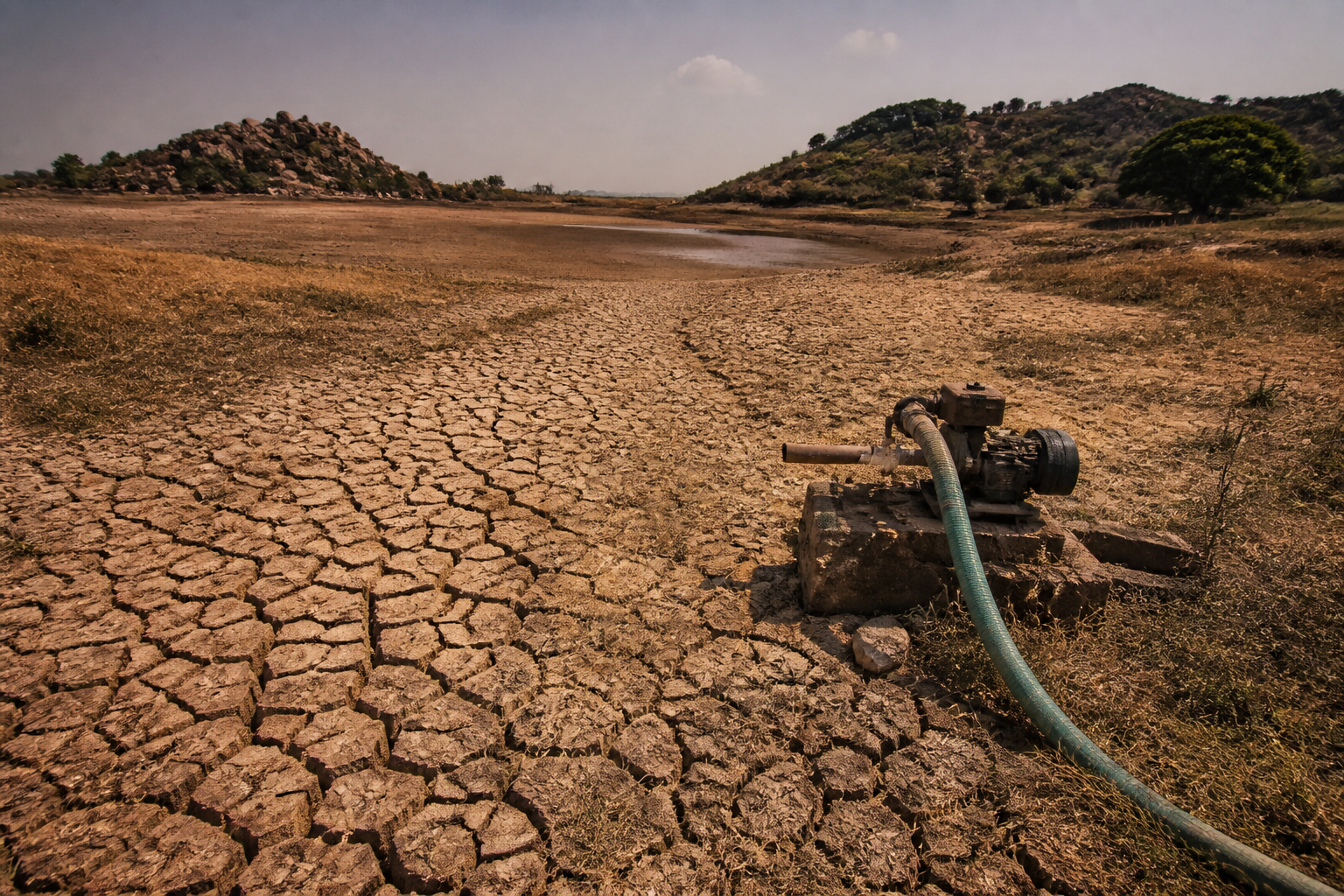
Karnataka’s latest drought declaration is not simply another difficult agricultural season. It is evidence of a water system repeatedly absorbing the same shock without changing how rainfall, groundwater, irrigation, farms and public finances are managed. The state has declared drought for the 17th time in the past quarter century, according to the Times of India report, while experts and officials continue to identify structural vulnerabilities that make many regions prone to recurring water stress.
The central problem is persistence. GS Srinivas Reddy, former director of the Karnataka State Disaster Management Centre, said he has tracked droughts in the state since 1990 and described the government’s response as insufficiently adapted to changing climate conditions and inconsistent rainfall. His assessment points to a shift from drought being treated as a periodic weather event to becoming a recurring governance challenge. Relief measures may address immediate distress, but they do not by themselves change the conditions that produce repeated drought declarations.
Reddy and Professor MN Thimmegowda of the University of Agricultural Sciences identified a combination of changing rainfall patterns, urbanisation, vegetation loss, conventional irrigation practices and inadequate water management as factors worsening the state’s vulnerability. These are not isolated agricultural concerns. They connect rural water availability to the functioning of towns and cities, the cost of electricity subsidies, migration and the ability of public institutions to maintain water infrastructure.
The geography of Karnataka makes this challenge particularly uneven. The state receives annual rainfall ranging from about 6,000mm to 450mm, according to the experts cited in the report. Coastal areas receive around 3,000mm, while parts of the plains receive about 600mm even in a good year because the Western Ghats act as a barrier to rain-bearing clouds. This sharp spatial variation means that a single statewide drought response can conceal very different local water conditions.
The distribution of rainfall also complicates infrastructure planning. A region that receives intense rainfall may still struggle to retain water if storage, recharge and distribution systems are inadequate, while a low-rainfall region may face prolonged dependence on groundwater and rainfall-sensitive agriculture. Thimmegowda and Reddy also pointed to Karnataka’s position as an upper riparian state, where water tends to flow downstream rather than being retained in the soil. The issue, therefore, is not only how much rain falls, but how effectively the state captures, stores and uses it.
The recurrence of the same drought-affected areas is one of the clearest indicators that the current system is not reducing vulnerability. Reddy, who co-authored a 2017-18 drought vulnerability assessment, identified 176 of Karnataka’s 239 taluks as drought-prone. He said many of these taluks have repeatedly appeared on drought-hit lists over the past 17 years. Thimmegowda added that at least 80% of drought-prone taluks remain the same during successive drought cycles.
That pattern changes the meaning of a drought declaration. If the same taluks repeatedly require relief, the state is dealing with a persistent exposure rather than a temporary emergency. The declaration becomes a recurring administrative response to a known geography of risk. The evidence cited in the report does not establish that a single intervention would eliminate drought, but it does show that existing measures have not prevented the repeated concentration of vulnerability in the same locations.
The state’s agricultural dependence on rainfall adds another layer to the problem. Reddy estimated Karnataka’s groundwater availability at about 450 tmc and surface water at as much as 1,300 tmc. Groundwater is used to irrigate 54% of cultivable land, while surface water irrigates the remainder. He also described the misuse of surface water as significant. These figures point to a water system in which the available resource is substantial in aggregate but unevenly accessed, managed and converted into reliable irrigation.
The pressure is not confined to farms. Government officials cited in the report said drought years increase electricity consumption for irrigation, placing additional pressure on state finances. For the current year, the finance department estimated that the power subsidy bill could rise to Rs 28,000 crore from a budgeted Rs 21,000 crore. In 2023-24, another drought year, the allocation increased by Rs 6,000 crore to Rs 7,000 crore. The figures show how water stress is transmitted through public expenditure: when groundwater pumping rises, the fiscal cost of subsidised agricultural electricity can rise with it.
This creates a cycle in which the state supports water extraction to protect agricultural livelihoods, but the same response can increase pressure on groundwater and finances. The report does not provide a complete assessment of groundwater levels or the long-term condition of aquifers, so the full extent of depletion cannot be established from the available evidence. It does, however, show that drought management is linked to energy policy and budget management, not only to rainfall or crop loss.
The social structure of agriculture is equally important. Reddy said small and marginal farmers hold 80% of agricultural land in Karnataka, with many owning less than half an acre. For some households, cultivation on such small holdings may make limited economic sense. He linked this pressure to migration from parts of north Karnataka, with younger and older members of farming families increasingly dependent on social security schemes. Thimmegowda cited a recent study that found 94% of farmers would prefer to leave farming if an alternative employment opportunity were available.
These observations suggest that drought is also reshaping the relationship between land, labour and settlement. When farming becomes economically unviable, households may leave agriculture even when land remains in their name. Migration can then transfer pressure to towns and cities, where new arrivals require housing, transport, jobs and basic services. The report does not quantify this migration or identify its destination cities, but it establishes the rural economic conditions that can contribute to wider urban change.
The vegetation question adds an environmental dimension. Thimmegowda said Karnataka’s forest cover is 22% on paper, while actual vegetation is 16%, and argued that declining vegetation and rising pollution have affected atmospheric pressure and rainfall patterns. These claims are attributed to him in the report and are not independently assessed in the supplied material. They nevertheless highlight a policy gap: land cover, watershed protection and rainfall resilience are often treated as separate subjects even though they influence the capacity of landscapes to retain water.
Urbanisation makes that gap more consequential. As cities expand, demand for water grows and open land that could support infiltration or local storage can be placed under greater pressure. The report does not provide city-level data on groundwater extraction, lake loss or urban demand, so it cannot establish the precise contribution of urbanisation to Karnataka’s present drought. But it identifies urbanisation as one of the structural factors experts believe is worsening vulnerability. That places city planning within the drought conversation rather than outside it.
The policy response described in the report is moving towards efficiency and local water storage. LK Atheeq, financial adviser to Chief Minister DK Shivakumar, said greater emphasis could be placed on micro-irrigation to improve water-use efficiency and potentially expand irrigated area without increasing water availability. He also said the government was working to rejuvenate and revive lakes and tanks across the state to improve surface-water availability and support groundwater recharge.
Atheeq also pointed to Maharashtra’s higher water-use charges for farmers and the use of those funds to maintain irrigation canals and pipelines. The comparison raises an institutional question about whether irrigation systems can be maintained through more closely linked user charges and service expenditure. The supplied report does not provide the respective charge levels, collection rates or maintenance outcomes, so it does not establish whether Maharashtra’s approach can be transferred directly to Karnataka. It does show that financing the upkeep of water infrastructure is part of the policy discussion.
The proposed measures address different points in the water cycle. Micro-irrigation concerns how efficiently water is applied to crops. Lake and tank rejuvenation concerns surface storage and recharge. Canal and pipeline maintenance concerns the reliability of distribution. None of these measures, in isolation, resolves the state’s rainfall variation, agricultural economics or uneven geography. Their significance lies in whether they are implemented as a connected water-management strategy rather than as separate projects announced during drought years.
Karnataka’s experience also exposes the limits of treating drought as an annual relief category. The state’s repeated declarations, the concentration of risk in the same taluks, the rise in irrigation-related power subsidies and the continuing dependence on rainfall together indicate a system under recurring stress. The evidence supplied does not permit a judgment on the effectiveness of the current government’s lake, tank or micro-irrigation initiatives because implementation details and outcomes are not provided.
What it does confirm is that Karnataka’s water challenge crosses administrative boundaries. Agriculture depends on irrigation and farm economics; electricity subsidies influence groundwater pumping; vegetation and land cover affect resilience; migration alters the demand placed on towns and cities; and lakes, tanks, canals and pipelines require sustained maintenance. A drought declaration may trigger immediate relief, but the deeper policy test is whether the same taluks, households and public budgets continue to face the same crisis.
The developments that merit monitoring are the implementation of micro-irrigation, the scale and condition of revived lakes and tanks, the management of groundwater and surface water, and the state’s irrigation-related power subsidy bill. Until those measures produce measurable changes in recurring drought exposure, Karnataka’s declarations will continue to describe not only a rainfall problem but an unresolved water-governance problem.
