


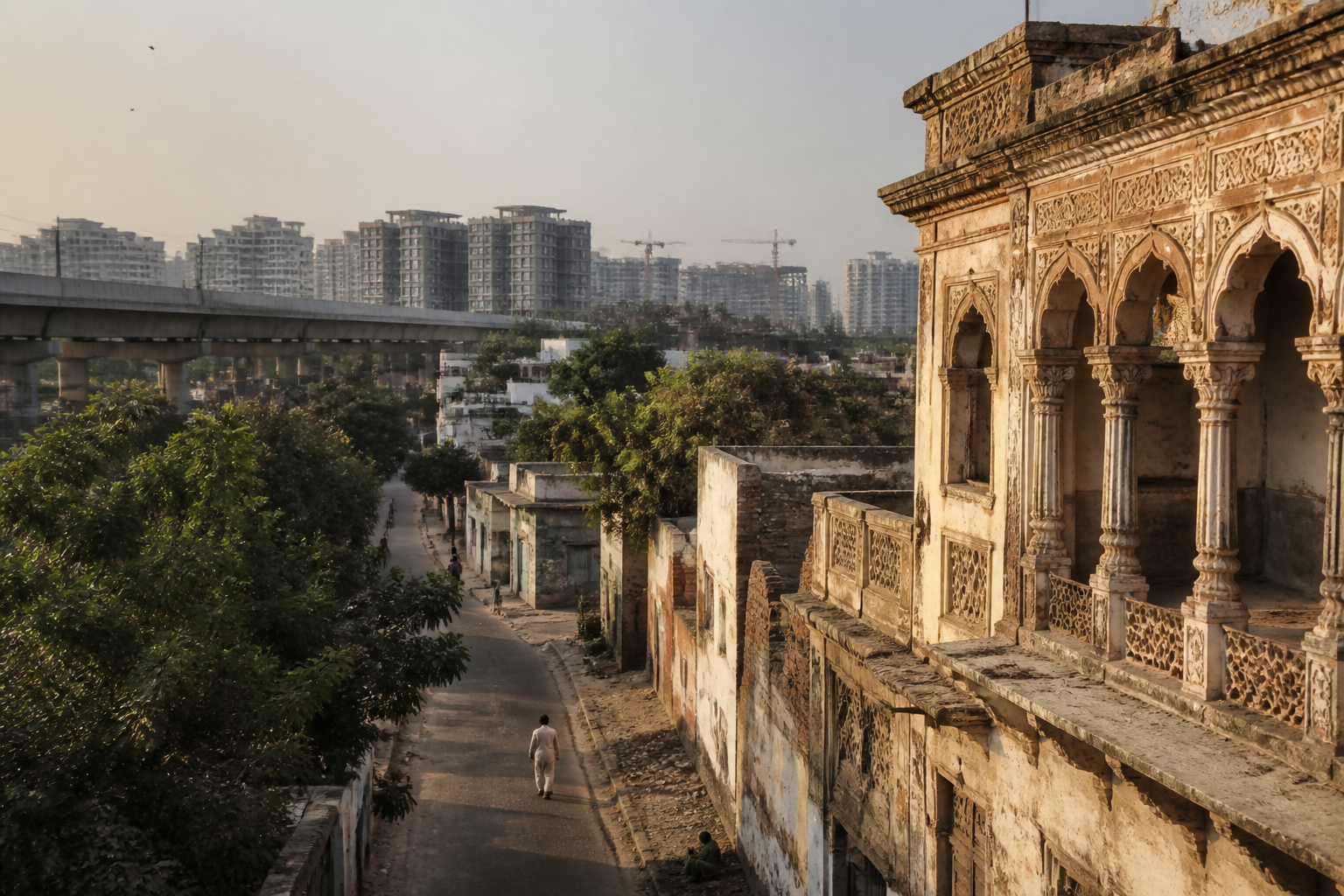
Delhi’s village heritage is being pushed out of public memory as planned colonies, high-rises, flyovers, Metro lines and landscaped developments occupy land that once supported farms, old houses and village institutions. Community-led digital archives are now documenting that transformation, but their work also reveals a larger urban problem: the capital has preserved the story of its rulers and major monuments more successfully than the everyday histories of the villages absorbed by its expansion.
Photographs and videos collected by local archivists show how quickly Delhi’s landscape has changed. A black-and-white photograph from 1978 captures farmers working in fields while an aircraft crosses the sky. Another image from the early 1980s shows a bullock cart moving along a road in Lutyens’ Delhi, with red sandstone government buildings behind it and an Ambassador car passing in the background. A film recorded more than six decades ago shows farmers harvesting wheat, using tractors and bullock carts, while women and children cut the crop by hand.
These images are not simply records of a rural past. They locate agriculture, village labour and community life within the geography of the present-day capital. Nilothi is now associated with Vikaspuri. Masoodpur lies beneath the urban geography of Vasant Kunj. Pilanji is remembered less often than Sarojini Nagar market, and Zamrudpur is overshadowed by Greater Kailash. Madipur is similarly less familiar to residents who know the Punjabi Bagh locality that grew around it.
The pattern is important because the names of newer neighbourhoods have become the dominant map through which Delhi is understood. The villages that preceded them have often survived physically only in fragments, in settlement pockets, old houses, shrines, ponds or the memories of older residents. Their histories are rarely visible in the public identity of the surrounding neighbourhoods.
Hardeep Shokeen, a teacher from Nilothi, began the Delhi_villages_culture Instagram account more than a year ago to create an informal digital archive of village life. The account has more than 42,000 followers, according to the report. Shokeen told The Times of India that rapid urbanisation had caused much of the history and culture of Delhi’s villages to be lost, and that the capital’s association with rural traditions was weaker in public imagination than that of states such as Haryana.
His archive combines old photographs, videos, conversations with village elders and visits to surviving structures. In Nilothi, he documented a nearly 60-year-old haveli with floral motifs, traditional jaali work and a colourful facade. The structure also contains evidence of local building practices, including thin Lahori or Lakhori bricks that some villagers made in their homes. A dilapidated haveli believed to be around 300 years old provides another reminder that the built history of Delhi extends well beyond its better-known monumental precincts.
The condition of these buildings illustrates the limits of treating urban heritage only as a collection of protected monuments. A haveli embedded in a changing village settlement does not exist separately from the community that uses, maintains or remembers it. Its value may lie in its construction, but also in the social practices, family histories and local knowledge connected to it. Once the building deteriorates or is replaced, those layers become harder to recover.
The same process can be seen in village religious and community spaces. Shokeen said that residents of Nilothi continue to visit the gram devta, or village deity, during occasions such as weddings, the birth of a child and the first harvest. Yet the small kutcha shrine that once stood there has been replaced by a more modern tiled structure. The practice continues, but its physical setting has changed, showing that urbanisation does not always erase institutions in one step. It can alter their form until the original landscape becomes difficult to recognise.
The preservation effort is also a race against the loss of first-hand knowledge. Shokeen travels to villages to meet elders who hold old photographs, newspaper clippings and folk songs in memory. His warning is straightforward: much of the remaining history is with a generation that will eventually pass away. In a city where redevelopment can change a settlement faster than formal documentation can keep pace, personal archives may become the first record of places that official histories have overlooked.
A second initiative, the Dilli Dehat Project, places this work within a wider social and urban framework. Founded by Puneet Singh Singhal, Gagandeep Singh Khadar Bidhuri and Parth Shokeen, the project began in mid-2023 and has nearly 70,000 Instagram followers, according to the report. It seeks to centre the voices of communities whose histories are often excluded, while examining how caste, land, labour, migration and urbanisation intersect in shaping Delhi.
That framing expands the heritage question. The disappearance of village histories is not only about old architecture or nostalgia for fields before construction. It is also about who is remembered as having shaped the city, whose land becomes part of a new neighbourhood, and which forms of work and social organisation remain visible after urban development changes the landscape. When a village is known mainly through the locality that replaced or surrounded it, the process of urbanisation can disappear from the public narrative.
Singhal told The Times of India that accounts of Delhi’s history commonly focus on the Mughals, the British, Shahjahanabad and the Walled City, while villages that are hundreds or even thousands of years old receive less attention. The digital archive is therefore performing an institutional function that has not been adequately absorbed into the city’s everyday public history: it is connecting present neighbourhoods to the settlements and communities that existed before them.
The response from residents suggests that this demand is not limited to archivists. The Dilli Dehat Project receives nearly 70 direct messages and emails each month, including photographs, village details and requests from people seeking information about their own local histories. That flow of contributions turns social media into a participatory archive. It also indicates that residents of a rapidly changing metropolis are looking for ways to understand the places they inhabit beyond current property values, road names and transport links.
The archive has practical limitations. Instagram can increase visibility and allow communities to contribute, but it does not by itself provide conservation status, legal protection, professional cataloguing or stable public access. The source material does not establish whether the documented havelis, ponds, shrines or village landscapes are covered by formal heritage protections, nor does it identify a government programme responsible for preserving them. What it does establish is that community initiatives are recording material that may otherwise remain scattered across family collections and oral memory.
This gap between documentation and protection is central to Delhi’s urban heritage challenge. A city can continue to grow while losing the physical and social evidence of how that growth occurred. New colonies and transport infrastructure may improve access and absorb more residents, but the benefits of expansion do not automatically preserve the identities of the settlements incorporated into the urban fabric. Without an institutional record, the transition from village to neighbourhood is remembered mainly through individual experience.
The evidence in these archives also complicates the idea that Delhi was once a rural landscape and is now entirely urban. The photographs show different systems existing alongside one another: agriculture near an expanding capital, bullock carts on roads framed by government buildings, and village religious practices continuing as the surrounding city changes. The urban transition was layered rather than instantaneous, and its remnants remain embedded in places that residents may now understand only through modern neighbourhood names.
For planners and administrators, the issue is therefore not simply whether a few old buildings can be saved. It is whether urban planning records the villages, land histories, community spaces and cultural practices that development absorbs. For residents, it is a question of whether the city offers any way to recognise the histories beneath familiar markets, colonies and transport corridors. For researchers and archivists, it is a question of how quickly memories can be collected before the people who carry them are no longer available.
Delhi’s community archives confirm that the capital’s past is still present in photographs, havelis, shrines, ponds, village names and family memories. They also show what remains uncertain: how much of this material can be formally documented, protected or integrated into the city’s public heritage systems. The next stage of the story will depend on whether these scattered records remain social-media collections or become part of a durable, citywide account of how Delhi was built.
