


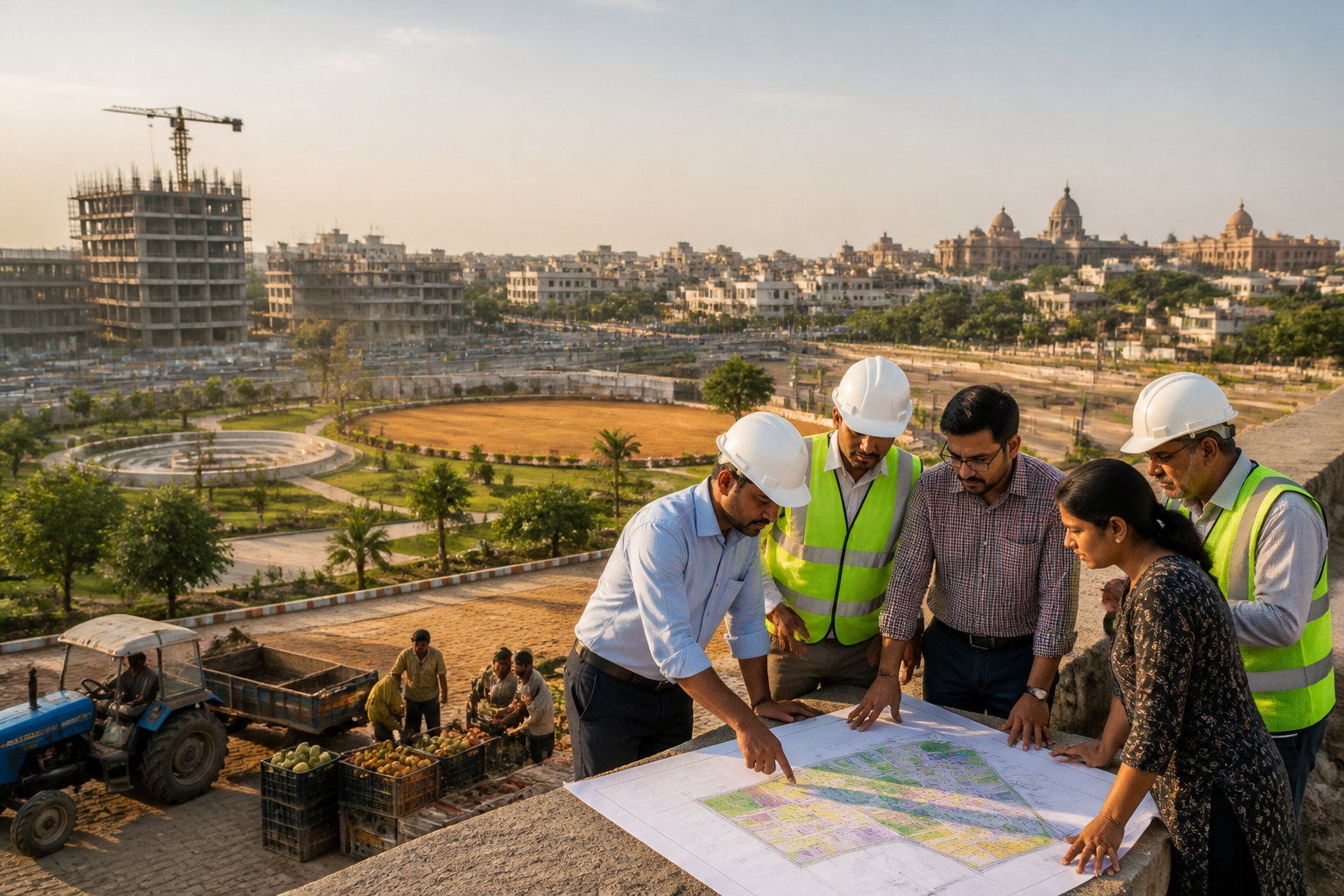
The Kalyana Karnataka development plan announced in Kalaburagi brings together a ₹1,917 crore package of ongoing and newly initiated works with a wider promise to change how one of Karnataka’s historically backward regions generates jobs, manages growth and delivers basic urban services. Its importance lies not in any single project, but in the attempt to link infrastructure, housing, industry, technology, health, tourism, sport and environmental action within one 10-point framework.
Chief Minister D.K. Shivakumar announced the plan at a Kalyana Karnataka Utsava event held at the Police Parade Ground in Kalaburagi. The programme included the foundation stone for 557 works valued at ₹1,071.56 crore and the inauguration of 383 works valued at ₹845.57 crore. Together, these works were presented as a total intervention of ₹1,917 crore.
The announcement therefore has two distinct layers. The first is a pipeline of projects that have either been launched or completed. The second is a set of institutional and policy proposals whose effectiveness will depend on future approvals, funding, land, administrative coordination and implementation schedules. The source report does not provide a project-wise breakup of the ₹1,917 crore package or specify how much of that amount is allocated to each of the 10 priorities.
That distinction matters because the plan combines conventional public works with longer-term economic and social objectives. The government has proposed a Kalyana Karnataka Economy Mission to accelerate industrial growth and investment in the region. It also intends to facilitate the creation of a Section 8 company for this purpose. The announcement indicates an effort to create a dedicated institutional vehicle, although it does not state the proposed governance structure, financing model, powers or operating timeline.
A second economic initiative is the proposed Bioeconomy Mission. Its stated purpose is to add value to regional agricultural products, including tur dal, Kamalapur red bananas, raisins and millets. This expands the development agenda beyond physical infrastructure. The focus is on connecting local production with processing and value addition, although the announcement does not identify specific processing facilities, supply-chain investments, markets or implementing agencies.
The plan’s technology component is aimed at preventing the concentration of opportunity in Bengaluru. The Chief Minister announced a 30-acre IT park in Kalaburagi and the establishment of KRIYA, described as the Kalaburagi Research, Innovation and Youth Accelerator. The stated objectives are to encourage innovation, startups and young entrepreneurs. The government said that more than 120 startups in Kalaburagi had already received support and set a target of more than 500 startups by 2030.
This is one of the clearest structural questions raised by the announcement: whether a new technology district can become an employment ecosystem rather than remain a real-estate project. The available information confirms the proposed land area and the startup target, but does not establish the expected number of jobs, the planned tenants, connectivity arrangements, training systems, or the relationship between the IT park and KRIYA. Those details will determine whether the initiative can address the stated goal of reducing the migration of skilled people from Kalyana Karnataka.
The urban agenda is also visible in the plan’s provision for Kalaburagi city infrastructure and a proposal to provide 50,000 sites to families without house sites. Housing land is a major form of urban policy because it influences where households settle, how cities expand and whether public services can keep pace with growth. However, the source report does not specify the locations of the sites, eligibility rules, tenure arrangements, servicing standards, acquisition process or the agencies responsible for delivery.
Without those details, the housing component remains a significant announcement but not yet an implementation framework. The difference between distributing plots and creating serviced neighbourhoods will depend on access to roads, water, drainage, electricity, public transport and social infrastructure. The 10-point plan lists urban infrastructure and housing as priorities, but does not state how these two elements will be coordinated.
Health is another pillar of the programme. The government has set a goal of making Kalyana Karnataka free of anaemia and announced a special two-year campaign covering screening, prevention and treatment. The announcement places the campaign within a defined period and identifies its three broad components. It does not, however, provide baseline prevalence figures, the number of people to be screened, the delivery system or the budget allocation.
The plan also uses public space, sport and tourism as tools of regional development. The Chandrashekhar Patil District Stadium is to be comprehensively developed within two years. The government is considering an agreement with the Karnataka State Cricket Association to provide cricket facilities in the region. A sports city is proposed at Hadgilharuti village in Kalaburagi taluk, with international-standard indoor and outdoor facilities for different sports.
The tourism proposal is organised around a pilgrimage and heritage circuit connecting Kalaburagi Fort, Sharanabasaveshwar Temple, Khwaja Bande Nawaz Dargah, Buddha Vihara, Malkhed, Sannati and Ganagapur. Ganagapur is to be developed in the first phase at a cost of ₹50 crore. This approach treats heritage sites not as isolated monuments but as a connected visitor network. Yet the announcement does not describe transport links, visitor facilities, conservation arrangements, accommodation capacity or the institutional body that will manage the circuit.
The environmental component is the most ambitious in duration and scale. The government has announced a 10-crore-tree campaign over the next decade, with a target of planting and maintaining one crore saplings each year. It is presented as a response to the need for greater green cover and stronger capacity to face the effects of climate change.
The use of the word “maintain” is important because the announcement does not describe the campaign merely as a planting exercise. Long-term survival, water availability, site selection and responsibility for upkeep will determine its urban and regional value. The source material does not provide a survival target, geographic distribution, species plan or monitoring system, so the measurable outcome of the campaign remains to be established.
An artificial-intelligence-based CCTV network is also included among the 10 priorities. The plan identifies the technology but does not specify the locations, operating agency, data protection safeguards, procurement method or public-safety objectives. These unresolved details are relevant because surveillance infrastructure is not only a technology purchase; it also involves maintenance, staffing, data governance and accountability.
Taken together, the 10 priorities suggest that the government is trying to frame regional development as a connected system. Industry and the Bioeconomy Mission are intended to strengthen economic activity. The IT park and KRIYA are intended to create new technology-linked opportunities. Housing sites and city infrastructure address settlement needs. Health, sports and tourism broaden the definition of development beyond industrial investment. The tree campaign and proposed AI-enabled CCTV network add environmental and administrative dimensions.
The institutional challenge will be coordination. The announcement refers to missions, a Section 8 company, an IT park, a startup accelerator, a sports city and a tourism circuit, but does not identify a single coordinating authority or shared delivery timetable. These initiatives involve different departments and levels of government. Their success will depend on whether land, finance, procurement, staffing and monitoring are aligned rather than pursued as separate announcements.
The ₹1,917 crore figure provides an immediate measure of activity, but it does not by itself establish the long-term impact of the plan. The larger commitments—50,000 sites, 500 startups by 2030, a two-year anaemia campaign, a decade-long tree programme and a 30-acre IT park—will require separate milestones and public reporting. The source material confirms the targets and broad intentions, but does not provide the baseline data needed to assess progress.
For Kalaburagi, the central urban question is whether the city can absorb this development while improving everyday access to housing, infrastructure and employment. For the wider Kalyana Karnataka region, the question is whether investment can be distributed through durable institutions and local value chains rather than remaining concentrated in individual projects. The announcement provides a broad framework and several quantified targets. The next test will be the publication of detailed implementation plans, budgets, responsibilities and progress measures for each of the 10 components.

