


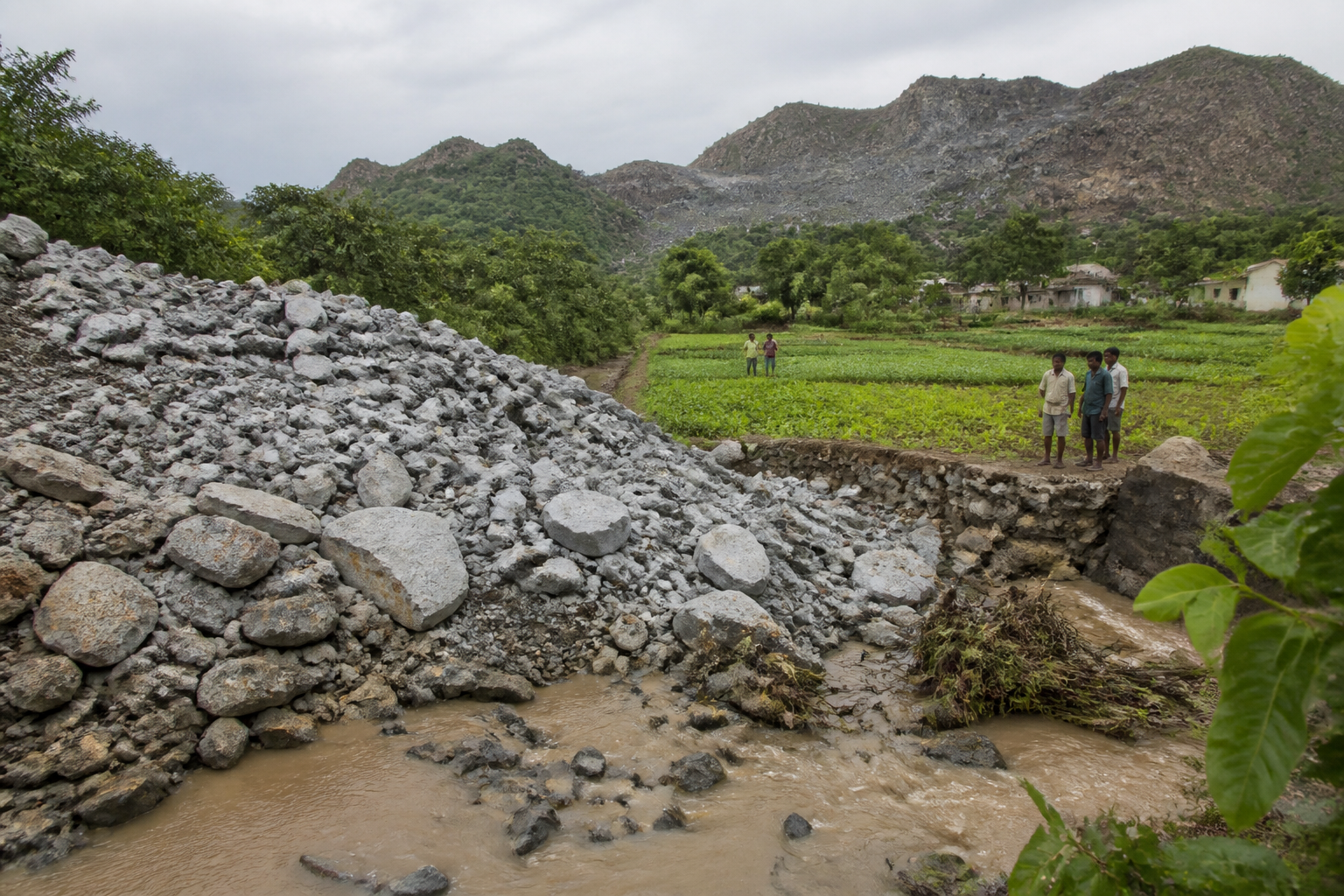
The protest by tribal farmers in Anakapalli over granite quarrying is not only a dispute about mining waste. It brings together three administrative questions that often remain separate in official records: who is responsible for preventing debris from entering agricultural water channels, how environmental permissions are being granted, and whether land once allotted to tribal families can later be reclassified as government property after a re-survey.
According to a report by Deccan Chronicle, tribal farmers staged a bare-chested protest against what they described as indiscriminate quarrying in the district. They alleged that granite waste had been dumped on tribal lands and into streams that irrigate agricultural fields. The protesters also said that complaints submitted to the district collector, the Narsipatnam revenue divisional officer and local revenue officials had not produced a response.
The allegations concern the streams Singarapu Gedda and Dudekula Gedda, which farmers said carried water to fields in Oota Gedda. When quarrying waste is deposited in a stream, the immediate concern is not limited to the loss of visible water flow. For cultivators dependent on seasonal channels, the obstruction can affect access to irrigation, the ability to cultivate fields and the cost of restoring the channel. The report says some farmers who could afford it spent thousands of rupees clearing debris, while poorer tribal cultivators remained unable to do so.
That difference in ability to respond is important to understanding the dispute. A blocked stream is a physical problem, but the burden of dealing with it is being shifted to individual households, according to the farmers quoted in the report. The result is an uneven form of environmental damage: families with money may be able to remove waste, while those with fewer resources face a longer interruption to cultivation. The report does not provide an official assessment of the quantity of debris, the length of the affected streams or the cost incurred by households, so the full scale of the damage remains unestablished.
The protesters also alleged that officials were continuing to grant environmental permits for new quarries, even as earlier quarrying waste remained on agricultural and tribal lands. This claim is central to the governance issue. Environmental permission is not merely a formal approval for extraction; it is connected to how an operation manages waste, protects drainage and responds to damage. The supplied report does not identify the permitting authority, list the quarries involved or reproduce the conditions attached to the permissions. Those details would be necessary to determine whether the alleged dumping represents a breach of permit conditions, inadequate monitoring or a wider failure in the approval process.
The dispute therefore appears to involve more than a conflict between farmers and quarry operators. It also concerns the institutional chain through which land, mining and environmental decisions are made. The tribal leaders named in the report — Solam Rajababu, Tokala Eswaramma and Turre Narasimha Murthy of the Komiri and Urla Hill Sagudarula Sangham — have asked the joint collector and other officials to inspect their fields and houses personally. Their demand points to a gap between written complaints and ground-level verification.
Administrative inspections matter in such disputes because the impact described by residents is spatial and visible. A field covered by debris, a blocked stream or a house threatened by quarrying can be mapped and documented. However, the report says the affected residents want officials to visit the locations rather than rely only on existing files. Until such an inspection takes place, the administration may have records of permits and land classifications without a complete account of how extraction is affecting cultivation and settlement on the ground.
Land tenure adds another layer of vulnerability. Tribal leaders said that land in the Komiri revenue area of Ravikamatham mandal had been allotted to tribal people through D-pattas in 1985. They further alleged that after a re-survey, the land was wrongly reclassified as government property. The report does not reproduce the pattas, the re-survey records or the order supporting the reclassification. It also does not include the revenue department’s response. These documents are essential because the legal and administrative status of the land will determine what protections, claims and remedies are available to the families concerned.
The reported effect is particularly significant for the 10 families said to depend on cashew plantations for their livelihoods. The issue is not simply whether a parcel is shown as private, assigned or government land on a revenue record. A land classification can determine whether a family is recognised as a legitimate cultivator, whether its plantation is treated as an established livelihood and whether it can challenge activity affecting the land. If records change without effective notice or review, residents may find themselves contesting both physical damage and the official description of their relationship to the land.
The case also shows how different administrative systems can produce conflicting outcomes. Quarrying is associated with mineral extraction and environmental regulation. Stream obstruction affects agriculture and local water management. D-patta land and re-survey disputes fall within the revenue administration. The protection of tribal livelihoods introduces another public-interest dimension. The report indicates that residents have approached several levels of the revenue administration, but it does not establish whether a coordinated inquiry involving all relevant departments has been ordered.
Political and social organisations have joined the protest, including CPM district executive member K. Govinda Rao, Girijana Sangam district secretary E. Narasimha Murthy and Vyavasaya Karmika leader V. Bhavani. Their participation has expanded the matter from a local complaint into a public demand for intervention. Their statements, however, do not replace an official technical assessment. The most important next step would be a documented inspection that records the condition of the streams, the location of quarry waste, the status of the affected fields and the relevant land records.
The report also refers to a promise made in November 2025 by legislators from the Madugula and Chodavaram constituencies to issue land titles to farmers cultivating land under the Urlava Hill. Tribal leaders said there had been no progress even after nine months. This part of the dispute indicates that the question of tenure predates the latest protest. It also suggests that the immediate quarrying controversy is occurring in an area where residents already consider their land status unresolved.
The available evidence does not establish why the promised titles have not been issued. It does, however, show how delays in land documentation can magnify the consequences of environmental damage. Families with clear and recognised rights may have a stronger administrative basis for seeking protection or compensation. Families whose claims remain disputed may first have to prove their status before their complaint about debris, water flow or livelihood loss is addressed.
There are several factual gaps that remain important. The report does not specify how many quarries are operating, the area under extraction, the names of the permit holders, the dates of the environmental approvals or the agencies responsible for monitoring compliance. It also does not include responses from the district collector, the revenue officials, the joint collector or the quarry operators. No technical measurement of blocked water flow, crop loss or plantation damage is provided. These omissions do not negate the residents’ allegations, but they limit what can be concluded about the scale and legal status of the problem.
What the report does establish is a pattern of overlapping claims: tribal farmers say quarry waste has damaged streams and land; some residents have paid to clear debris; poorer cultivators remain unable to do so; land allotted through D-pattas is alleged to have been reclassified; and promised title action has not moved forward. Each claim requires a separate documentary and field-level response, but together they describe a governance problem in which extraction, environmental safeguards and land records are not being addressed as one connected system.
For Anakapalli’s affected communities, the immediate demand is direct intervention by the joint collector and an inspection of fields and houses. The outcome of that inspection, the response of the revenue and environmental authorities, and the status of the 1985 D-patta records will determine whether the dispute moves towards remediation or remains another unresolved complaint. Until those steps are documented, the central questions about quarry permits, debris disposal, stream protection and land classification remain open.
