


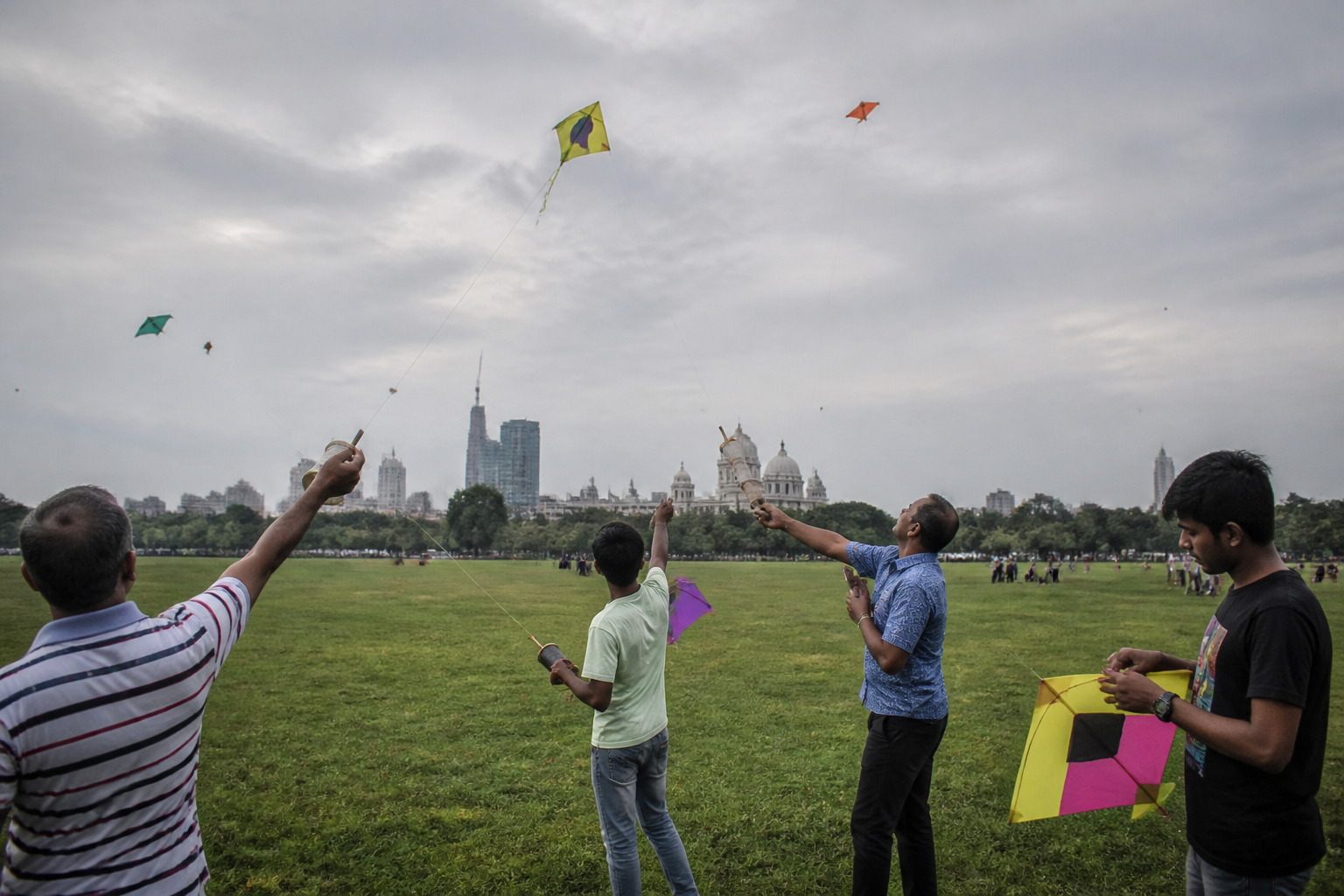
The decision to pause Kolkata’s 78-year-old kite festival at the Maidan is more than the cancellation of a seasonal gathering. It shows how a public-space tradition can weaken when safety regulations, changing participation patterns and the decline of supporting livelihoods converge. Organised by the Calcutta Kite Association on Vishwakarma Puja, the festival once brought around 1,000 kite enthusiasts to the Maidan before continuing for a week.
The festival was not held this year because organisers said they could no longer ensure compliance with the ban on Chinese manja, while participation had also declined. The association’s account, reported by the Times of India, points to two connected pressures: a material safety concern involving kite strings and a shrinking social and commercial ecosystem around kite flying.
The event’s history is closely tied to Kolkata’s urban culture. The Calcutta Kite Association was formed in 1949 by Anup Chandra Nag, the then owner of Bhim Chandra Nag Sweets. For decades, people gathered at the Maidan from the afternoon on Vishwakarma Puja, carrying kites of different shapes and spools of string. The festival continued for a week and drew participants across social and religious communities, according to Nashir Ahmed, an association member who helped oversee it.
That continuity matters because the Maidan is not simply an open tract of land. It is one of Kolkata’s most recognisable public spaces, used for recreation, gatherings, sport and civic activity. A festival that brought large numbers of people into the space represented a recurring form of public use: informal, seasonal and dependent on both community participation and the availability of low-cost materials.
The immediate regulatory issue was Chinese manja, a synthetic kite string associated with injuries to bikers and other road users. The manufacture and sale of the string was banned by the National Green Tribunal, according to the report. Ahmed said police had previously monitored its use during the festival but that it was difficult for organisers to ensure every participant would use cotton string instead.
This creates a practical enforcement problem for public events. A ban can identify a hazardous material, but compliance at a large, informal gathering requires supervision, participant cooperation and access to an acceptable alternative. The association’s concern was not that kite flying itself had been prohibited. Rather, organisers said they could not guarantee that all participants would bring or use cotton strings, making the event difficult to manage safely.
The distinction is important. The festival’s suspension resulted from the interaction between a safety regulation and the organisational limits of a voluntary association. The event did not have a formal commercial venue with controlled entry, standardised equipment or a clearly defined participant list. It took place in an open public landscape, where monitoring the materials used by hundreds of people would have been difficult.
The festival’s decline also predates this year’s decision. Ahmed said participation had reduced over time, while many kite makers and sellers who had been part of the festival shifted to other trades. The event had once drawn about 1,000 enthusiasts, but the organisers now described a dearth of participants. This suggests that the ban on Chinese manja was not the only pressure on the festival; it intensified an existing decline in interest and supply.
The experience of kite makers in Bowbazar provides a ground-level view of that change. Bappaditya Dutta, a kite maker, said demand for kites had slumped. His comment indicates that the festival’s disappearance affects more than the people who flew kites at the Maidan. It also affects small-scale makers and sellers whose work depended on a predictable annual increase in demand.
That relationship between public events and informal livelihoods is often difficult to see in city reporting. A festival may appear to be a recreational activity, but it can support a temporary commercial network involving makers, sellers and local establishments. When participation falls, the effects are distributed across that network. When an event is suspended, the remaining demand may not be sufficient to sustain specialist work.
The account given by staff at Bhim Chandra Nag Sweets adds another dimension. Robin Das said the shop had a long association with kite flying and that, after the festival was discontinued, staff did not fly kites elsewhere either. This suggests that the event functioned not only as a programmed gathering but also as an institutional tradition linked to local businesses and family histories.
The reported loss is therefore cultural and urban at the same time. The festival used the Maidan as a shared setting and connected a seasonal ritual with a wider network of shops, makers, sellers and participants. Its decline reflects how traditions survive in cities only when the physical space, social interest, regulatory conditions and supporting economy remain aligned.
The safety concern remains central. Chinese manja had caused injuries to bikers, and police had monitored its use in the past, according to the report. The ban addressed a real risk associated with the string. The organisers’ response also shows the difficulty of preserving an activity when the safer substitute requires consistent compliance that cannot easily be guaranteed in an open public event.
The available account does not establish whether the festival could return under a different format, whether the authorities considered a controlled event, or whether a formal system for supplying and checking cotton strings exists. It also does not quantify the recent fall in attendance or identify how many kite makers and sellers depended on the festival. These gaps matter because the event’s future cannot be assessed through nostalgia alone. Its continuation would depend on both safe practice and sufficient participation.
The story also raises a broader question about how cities manage older public traditions. Urban public spaces are frequently assessed through formal functions such as transport, sport, construction or large organised events. Smaller traditions occupy the same spaces differently. They rely on informal access, community knowledge and seasonal routines rather than permanent infrastructure. When those traditions weaken, there may be no single decision that explains their disappearance.
In Kolkata’s case, the Maidan festival appears to have been sustained by a combination of long-standing institutional association, local business support and a large base of enthusiasts. The loss of any one element could have reduced its strength. The reported decline in participation, the movement of kite makers into other trades and the difficulty of policing banned string together indicate a breakdown across several parts of that system.
For municipal and event authorities, the issue is not simply whether a traditional gathering should be allowed. The central administrative questions are whether the activity can be conducted without exposing road users to hazardous string, how compliance can be checked in an open space, and who would carry responsibility for enforcement. The source material does not record any official proposal or decision on these questions beyond the organisers’ decision to pause the festival.
For the kite-making trade, the issue is demand. Dutta’s observation that kite demand has slumped shows how a public event can act as a market anchor for a specialised craft. Without regular occasions that bring buyers and users together, such work may become less viable. The report does not establish whether online sales, other festivals or alternative markets have replaced the Maidan demand.
The festival’s pause also demonstrates that cultural continuity depends on practical urban conditions. A tradition may be widely remembered, but memory alone cannot maintain it. It needs participants, safe materials, organisers willing to assume responsibility and a public setting where the activity can take place. Kolkata’s kite festival had all of these for decades, but the evidence supplied indicates that several of those conditions have weakened.
The immediate fact is that the Calcutta Kite Association did not hold the festival on Vishwakarma Puja this year after 78 years. The evidence points to reduced participation and the difficulty of preventing banned Chinese manja from being used. What remains uncertain is whether the pause will become permanent or whether a safer, more controlled model could restore the event. Any future decision will need to address both the documented safety risk and the declining network of participants and makers that once sustained the Maidan tradition.
