


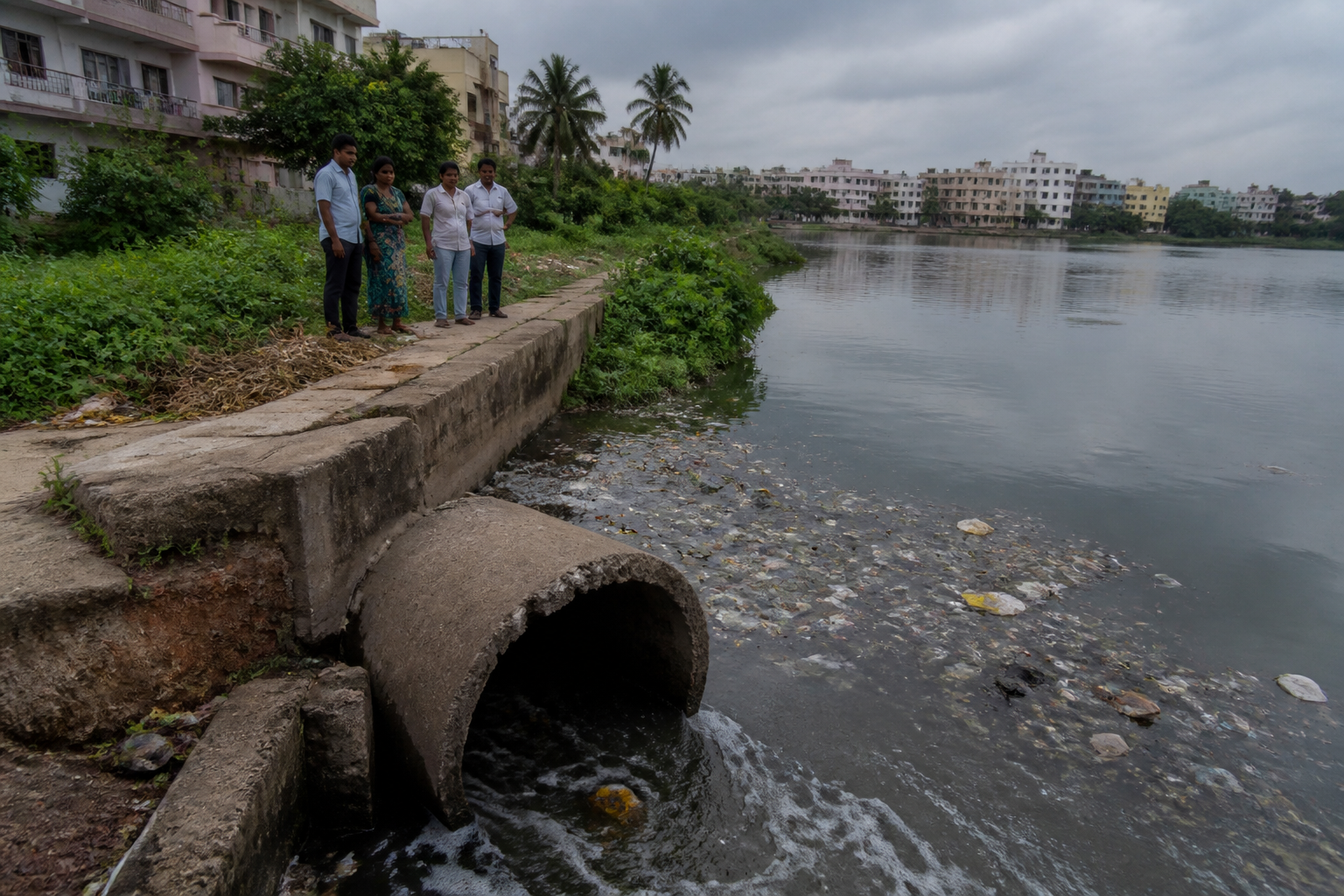
Seegehalli Lake’s deterioration exposes a familiar weakness in Bengaluru’s waterbody policy: rejuvenation can improve a lake’s appearance and infrastructure, but it cannot protect the asset if the drains feeding it remain open to garbage and sewage. The lake, which was rejuvenated about a decade ago at an estimated cost of Rs 8 crore, is again receiving refuse through a stormwater drain and sewage through connected flows, according to a report by Bangalore Mirror.
The immediate problem is visible in the lake itself. Garbage has accumulated in the water, while dirty water and sewage have affected the surrounding environment. Residents near Ajith Layout and Chikka Devasandra Layout say refuse is being thrown into a stormwater drain that carries rainwater towards the lake. When it rains, the accumulated waste is washed downstream and enters the waterbody.
This is not simply a lake-cleaning problem. It is a failure of the boundary between neighbourhood waste management, stormwater infrastructure and sewage control. A lake may be desilted, landscaped or provided with public access, but those interventions remain vulnerable when the inflow channels are treated as informal dumping points. In Seegehalli, the drain appears to be functioning simultaneously as a rainwater route, a garbage pathway and a conduit for sewage.
The report also points to a gap in enforcement. Residents have continued to dump different types of refuse into the drain, while no one has been held responsible or penalised for sewage entering the lake, according to the account. The absence of effective prevention means that the cost of restoring the waterbody can recur even after public money has already been spent on rejuvenation.
Lake activist Balaji Raghotham told Bangalore Mirror that he had repeatedly alerted Bengaluru East City Corporation authorities about deteriorating water quality and garbage entering the lake through the stormwater drain. He identified the drain on the western side of the lake as a significant route through which garbage reaches the waterbody along with rainwater.
His explanation highlights the importance of the infrastructure immediately outside the lake boundary. The report says the drain has not been fenced to prevent dumping. Without a physical or operational barrier, the waterbody remains exposed to the behaviour taking place upstream. The lake’s condition is therefore being shaped not only by what happens inside its perimeter but also by how nearby layouts manage waste and how civic agencies maintain the drainage network.
The consequences are being experienced by people who use the lake as a public space. Senior citizens from adjoining areas, who previously visited the lake for daily walks, now find it difficult to use the surroundings. One resident described the polluted water and garbage as an eyesore and a health hazard. Other residents said the waste and dirty water had created conditions favourable to mosquitoes and had made them reconsider visiting a place intended for relaxation and recreation.
That change in use matters because the public value of a rejuvenated lake is not limited to water storage or ecological improvement. The lake was also expected to function as an accessible urban open space. When pollution makes residents avoid it, the failure is both environmental and civic. The investment has not translated into a reliable public amenity because the systems around the lake have not prevented renewed contamination.
The institutional response described in the report is divided between two civic bodies. BBMP Executive Engineer (Lakes) Bhupradha said measures were underway to clean the stormwater drain and the lake. She said she would ensure that garbage was blocked from entering the lake, but identified sewage as a major issue and said the BWSSB engineer had already been informed.
BWSSB Assistant Executive Engineer Kanakaraj said he had sent a detailed report on the sewage problem to higher authorities. According to him, work to arrest the flow of sewage into the stormwater drain or lake would begin after approval from those authorities. These statements establish that the agencies recognise separate components of the problem, but they also show how responsibility is distributed across administrative functions.
The lakes division can address waste already present in the waterbody and may be able to block solid waste at the drain. Sewage interception, however, lies with the water and sewerage utility. Approval from higher authorities is required before work begins, according to the BWSSB official quoted in the report. This creates a sequence in which the lake may be cleaned while the source of contamination remains active, or in which action on the source is delayed while pollution continues to accumulate.
The distinction between stormwater and sewage is central to the case. Residents are using a stormwater drain to dispose of garbage, while sewage is also entering the drain or lake. A drain designed to carry rainwater is consequently carrying solid waste and contaminated flows. Each additional function increases the burden on the lake and complicates the task of restoration. Cleaning the visible waste cannot by itself resolve an inflow problem, and repairing sewage connections cannot by itself stop household dumping.
The reported history of Seegehalli Lake also raises questions about how rejuvenation projects are evaluated. The estimated Rs 8 crore spent about ten years ago represents a substantial public investment, but the supplied report does not provide details of the original project’s scope, maintenance contract, performance indicators or post-rejuvenation monitoring. It therefore cannot establish which components failed or whether the original works included measures to control inflows.
What the report does establish is that the lake’s present condition is connected to a maintenance and enforcement gap. Residents have been flagging the problem, garbage continues to reach the lake, sewage remains unresolved and civic agencies are still discussing remedial work. The time gap between rejuvenation and renewed deterioration suggests that capital spending on a waterbody has to be matched by routine operations outside the lake’s immediate boundary.
The case also demonstrates why citizen complaints are an important part of urban waterbody governance. The concerns raised by residents are not limited to aesthetics. They identify the route by which waste enters the lake, describe the impact on public use and point to the absence of penalties. However, repeated complaints have value only when they are converted into inspections, enforcement records, drain maintenance and time-bound utility action.
The available account does not state how much waste has accumulated, how many households are connected to the affected drainage system, what the sewage source is, or when the proposed work will be completed. It also does not report any water-quality measurements or details of penalties issued. Those gaps prevent a fuller assessment of the scale of contamination. They do not, however, obscure the basic administrative problem: the lake is receiving pollution through infrastructure that agencies have identified but not yet fully secured.
Seegehalli Lake’s decline is therefore a test of whether Bengaluru treats lake rejuvenation as a one-time construction project or as a continuing governance responsibility. The evidence in the report points to a system in which public expenditure restored the waterbody, but weak waste enforcement, unprotected drainage and pending sewage intervention allowed the damage to return. The next measurable steps are the cleaning of the drain and lake, the blocking of solid waste, approval and execution of sewage-control work, and a clear account of responsibility for preventing another cycle of pollution.

