


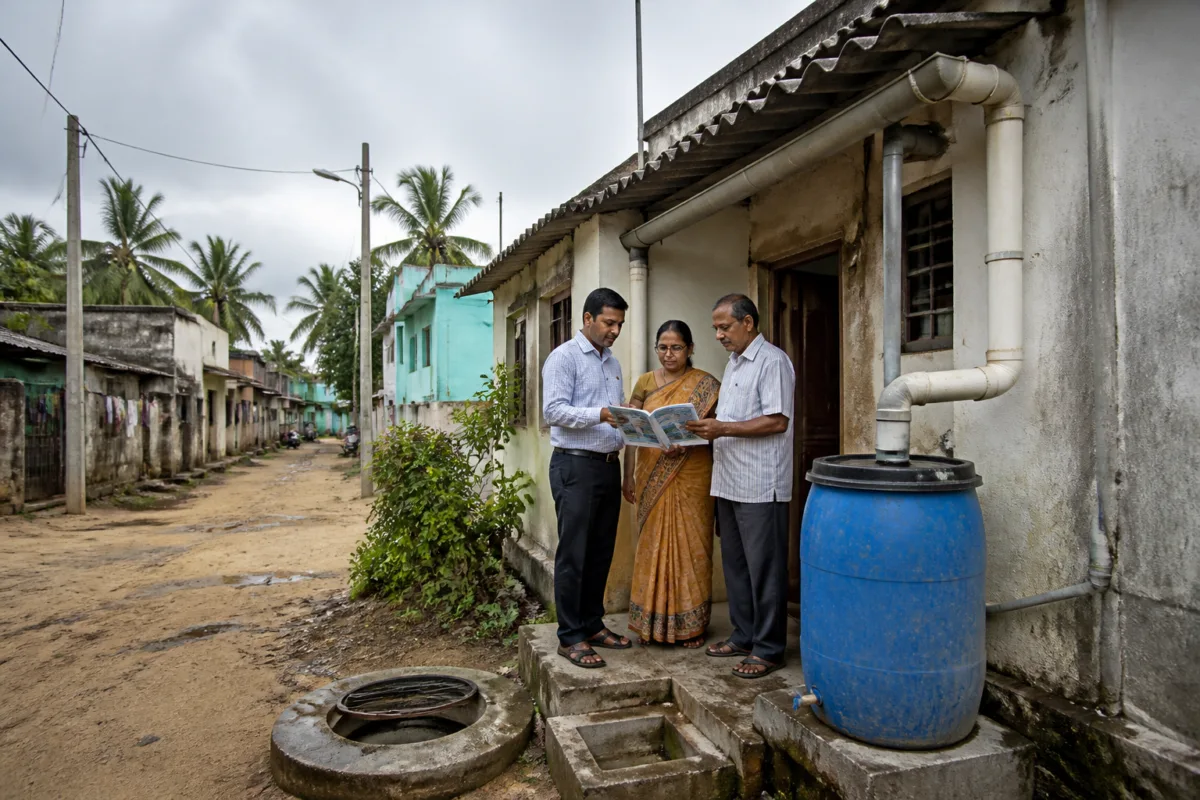
A study of 200 households in Dumas, a coastal village on Surat’s outskirts, has found that 65.5% of residents had no prior knowledge of rainwater harvesting, even as saline groundwater leaves the settlement dependent on a single remaining public well for drinking and household needs. The findings point to a central challenge in coastal water management: infrastructure alone cannot improve water security when residents lack information, confidence or motivation to adopt household-level conservation measures.
The study was conducted between January and May 2026 by Jahanavee Dhimmar, a second-year MSc Nursing student at T and TV Nursing Institute, affiliated with Veer Narmad South Gujarat University. It was carried out under the guidance of institute principal Kirankumar V Domadiya. The community health nursing department later compiled the findings into a research report and submitted it in person to Union minister of Jal Shakti C R Patil.
Dumas is known as a beach destination and picnic location, but its water problem is not seasonal in the ordinary sense. The village has struggled for decades to access potable water because groundwater in much of the area is saline. Most wells are reportedly unfit for regular use, leaving residents largely dependent on one public groundwater source. That dependence gives the study’s findings a significance beyond awareness levels: it shows that the settlement’s existing water options are both limited and vulnerable.
The study recorded an average knowledge score of 54.8% on rainwater harvesting. It also reported that 57% of respondents had an unfavourable attitude towards the practice. Together, the figures describe a gap at two levels. Many residents may not understand the available methods, while a substantial share also appears unconvinced about their usefulness or feasibility. The report does not establish why respondents held these views, but the combination of limited knowledge and unfavourable attitudes helps explain why rainwater harvesting has not become a routine household practice in Dumas.
This matters because rainwater harvesting is not a single intervention. It can include collecting water from roofs, storing it for household use, directing runoff towards recharge pits or reducing pressure on groundwater sources through more careful water use. The study’s findings do not measure how many homes have functioning systems, how much water could be captured or whether local buildings have the physical infrastructure required for installation. They do, however, identify a basic precondition for any such programme: residents need to know what the systems are, how they work and why they are relevant to their settlement.
The Dumas case also shows why coastal water scarcity cannot be assessed only through rainfall. The report notes that the village faces groundwater salinity despite being located in a state that can receive a good monsoon. Rainfall may therefore coexist with poor access to usable water when groundwater quality is compromised and local systems for collecting or storing rain are weak. In such locations, the practical question is not simply whether water falls from the sky, but whether households and public agencies can retain and use it before it is lost.
The study was designed as a descriptive community-based assessment, covering 200 households. Its results offer a local snapshot rather than a measurement of all coastal settlements around Surat or Gujarat. The report does not provide a comparison with other villages, a breakdown by income or housing type, or data on household water consumption. It also does not quantify the quality of the single remaining public well or establish whether residents receive water through other formal or informal arrangements. Those limits are important because awareness programmes and infrastructure solutions may need to be designed differently for households with different building conditions, incomes and access to public supply.
Even with those limits, the study brings an institutional issue into view. National campaigns such as the Centre’s Catch the Rain initiative and the Jal Jeevan Mission are designed to support water conservation and improved water access, but their impact depends on implementation within particular settlements. A campaign reference or scheme framework does not automatically create a functioning local system. In Dumas, the immediate challenge identified by the study is the distance between broad water-policy objectives and household understanding of the measures that could support them.
That distance also raises questions about administrative responsibility. The study was undertaken by an educational institution’s community health nursing department rather than by a municipal water agency or a dedicated water utility. Its findings were presented to the Union minister of Jal Shakti, indicating that the issue has been placed before a national ministry. However, the supplied report does not record a government commitment, sanctioned project, funding decision or implementation schedule following the presentation. The next stage would therefore determine whether the findings remain an awareness document or become the basis for a local water programme.
The choice to distribute an informational booklet after the study reflects one immediate response to the measured awareness gap. It may help residents understand rainwater harvesting methods, but the report does not provide evidence yet on whether the booklet changed attitudes or led to installations. Awareness is an important first step, particularly where 65.5% of respondents reported no prior knowledge, but adoption would also depend on technical design, cost, maintenance, available space and the suitability of systems for local buildings. None of those outcomes has been measured in the supplied material.
The figures create a clear sequence of concern. First, 65.5% of respondents had no prior knowledge of rainwater harvesting. Second, the average knowledge score was 54.8%. Third, 57% displayed an unfavourable attitude towards the practice. These numbers should not be treated as interchangeable measures: the first records prior awareness, the second summarises knowledge performance and the third records attitude. Read together, they indicate that Dumas faces both an information deficit and a weaker social base for adoption.
The absence of local adoption data is itself significant for policy evaluation. Without information on the number of functioning rooftop systems, recharge pits, storage tanks or household-level conservation measures, it is not possible to say whether the awareness problem has translated into a particular volume of lost water. Nor can the report establish how much additional water Dumas could secure through rainwater harvesting. Such measurements would be needed to connect public education with water-supply outcomes.
The study also highlights the importance of treating water scarcity as a public-health and community-governance issue rather than only an engineering problem. It was produced through a community health nursing department, and its stated concern extends to careful water use, climate change and local participation. In a village where potable water access is constrained by salinity, household behaviour, public communication and source protection become linked. The single public well is not merely a piece of infrastructure; it is the point around which everyday water dependence is organised.
For Dumas, the larger urban question is how settlements at the edge of expanding cities are governed. The village is a scenic destination associated with Surat, yet its reported water conditions differ sharply from the image of a well-connected urban region. Its experience shows how peripheral communities can remain exposed to basic-service vulnerabilities even when they are geographically close to a major city and visible to visitors.
What the evidence confirms is a serious local gap in awareness and attitude towards rainwater harvesting amid long-standing groundwater salinity. What it does not yet confirm is whether awareness-building will improve water security, how many households can adopt harvesting systems or what public agency will lead implementation. The booklet distribution is an initial step; the more consequential milestones would be a documented local water plan, technical support for households, monitoring of adoption and a clear response from the relevant authorities.

