


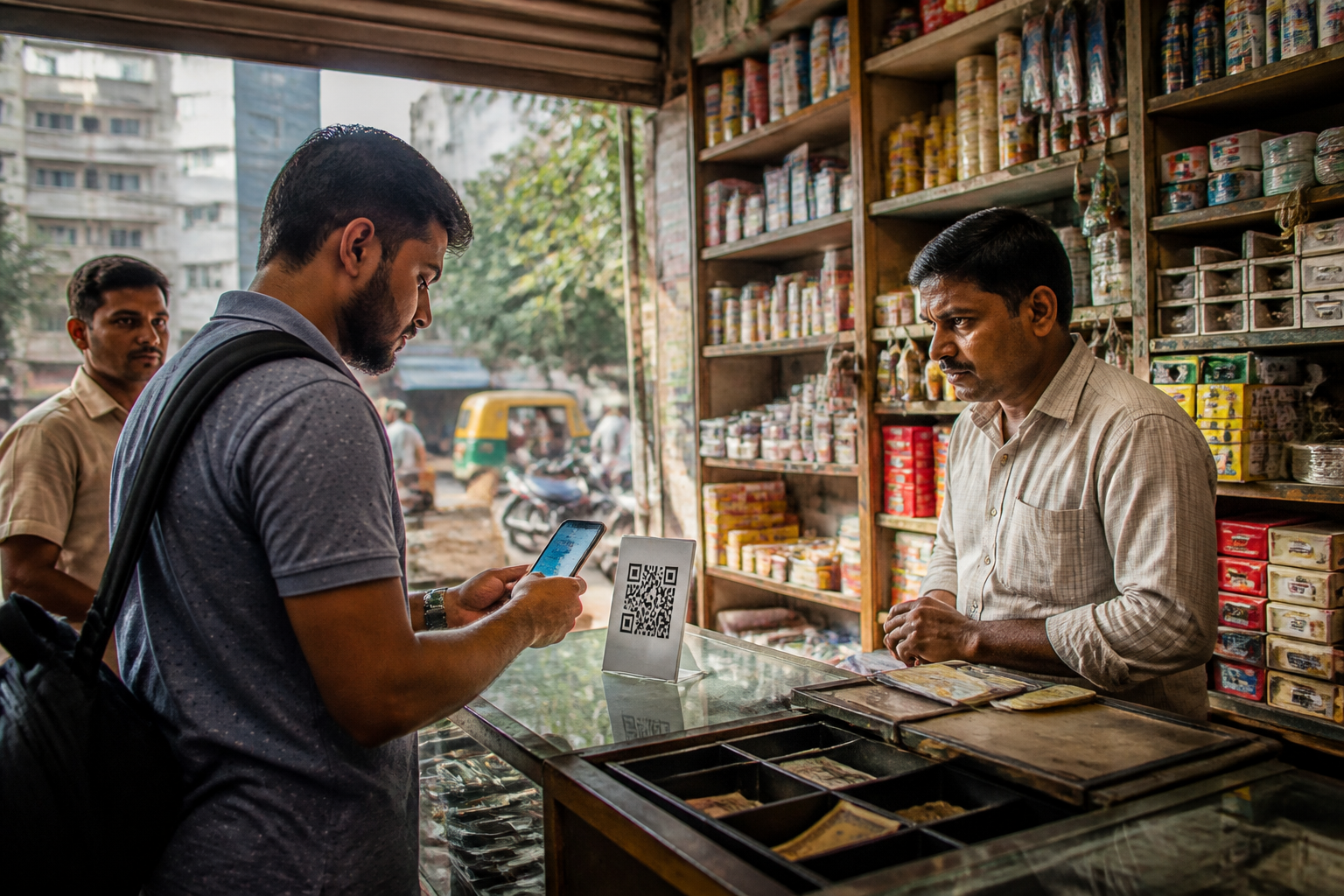
The reported introduction of a 0.4% merchant discount rate on selected UPI transactions above ₹2,000 has opened a wider question than the cost of a single digital payment: who ultimately pays for India’s shift away from cash? Traders and customers interviewed in Delhi, Noida and smaller cities have expressed concern that a cost imposed on merchants could eventually appear as a surcharge, higher prices or a renewed preference for cash.
According to the report by Aaj Tak Business, an NPCI circular says the charge will apply only to 4% of selected merchants and only on UPI transactions above ₹2,000. The maximum MDR is reported to be ₹300. The circular, as described in the report, also says that 96% of small merchants will not be affected, while businesses earning ₹1 lakh a month and transactions up to ₹2,000 will remain outside the reported impact.
Those exemptions are central to understanding the policy. The measure is not described as a universal charge on every UPI payment, nor as a fee that customers must directly pay. It is a merchant-side cost for a limited category of larger transactions. Yet the response from traders and consumers shows why the distinction between who is formally charged and who bears the economic burden is not always straightforward.
For a customer, the payment interface may remain unchanged. The uncertainty begins at the shop counter. If a merchant’s margins are already narrow, even a small transaction cost can influence which payment methods are accepted, whether a discount is offered, or whether the customer is asked to pay in cash. The reported reactions suggest that the operational question is not only whether MDR is legally recoverable from customers, but how merchants will respond when their payment costs rise.
The report quotes Noida customers who feared that merchants would either ask for cash on transactions above ₹2,000 or recover the cost through an additional charge. One customer said the government might not be present to settle a dispute between a buyer and a shopkeeper. Another argued that any higher cost faced by traders would eventually be passed on to consumers. These views are perceptions, not evidence that every merchant will impose a surcharge, but they identify the point at which a technical payment rule becomes a ground-level consumer issue.
For small retailers, payment costs sit within a broader structure of thin margins, taxation, inventory expenses and competition. A shopkeeper selling hardware, electrical goods, supplies or other products may receive a large share of payments digitally because customers do not carry enough cash. If a payment charge is applied repeatedly, the cumulative cost may matter even when each individual transaction appears small.
The report quotes Noida traders who said that the charge could reduce margins and encourage businesses to prefer cash. Vikas Jain, identified as a shopkeeper, described the measure as a threat to businesses and argued that it could hurt both merchants and customers. Interior contractor Arif Ali said that many people now depend on digital payments because cash flows are limited, and that merchants could reduce digital options to avoid repeated charges.
Rajesh Ojha, a hardware and supply trader, said that if the cost is imposed, shopkeepers may place the burden on customers. His concern reflects a basic feature of retail economics: a merchant’s ability to absorb a new expense depends on the margin available after all other costs are paid. The supplied report does not establish the margins of the businesses affected or show how many merchants will change their behaviour. It does, however, document a clear concern that the policy could alter payment choices at the point of sale.
The issue is particularly visible at fuel stations. The report says petrol-pump dealers face a fixed MDR of ₹5 on UPI payments above ₹2,000. Dealers cited in the report argued that the cost could be significant because their profit per litre is limited. Some said they might prefer cash for such transactions if the charge is not waived. This example demonstrates why a uniform payment rule can have different consequences across sectors: the same ₹5 cost may be immaterial to one business and meaningful to another.
The debate also exposes the institutional complexity behind UPI payments. A customer generally experiences UPI as a simple transfer through a mobile application. The merchant, however, operates within a network involving banks, payment service providers, acquiring arrangements and settlement rules. Merchant discount rates are part of that underlying system. When the cost structure changes, the result is not always visible in the payment application itself; it emerges through merchant behaviour, pricing and acceptance policies.
The reported NPCI position, as presented by Aaj Tak Business, attempts to limit the impact by excluding most small merchants and lower-value transactions. That design indicates an effort to distinguish routine low-value digital payments from larger transactions involving a smaller group of businesses. The reported cap of ₹300 also places an upper limit on the charge. But these safeguards do not eliminate uncertainty for traders whose average transaction size is above the threshold.
Alwar traders interviewed for the report said that nearly 90% of their transactions are now online and that large transactions of more than ₹2,000 are common in their businesses. They therefore view the threshold not as an occasional exception but as a point that could affect normal operations. Their response illustrates the importance of transaction patterns rather than headline percentages. A rule affecting only 4% of merchants nationally could still be commercially significant in a locality or sector where digital payments above ₹2,000 are routine.
This is also why merchant classification matters. The available report does not provide a detailed breakdown of the 4% category, the sectors covered, the exact acquiring arrangements involved or the date on which the reported MDR becomes operational. Without those details, it is not possible to estimate the total additional cost for merchants or the likely effect on consumer prices. The central facts available are the thresholds, the reported exemptions and the reactions recorded by the news report.
The policy challenge is therefore one of communication as much as collection. If merchants and consumers believe that every UPI payment above ₹2,000 will attract an unavoidable customer charge, the response may be driven by fear rather than by the actual scope of the rule. Conversely, if the formal position says customers cannot be charged directly but merchants have no practical way to absorb the cost, disputes may shift to the retail counter.
The interviews also point to a trust issue in digital public infrastructure. UPI has become part of ordinary urban commerce, including transactions made by customers who carry little cash. A payment system becomes embedded not only when people know how to use it, but when they believe it will remain predictable and widely accepted. If merchants begin displaying cash-only preferences for larger purchases, customers may experience the change as a reduction in convenience even if the network itself continues to function normally.
The concern is not limited to metropolitan consumers. The report includes reactions from Noida, Delhi, Alwar and smaller cities, where merchants described digital payments as a routine part of business. This geographic spread matters because payment infrastructure connects formal and informal commerce across different urban contexts. A small retailer, a fuel dealer and a customer buying hardware may interact with the same payment system, but their ability to absorb costs is different.
The broader urban question is whether digital payment growth can remain inclusive when the economics of acceptance change. Digital transactions reduce the need for cash handling and can make payments easier for consumers and businesses. But access depends on merchants continuing to accept the instrument without adding hidden friction. A cost that appears minor at the network level can become significant when repeated across thousands of daily transactions and passed through a fragmented retail market.
The evidence in the supplied report confirms three things. First, the reported MDR is targeted rather than universal, with an exemption for most small merchants and transactions up to ₹2,000. Second, traders and customers in several locations fear that the cost could reduce margins, encourage cash payments or be passed on indirectly. Third, the likely effect depends heavily on sector, transaction size and merchant economics—details that are not established in the report.
The next developments to monitor are the precise terms of the NPCI circular, the categories of merchants covered, the implementation date, how payment providers communicate the change, and whether merchants alter their acceptance policies. Until those details are publicly clear, the most important distinction remains between a charge formally levied on selected merchants and the possibility that its practical cost could be felt by consumers at the point of sale.
