


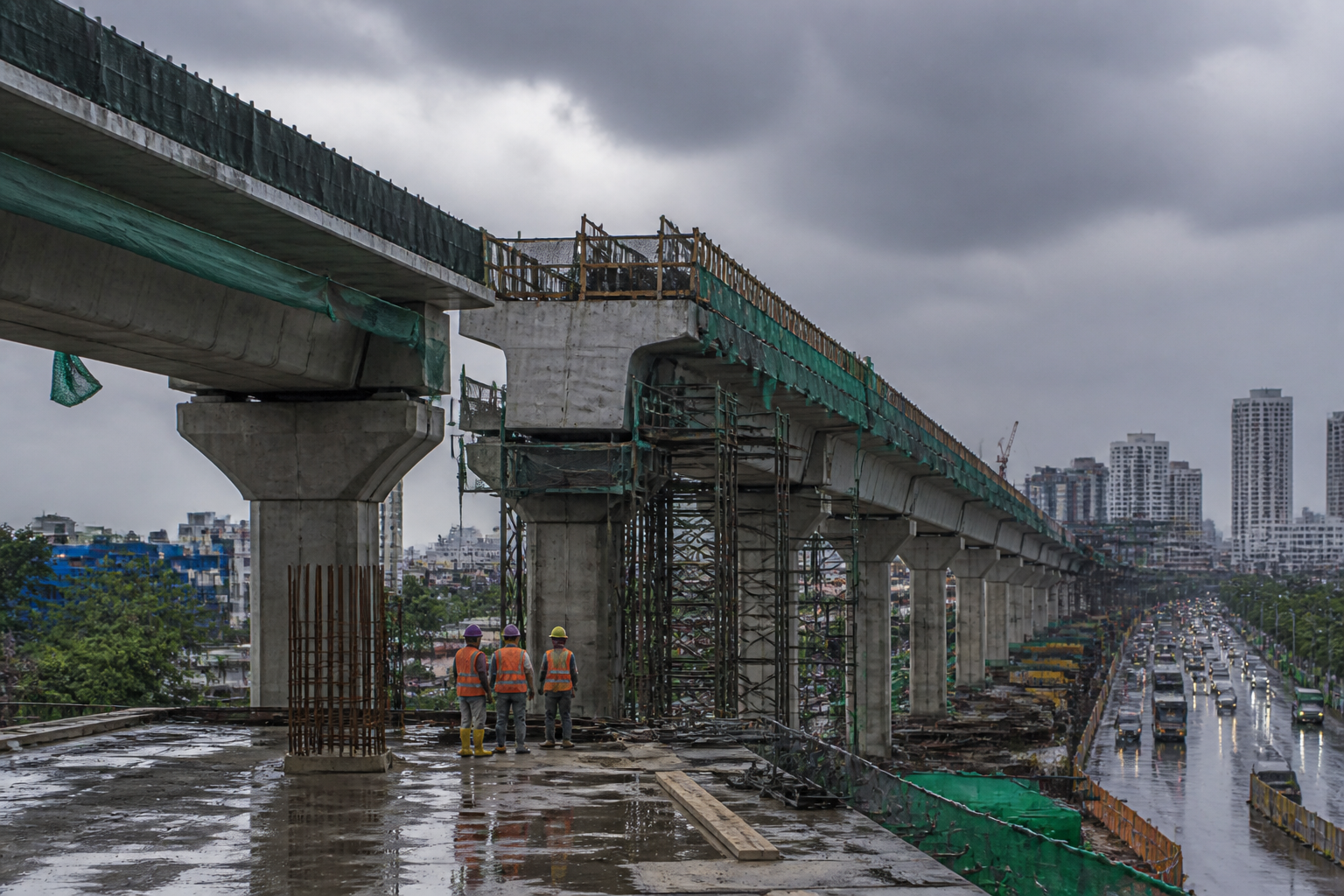
The deaths of two construction workers at Mumbai Metro Line 4’s Bhakti Park site are not an isolated workplace accident in the available record. They occurred on a corridor where a separate collapse in February had already killed one person and injured three others, and both incidents involved the same contractor and subcontractor. The pattern raises a central question about how safety responsibility is enforced across a large public infrastructure project when work is distributed through multiple layers of contracting.
The latest incident took place last Saturday at a construction site near the Monorail station in Wadala. Nahij, 33, and Sakim, 37, were descending from the first floor on iron staging when it gave way at around 7.30 pm. Both were centering workers. Nahij was declared dead after being taken to Sion Hospital, while Sakim died later that night during treatment in the intensive care unit.
According to a complaint filed by their colleague Safiqul Mukhtar Hussain, seven workers had reported for duty at about 8.30 am and were scheduled to work until 7 pm. Steel construction and carpentry work was under way on the first floor. When rain began as the workers prepared to leave, some workers had already used a ladder to exit while others gathered their material and safety equipment. Hussain’s complaint attributed the deaths to alleged negligence and recklessness by the subcontractor’s supervisor.
The police registered a first information report against site supervisor Tarikh Ul Islam under Section 106(1) of the Bharatiya Nyaya Sanhita for causing death by negligence. The two deceased workers were from Tetia village in West Bengal and had been working at the site for two to three months, according to the report. They were staying near the construction area, and their bodies were sent to relatives in West Bengal.
The immediate circumstances matter because construction safety depends on controls being maintained during routine transitions, not only during major lifting or concreting operations. In this case, the reported failure occurred while workers were descending from a temporary iron structure after work. The supplied account does not establish whether the staging had been inspected, who had approved its use, or whether a formal safety audit followed the collapse. Those unanswered questions sit at the centre of accountability for temporary works on an elevated transport project.
The incident also exposed a reporting gap. The deaths did not appear in the Brihanmumbai Municipal Corporation Disaster Management Department’s reporting because the fire brigade was not called to the site. That means the absence of a disaster-management entry cannot be treated as evidence that no serious incident occurred. It instead shows how construction deaths can remain outside routine municipal emergency reporting when the response is handled privately and victims are transported in private vehicles.
The Mumbai Metropolitan Region Development Authority, which is executing Metro Line 4, had not issued a public statement five days after the incident, according to the report. Officials said information about the incident, action against contractors and compensation for the families would be provided later. The delay is significant because MMRDA is not merely a project financier or passive administrator in this case: it is the authority responsible for executing the corridor and for applying its contractual safety framework.
Metro Line 4, also known as the Green Line, is planned as a 32.32-km elevated corridor between Wadala and Kasarvadavali in Thane, with 30 stations. It is intended to connect parts of Mumbai and Thane with the Eastern Express Highway, Central Railway, Monorail and other Metro corridors. Its scale makes the safety system more complex, but it also makes institutional clarity more important. A public authority must be able to identify the contractor, subcontractor, consultant, site supervisor and responsible safety officer after an incident, and communicate what action has followed.
The February collapse provides the strongest context for assessing the latest death. At a Mulund construction site on the same corridor, a concrete parapet slab fell onto the road below, killing one person and injuring three others. The victims were travelling in a rickshaw and a car. The Mulund and Bhakti Park sections were being constructed by Reliance Infrastructure and Astaldi SPA Joint Venture, or RAJV. RAJV had subcontracted work at both sites to Milan Road Buildtech. The Metro line’s consultant is a joint venture of DB Engineering & Consulting, Hill International and Louis Berger.
The repeated involvement of the same delivery chain does not by itself prove that the two incidents had the same technical cause. The February collapse involved a concrete parapet slab falling from a viaduct, while the latest deaths involved iron staging used by workers. But the common contractor and subcontractor make the incidents institutionally connected. They require scrutiny of whether corrective actions after the first accident reached other work fronts, whether safety systems were applied consistently, and whether penalties changed worksite practice rather than ending with a financial transaction.
MMRDA rules cited in the report require a safety-lapse incident to attract a fine equivalent to 1 per cent of the contract cost on both the contractor and the consultant. After the February Mulund incident, RAJV was fined Rs 5 crore and the consultant Rs 1 crore. MMRDA had initially announced that the consultant would be terminated but later decided to retain it. The report does not state whether any penalty, suspension, work stoppage or corrective order had been imposed after the Bhakti Park deaths.
The contract structure adds another layer to the accountability problem. Milan Group’s website states that contract package CA-08, covering the Wadala to Amar Mahal Junction stretch, was subcontracted at a revised cost of Rs 996.96 crore, compared with an original cost of Rs 540 crore. The existence of a large revised contract value does not, on its own, indicate a safety failure. It does show why responsibility cannot be left at the level of an individual site supervisor. Safety obligations must travel through the principal contractor, subcontractor, consultant and project authority, with records that can be examined after an incident.
For workers, the risks are also shaped by their employment and living conditions. The two deceased men had been at the site for only two to three months and were staying near the construction area, according to the complaint. The available report does not establish their formal employment status, the safety training they received, insurance coverage, wage records or compensation arrangements. MMRDA’s proposed response on compensation is therefore an important pending part of the case, not a minor administrative detail.
The broader urban question is whether rapid infrastructure expansion is being matched by equally visible systems for protecting the people who build it. Metro projects are presented through corridors, stations, connectivity and completion targets. Their physical delivery, however, depends on workers operating around temporary structures, elevated decks, steel systems, rain and active construction zones. When a second fatal incident occurs on the same corridor within months, the public record needs more than a police case. It needs a clear account of what changed after the first incident and who was responsible for ensuring that change.
The evidence currently confirms two fatalities, a police case, a previous fatal collapse on the same Metro line, common contractor and subcontractor involvement, and a delay in public disclosure by the project authority. It does not yet establish the precise engineering cause of the staging failure, whether required inspections were completed, or what action MMRDA has taken against the project participants. Those details, along with compensation for the families and the authority’s response, are the next measurable indicators of whether the project’s safety framework is functioning as an enforceable system rather than merely a penalty rule on paper.
