


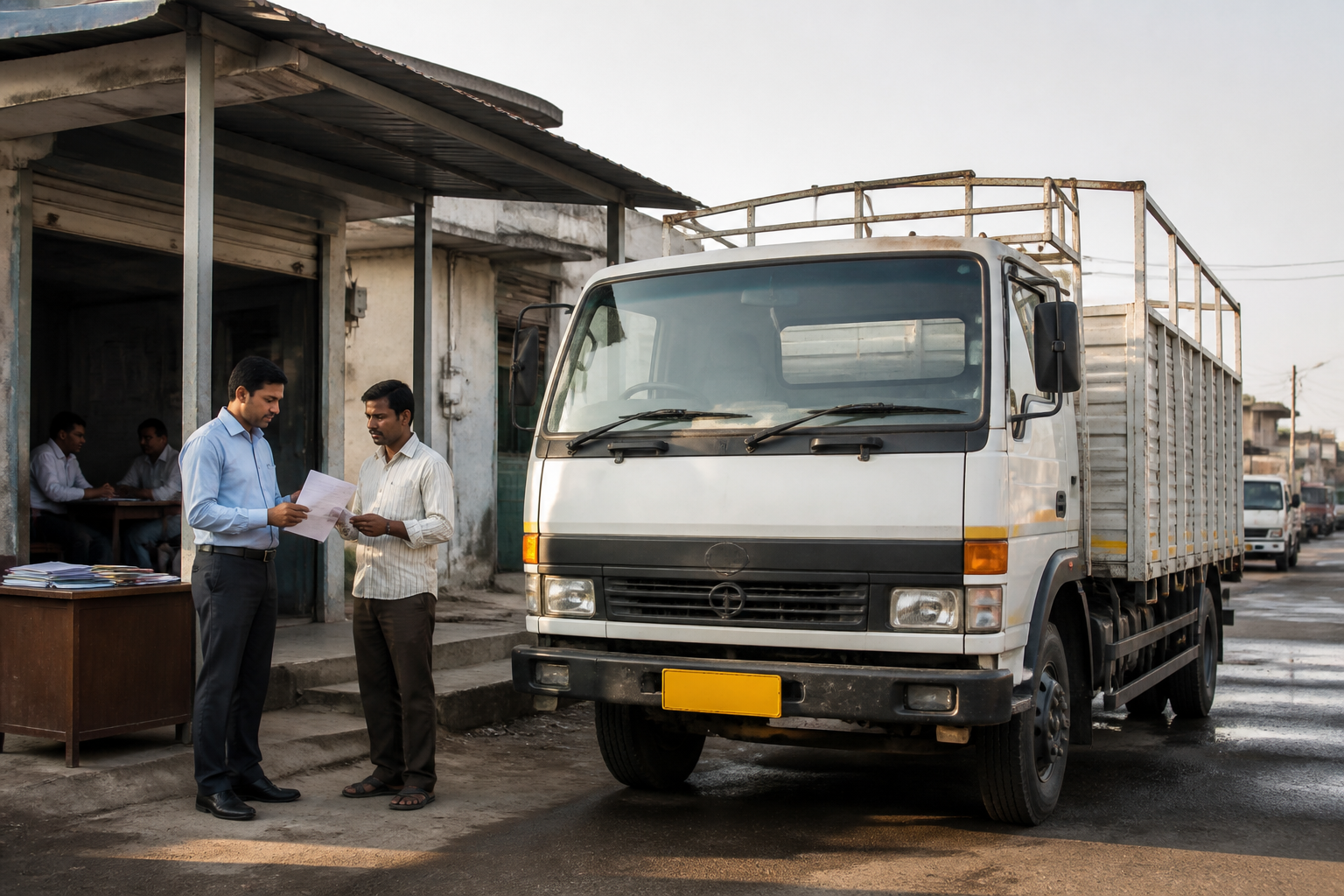
The Supreme Court has ruled that banks and finance companies cannot use force, threats or covert methods to seize vehicles from borrowers who default on loan repayments, even when the loan agreement allows repossession. In a case involving a commercial truck, the court ordered Cholamandalam Investment and Finance Company to pay ₹10 lakh in compensation, return ₹4.5 lakh with 6% annual interest and pay ₹50,000 in litigation costs.
A Bench of Justices P.S. Narasimha and Alok Aradhe heard the dispute involving Hari Dutta Sharma and his Tata SFC 407 truck. The vehicle had been financed through a commercial vehicle loan issued by Cholamandalam Investment and Finance Company. According to Sharma’s account, four unidentified men arrived at around 1 am on 9 April 2023, broke the truck’s steering lock and drove it away. He alleged that he had not received the required notice before the seizure.
Sharma had taken a loan of about ₹10.40 lakh, of which ₹9.36 lakh was disbursed. He later received a supplementary loan of ₹1.04 lakh. After the truck was taken, he filed a lost article report and an e-FIR on the same day. The finance company subsequently said that it had sold the truck for ₹4.5 lakh on 31 August 2023, while continuing to claim that ₹5.71 lakh remained outstanding.
The Supreme Court did not hold that a lender has no right to repossess a vehicle after a loan default. It recognised that a loan agreement may contain a self-help repossession clause, allowing the lender to take possession without going through a prolonged court process in certain circumstances. However, the court made clear that this right must be exercised within the law and through a fair, reasonable process.
The ruling draws a distinction between the legal right to take possession and the power to forcibly remove a vehicle. Recovery agents cannot threaten or intimidate borrowers, use physical force, adopt muscle-power tactics or contact them in an inappropriate manner. The court also referred to Reserve Bank of India master circulars, guidelines and other instructions governing recovery practices, stressing that borrowers must not be harassed during debt collection.
The judgment also examined the repossession terms in the loan agreement. The agreement contained a seven-day notice requirement, but the court found that the relevant provisions gave the company broad scope to take possession of and sell the vehicle without adequate notice and procedure. The court held that self-help repossession is not inherently unlawful, but it cannot be used to take away a borrower’s property at night or by force.
The case places renewed attention on how recovery rules operate for commercial vehicle owners, for whom a truck or other vehicle is often also the means of earning a livelihood. At the same time, the ruling does not cancel a lender’s right to recover legitimate dues or sell a repossessed vehicle when the contractual and legal requirements are met. It instead requires the recovery process, including notice, possession, an opportunity to clear dues and sale or auction, to follow the agreement and applicable rules.
The Supreme Court also questioned whether RBI recovery guidelines are being effectively implemented, observing that issuing rules alone is not enough if compliance is not ensured. It directed that a copy of the judgment be sent to the RBI. Borrowers facing repayment difficulties have been advised to communicate with their lender in writing and preserve documents relating to dues, notices, payment deadlines and any repossession action.
