


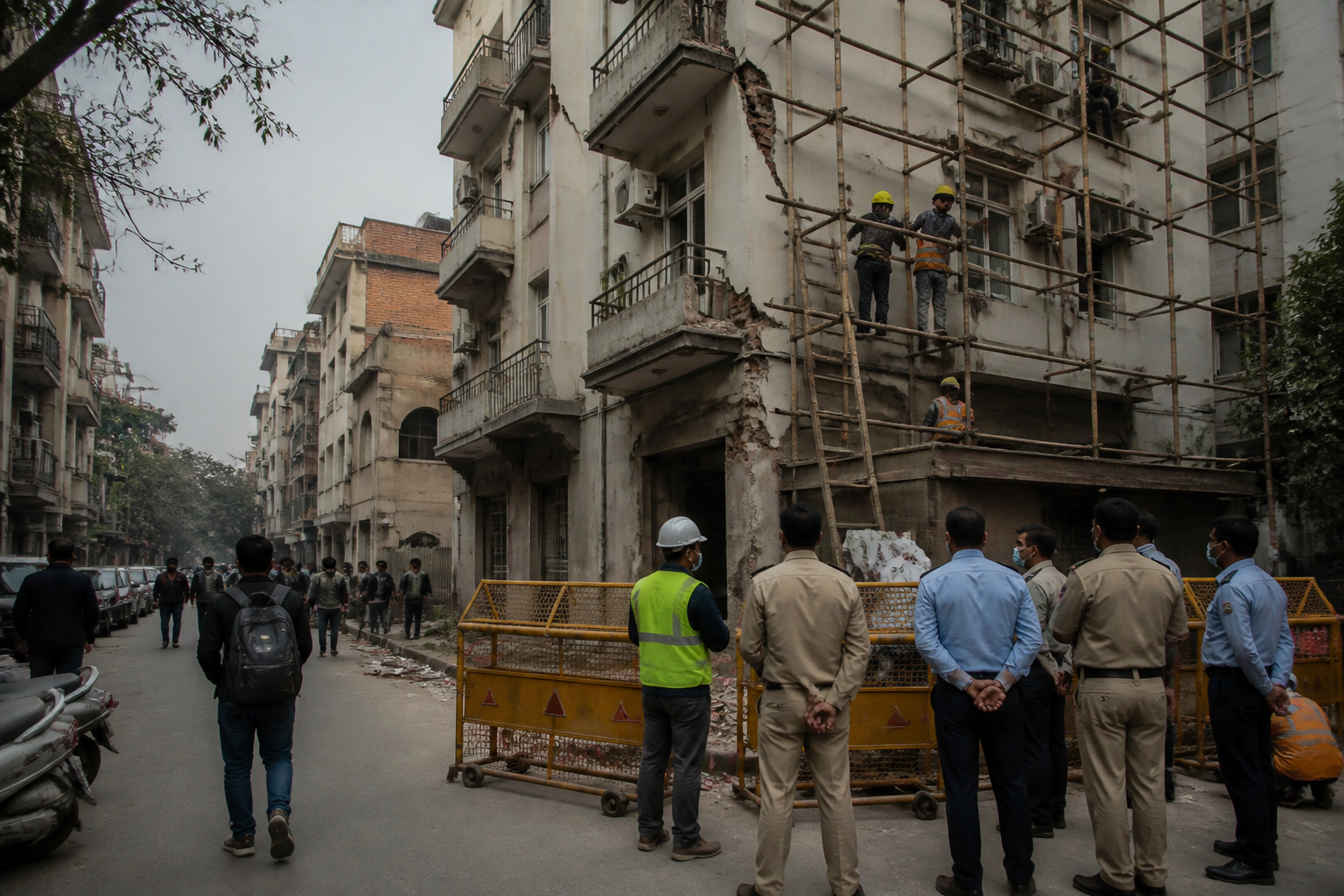
The Delhi High Court’s observations on the Satya Niketan building collapse have shifted attention from one fatal incident to a wider urban failure: the capital has attracted students from smaller towns for decades without creating enough safe, regulated and affordable accommodation for them.
The five-storey paying guest building near Delhi University’s South Campus collapsed during repair work on September 6. Seven people died and several others were injured. The court has described the incident as more than an ordinary accident, linking the deaths to alleged negligence and criminal conduct while also questioning the shortage of hostels and the regulation of paying guest accommodation in Delhi.
That distinction matters. A building collapse is immediately understood as an emergency involving rescue, compensation and investigation. But the court’s remarks place the Satya Niketan incident within a longer chain of decisions: students move to the capital, private accommodation fills the gap left by limited hostel capacity, buildings are altered or repaired, and multiple authorities are expected to ensure that the resulting housing stock remains safe. When any part of that chain fails, the consequence is not merely a defective building. It can be the loss of life for people who moved to the city in search of education and work.
The court was hearing a public interest petition seeking an independent investigation into the Satya Niketan incident, inspections of all paying guest properties and compensation and rehabilitation for victims and their families. A bench comprising Chief Justice D.K. Upadhyaya and Justice Tejas Karia described the deaths of four students as particularly tragic. According to the report, the bench said the students had come to the capital from smaller towns with hopes of building a better future, but that the negligent and criminal conduct of some people had destroyed those aspirations.
The language used by the court places responsibility beyond the immediate owner or contractor. It raises the question of how a city permits high-demand student accommodation to operate and expand, particularly in neighbourhoods around major educational institutions. The issue is not simply whether one property complied with a rule. It is whether the regulatory system can identify unsafe buildings before a failure occurs and whether residents have a practical way to report risks or obtain protection when accommodation is unsafe.
The institutional structure described in the report is already complex. The Municipal Corporation of Delhi has been directed to conduct a high-level investigation. The court has also referred to the role of the government, the MCD and other agencies in addressing the safety of paying guest properties and the shortage of student housing. The Centre’s Additional Solicitor General, Chetan Sharma, told the court that authorities had taken steps after the collapse, including identifying and mapping land and other facilities for students.
That response indicates that the administration is considering the problem not only as an enforcement matter but also as a capacity problem. If students have few formal hostel options, demand does not disappear. It moves into private paying guest accommodation, rented rooms and buildings that may not have been designed for the intensity or form of occupation they eventually carry. The supplied report does not establish how many such properties operate in Delhi, how many have been inspected or what proportion comply with safety requirements. Those gaps are central to understanding the scale of the problem.
The court’s criticism that the shortage of hostels is not new is equally significant. The bench noted that students from smaller towns have been coming to Delhi for higher education and career opportunities for the past 20 to 25 years, yet adequate hostel arrangements have not been created for them. This frames student housing as a long-running urban planning and governance question rather than a temporary response to a single academic cycle.
Delhi’s educational geography makes the issue especially visible around institutions such as Delhi University’s South Campus. Areas close to campuses experience concentrated demand for accommodation, but the available housing is not necessarily planned, financed or regulated as student housing. The report does not provide details of zoning permissions, occupancy levels, building approvals or the repair work underway at the Satya Niketan property. It does, however, establish that the collapse happened during repairs, making the safety of alteration and maintenance work a critical part of the investigation.
Repair activity can change the structural condition and use of a building, but the source material does not specify what work was being undertaken, who authorised it or whether officials had inspected the premises. These are matters the MCD investigation and the court proceedings will need to clarify. Until those facts are established, responsibility should not be assigned beyond the court’s recorded description of negligent and criminal conduct by those it held responsible in its observations.
The case also illustrates why inspections after a disaster are not the same as a functioning safety system. The High Court ordered a high-level MCD investigation on September 7, one day after the collapse. The court also said the government could not avoid its responsibility. Post-incident action may identify failures at the property, but a broader review of paying guest buildings is needed to determine whether the same risks exist elsewhere. The petition before the court specifically seeks inspection of all PG properties, indicating that the concern extends beyond Satya Niketan.
The administrative challenge is not limited to finding buildings. It involves maintaining an updated record of properties, identifying who owns and operates them, understanding how many people live in them, checking whether repairs or structural changes are taking place, and ensuring that safety findings lead to enforcement. The source report says that officials have begun identifying and mapping land and other facilities for students, but it does not say whether this is part of a funded hostel programme, a completed survey or an early administrative exercise. That distinction will determine how far the response goes beyond an announcement.
Compensation and rehabilitation form another part of the court petition. For families of those killed, compensation cannot restore the lives lost. But in institutional terms, a compensation process can show whether the state treats a building disaster as an isolated private dispute or as a public safety failure involving a vulnerable urban population. The report does not state the amount of compensation proposed, the eligibility criteria or the status of rehabilitation measures.
The central evidence currently available is therefore uneven. The deaths, injuries, location, building type and timing of the collapse are reported. The High Court’s observations, the MCD investigation and the government’s submission are also identifiable. But the underlying technical questions remain open: what caused the collapse, whether repair work breached approved conditions, which permissions were in force, whether inspections had taken place and which agency was responsible for each stage of oversight.
Those questions matter because paying guest housing sits between formal housing and informal accommodation. Residents may pay regularly and depend on the property as their primary home, while the building may not be treated by every institution as a specialised residential facility requiring continuous oversight. The source material does not establish the legal classification of the Satya Niketan property, but the court’s decision to connect the collapse with PG regulation shows that this institutional ambiguity is part of the public-interest issue.
The case also exposes a mismatch between the city’s education economy and its housing infrastructure. Delhi continues to function as a destination for students from smaller towns, yet the court says the hostel shortage has persisted for two to three decades. This suggests that educational access cannot be separated from accommodation. A seat in a college is not sufficient if students cannot find housing that is safe, affordable and close enough to use.
For municipal administration, the immediate test is whether the promised response produces a transparent account of the city’s student accommodation stock and its safety condition. For the government, the question is whether identifying land and facilities leads to actual hostel capacity. For the court, the upcoming proceedings will provide an opportunity to examine the independent investigation, inspections, compensation and rehabilitation measures sought in the petition.
The Delhi High Court has listed the public interest petition with another related pending petition for hearing on September 25. Until then, the Satya Niketan collapse remains both a criminal and technical investigation and a test of whether Delhi will treat student housing as essential urban infrastructure. The facts established by the MCD inquiry and the court’s next directions will determine whether the response addresses one building or the wider system that allowed demand for student accommodation to outpace safe, accountable supply.
