


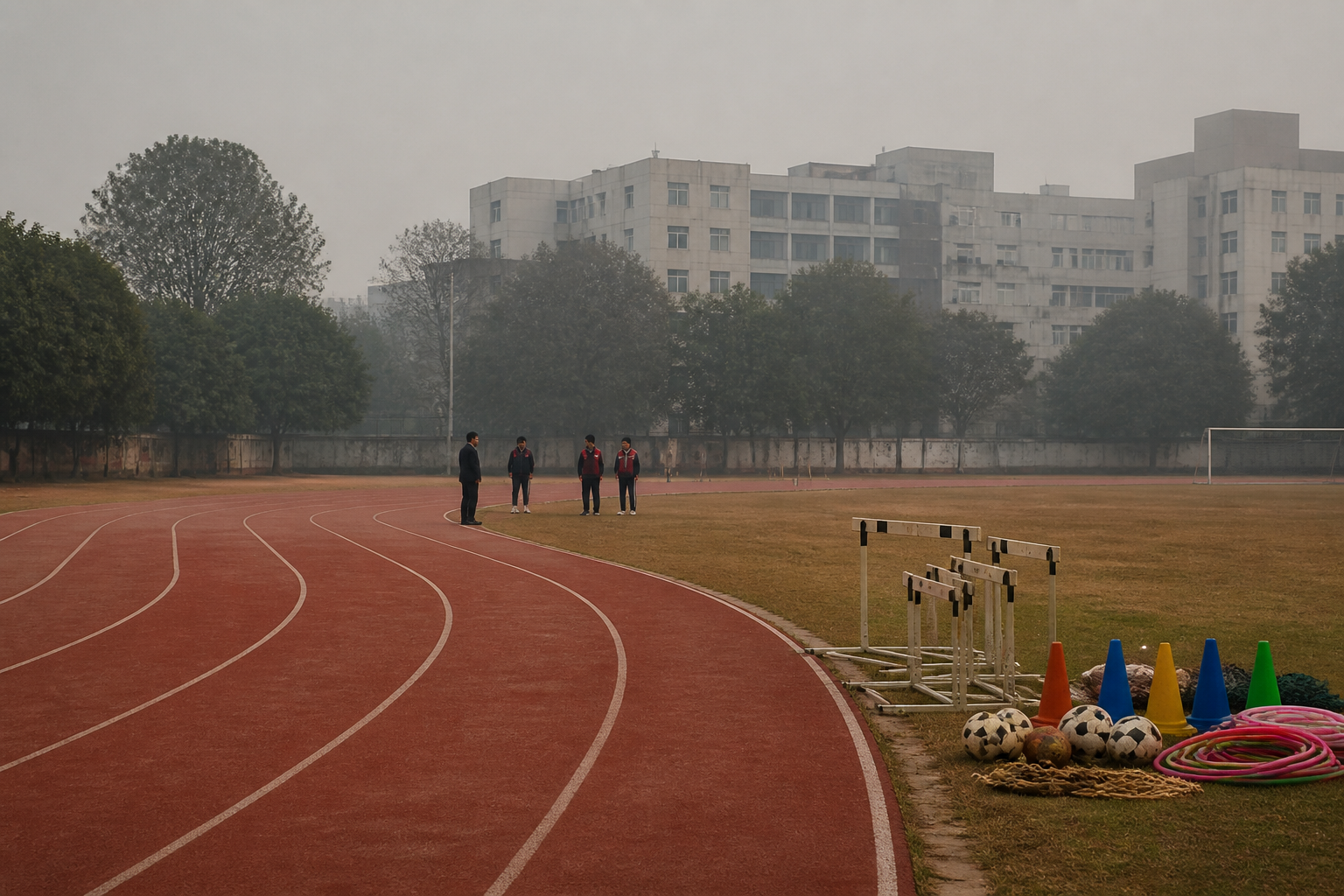
The Commission for Air Quality Management’s direction to Delhi and other National Capital Region governments to avoid physical sports events in November and December is more than a seasonal scheduling instruction. It shows how recurring winter air-quality risks are beginning to alter the basic operation of schools and the participation of children in public life.
In an order dated September 10, CAQM asked the Delhi government and NCR state governments to ensure that physical sporting activities and competitions are not scheduled during November and December, citing air-quality trends. Events already on the calendar may be rescheduled, the commission said, while students affected by the change should not be unduly disadvantaged.
The direction follows a similar order issued last year after the Supreme Court raised concerns about children taking part in school sports competitions during periods of poor and severe air quality. CAQM said the Supreme Court, in an order dated November 19, 2025, asked it to issue appropriate directions to schools in Delhi-NCR regarding sports and games competitions planned for November and December.
That sequence is important. The latest direction is not presented as an isolated response to one pollution episode. It reflects an administrative attempt to deal with a recurring period in which outdoor physical activity can carry additional health risks. The supplied report does not provide current or historical AQI readings, pollutant concentrations or hospitalisation data. But the decision to repeat the scheduling intervention indicates that winter air pollution has become a predictable constraint on institutional planning.
The immediate responsibility has been placed on governments. CAQM has asked the Delhi government and state governments in the NCR to ensure that physical events are not scheduled during the two-month period. This makes the issue one of coordination as much as public health. School competitions often involve institutions, education departments, local administrations, event organisers, parents and students. A direction addressed to governments therefore has to travel through several layers before it changes an actual calendar.
The order also recognises that postponement has consequences beyond the event itself. School sports competitions may be linked to selection, inter-school participation, academic calendars and opportunities for students to demonstrate their abilities. CAQM specifically said students unable to participate because of rescheduling should not be unduly disadvantaged. It asked governments to explore ways to reschedule events or provide alternative opportunities at an appropriate time without compromising students’ health or academic progress.
This creates a two-part administrative test. The first is whether authorities can reduce exposure to hazardous outdoor conditions. The second is whether they can preserve equal access to sporting opportunities after an event is moved. A postponement that simply removes a competition from the calendar would address the immediate exposure risk but could create new disadvantages for students whose schedules, facilities or school resources differ. The CAQM direction places both concerns within the same framework.
The policy also reveals a limitation in the way urban environmental risk is managed. Air pollution is often treated as an emergency condition, triggering restrictions or advisories when levels become visibly dangerous. The CAQM order, as described by the Times of India report, instead works through the calendar. November and December are identified in advance because of established air-quality trends, allowing governments and schools to alter plans before competitions take place.
Calendar-based planning can be administratively simpler than making repeated event-by-event decisions. Schools can avoid committing to dates that may later be cancelled, and governments can communicate a common planning window. At the same time, a fixed two-month restriction cannot capture all local variation. The supplied material does not explain whether the direction creates exceptions based on real-time air-quality readings, indoor venues, specific sports or local conditions within the NCR. Those operational details will determine how consistently the policy is applied.
The geographical scope adds another layer. Delhi-NCR is not governed by one municipal authority. It includes Delhi and parts of neighbouring states, with different governments, school systems and local administrative arrangements. CAQM’s intervention is therefore intended to create a coordinated regional response to a condition that does not stop at a municipal boundary. The need for such coordination reflects the regional nature of the air-quality problem, even though the direction’s immediate target is school sports.
The institutional chain is clear from the supplied account. The Supreme Court expressed concern about the health effects of children participating in physical sports during adverse air-quality periods. CAQM then issued directions to governments and schools. Governments are expected to organise the response, while schools and event organisers will ultimately have to revise their schedules and communicate the changes to families and students.
This arrangement also raises questions about implementation that the current report does not answer. It is not clear how governments will monitor compliance, whether a consolidated list of affected events will be prepared, or how alternative opportunities will be funded and delivered. The report also does not state whether private schools, government schools and sporting bodies will follow a common procedure. These gaps do not negate the direction, but they show where a public-health instruction becomes an administrative programme.
The available timeline suggests that the response is becoming institutionalised. CAQM issued a similar order last year, and the Supreme Court’s November 19, 2025 order provided the basis for directions concerning the following November-December period. The repetition matters because it indicates that the disruption is not being treated as a one-off cancellation. Instead, winter sports planning is increasingly being shaped around the expectation that air quality may make outdoor competition unsafe for children.
There are only a few specific numerical markers in the supplied material: the two-month November-December period, the September 10 CAQM order and the Supreme Court’s November 19, 2025 order. No pollutant data, number of schools, count of competitions or estimate of affected students has been provided. That absence limits any assessment of the scale of the disruption. It is possible to identify the institutional response, but not to quantify its reach from the available evidence.
That distinction is important for understanding the policy. The direction establishes a precautionary administrative approach, but the source material does not establish the health outcome of last year’s postponement or whether alternative events were successfully organised. Nor does it specify how long students may have to wait before rescheduled competitions can be held. Without those details, the effectiveness of the measure remains tied to implementation information that governments and schools would need to make public.
The larger urban question is whether a city should adapt its public institutions to recurring pollution or reduce the pollution that forces those adaptations. The CAQM order addresses the immediate risk to children during outdoor physical activity. It does not, in the supplied account, address the causes of the air-quality trends that make November and December unsuitable for school competitions. That distinction places the measure within a broader pattern of managing exposure rather than resolving the underlying environmental condition.
For schools and families, the practical issue is therefore not only whether a competition is postponed. It is whether the replacement arrangement remains fair, accessible and academically workable. CAQM’s reference to alternative opportunities acknowledges that health protection and student development cannot be treated as competing administrative objectives. The success of the direction will depend on whether authorities can protect children without allowing pollution-related disruption to become an unequal burden.
The evidence currently confirms a repeated regional intervention, supported by a Supreme Court concern and implemented through CAQM directions to governments. It does not establish the number of events affected, the current pollution levels or the detailed mechanism for rescheduling. The next developments to watch are the operating instructions issued by Delhi and NCR governments, the treatment of already scheduled competitions and the evidence of whether students receive equivalent opportunities after postponement.
