


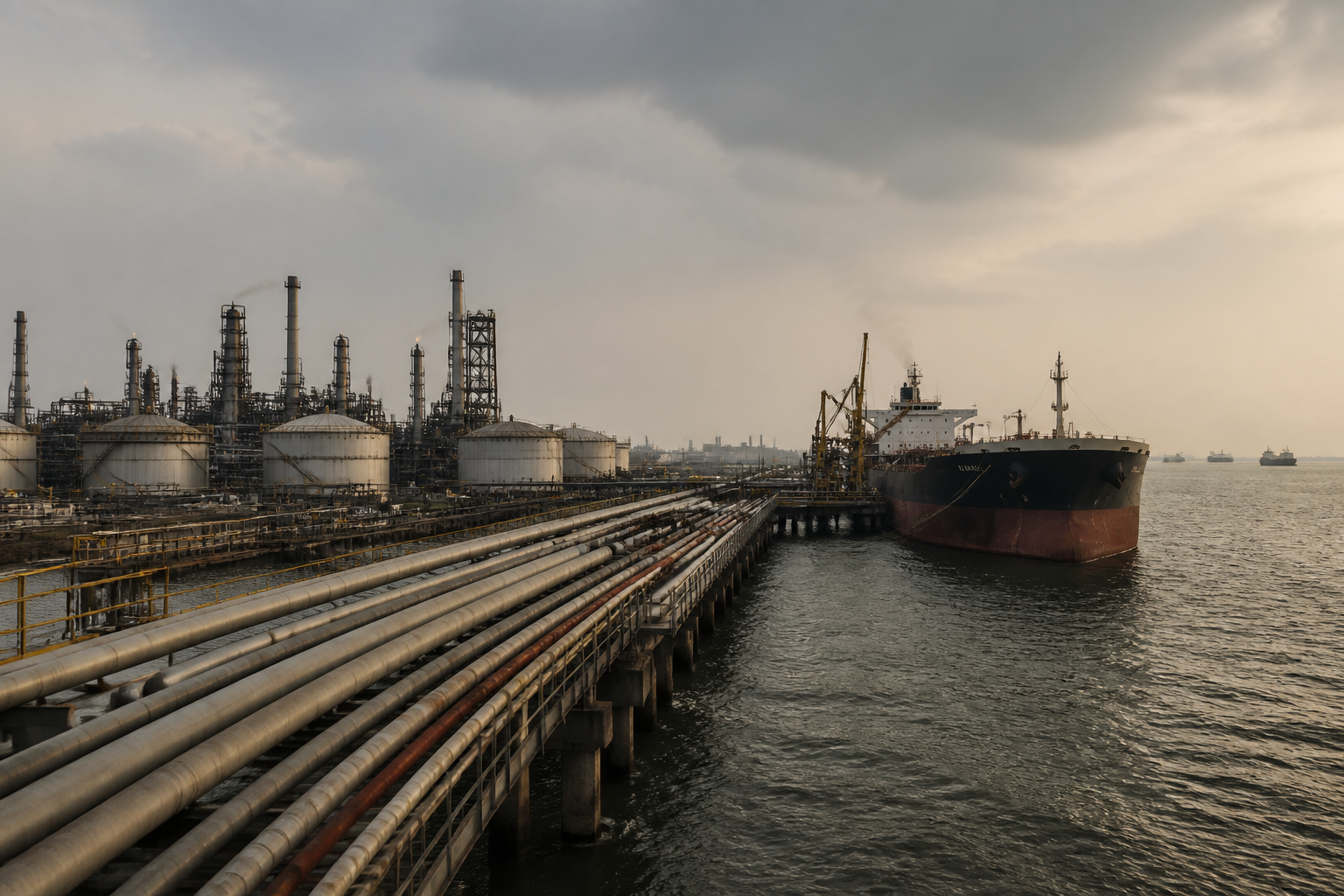
India’s Russian crude advantage is under pressure from three directions at once: attacks affecting export infrastructure, disruption around Saudi Arabia’s East-West Pipeline and stronger Chinese competition for Russian barrels. The immediate issue is not necessarily whether Indian refiners will run out of crude. It is whether the price, freight and insurance advantages that made Russian oil so valuable to India can survive a tightening global market.
That distinction matters because India imports around 90% of its crude oil. A disruption in one producing country or shipping route can often be managed through substitution. The challenge becomes more difficult when several supply chains are stressed simultaneously, global inventories are described as depleted, and the main discounted source of crude becomes more expensive.
The pressure is emerging as the global oil system adjusts to the conflict involving Iran and the United States. The supplied report says Hormuz flows have already been sharply reduced, while global oil supply is expected to fall by 5.7 million barrels per day this year. At the same time, attacks have affected Russian export infrastructure and Saudi Arabia’s ability to move crude from its production areas to its Red Sea terminal.
Saudi Arabia’s East-West Pipeline is central to this calculation. According to a Reuters report cited by Times of India, Saudi Arabia could run out of exportable oil stocks at key Red Sea ports within five to seven days if the pipeline remains shut following drone attacks. The potential loss of as much as 4 million barrels per day, or about 4% of global supply, would deepen an already strained physical market if the outage continued.
For India, the importance of the disruption is not limited to Saudi production. The pipeline shutdown reduces the ability to reroute crude through an alternative export corridor. The report says the Red Sea port of Yanbu supplied around 9% of India’s crude imports since the war began. Indian refiners may be able to manage an immediate shortfall using existing inventories, but a prolonged interruption would force them to compete for replacement grades and potentially pay more for freight.
This is where Russia becomes central to India’s procurement strategy. Russian crude remains the largest component of India’s oil import basket and continues to be a major source of supply for its refiners. But its availability is no longer determined only by production. Export terminals, shipping capacity, insurance exposure, port access and the risks associated with Black Sea movements now influence how much crude can actually reach buyers.
Natalia Katona, a commodity analyst quoted by Times of India, said Russian export infrastructure was already being used close to maximum capacity. She also pointed to constraints on Black Sea shipments caused by attacks, shipping risks and higher freight rates. The report places freight from the Black Sea region at around $20 per barrel and freight from the Baltic region at about $13 per barrel, reflecting the constraints affecting these routes.
The result is a supply problem that can appear differently at different points in the system. Russian refineries facing full or partial outages could, in theory, release more crude for export. But if export terminals lack sufficient capacity, tankers are unavailable or shippers avoid risky routes, the barrels cannot necessarily be moved. Production may then have to be reduced. Katona said Russian output was expected to decline somewhat year on year, citing comments from Russia’s deputy prime minister Alexander Novak.
For Indian refiners, however, the more immediate risk may be competition rather than an outright collapse in Russian production. China is the biggest importer of Russian crude, and its refineries are gradually returning to operation as stronger fuel margins improve refining economics across Asia. The report says China’s seaborne imports of Russian crude rose from 1.40 million barrels per day in July to 1.69 million barrels per day in August, in addition to approximately 1 million barrels per day arriving through pipelines.
That increase has occurred even though China’s overall seaborne crude imports in August remained almost 40% below their pre-conflict level. This means the market does not yet show a broad Chinese oil-demand boom. But a recovery in Chinese buying would place India and China in more direct competition for the same Russian cargoes, particularly when Iranian supplies remain constrained.
The geography of the trade also gives Chinese buyers an advantage for some grades. Katona said China has better freight economics for ESPO, Sakhalin and Arctic crude because these supplies can reach northern China more cheaply during the peak Northern Sea Route season. Some Urals cargoes from Russia’s western ports are also moving towards China through the Northern Sea Route and the Suez Canal, putting those shipments into more direct competition with Indian refiners.
The effect is already visible in pricing. Urals delivered to India was offered at a premium of $1 to dated Brent for September-October arrivals, compared with discounts of more than $10 earlier in July. Katona said the grade later moved to a premium in some transactions as export availability tightened. Even if Russian volumes reaching India remain close to 2 million barrels per day, the economic benefit could be considerably smaller if the discount disappears.
That is the key distinction between physical security and economic security. India may still be able to obtain crude, but the cost of obtaining it can rise through several channels at the same time: higher benchmark prices, narrower discounts, longer voyages, increased freight, insurance costs and competition for refinery-compatible grades.
Pankaj Srivastava, senior vice-president for commodity markets and oil at Rystad Energy, told Times of India that limited alternatives would keep Indian refiners dependent on relatively expensive Russian barrels. Strong product cracks and elevated refinery margins are offsetting much of the impact of higher crude costs for now. But he estimated that every $1 per barrel increase in crude prices raises India’s import bill by approximately $5 million per day, assuming imports of around 5 million barrels per day.
This creates a direct link between global shipping disruption and India’s urban economy. Higher crude costs feed into the operating expenses of transport companies, logistics networks, construction activity and businesses that depend on diesel or other petroleum products. The supplied report also identifies pressure on the current account, the rupee and inflation if higher energy costs persist. The effect on households would depend partly on how much of the international increase is passed through into domestic fuel prices.
The institutional exposure extends beyond consumers. Oil marketing companies could face margin pressure if retail fuel prices do not fully reflect higher international crude and freight costs. The government’s fiscal position could also come under pressure if it absorbs part of the increase or delays price adjustments. The challenge is therefore shared across refiners, fuel retailers, the central government, importers and the wider economy.
India’s strongest defence is diversification. The report says the country sources crude from more than 40 countries, giving refiners flexibility if Russian oil becomes less attractive or harder to obtain. But diversification is not the same as cost neutrality. Replacement barrels must match refinery configurations, quality requirements, shipping routes and delivered prices.
Praveen Rai, director at Grant Thornton Bharat, identified Iraq, Saudi Arabia and the United Arab Emirates as the most attractive alternatives from a cost and logistics perspective. Iraqi medium-sour grades are considered the closest replacement for Russian Urals because they match the requirements of Indian refiners more closely. Venezuela, Brazil, Nigeria and Angola provide another group of possible suppliers, although longer sailing distances and geopolitical risks could increase freight costs. US crude offers another diversification option, especially for lighter grades, but may be less economical for refineries designed for medium-sour crude.
The practical response is therefore likely to be a portfolio shift rather than a single replacement. Rai said Indian refiners could increase purchases from Iraq and the UAE while selectively sourcing from Venezuela, Brazil, West Africa and the United States. Yet every additional source brings a trade-off involving grade compatibility, voyage length, sanctions exposure, insurance and price.
There is also a separate policy risk related to possible US sanctions on Russian crude purchases. The report says India could face fresh tariffs if a sanctions bill in the United States is passed and gives the administration power to impose penalties. That possibility adds uncertainty to a procurement strategy that is already being tested by market and logistics constraints.
The evidence therefore points to a narrower margin of safety for India. Its diversified crude basket reduces the risk of a complete physical supply failure, while existing inventories and alternative suppliers can help refiners manage short-term disruption. But diversification cannot fully protect the import bill when several major routes are disrupted and the discount on the largest source of crude weakens.
The next developments to monitor are the duration of the Saudi pipeline shutdown, the ability of Russian ports and tankers to maintain export flows, the pace of Chinese refinery demand recovery and the movement of Urals differentials for Indian deliveries. These indicators will show whether the current pressure remains a temporary logistics shock or becomes a sustained increase in the cost of powering India’s economy.
