


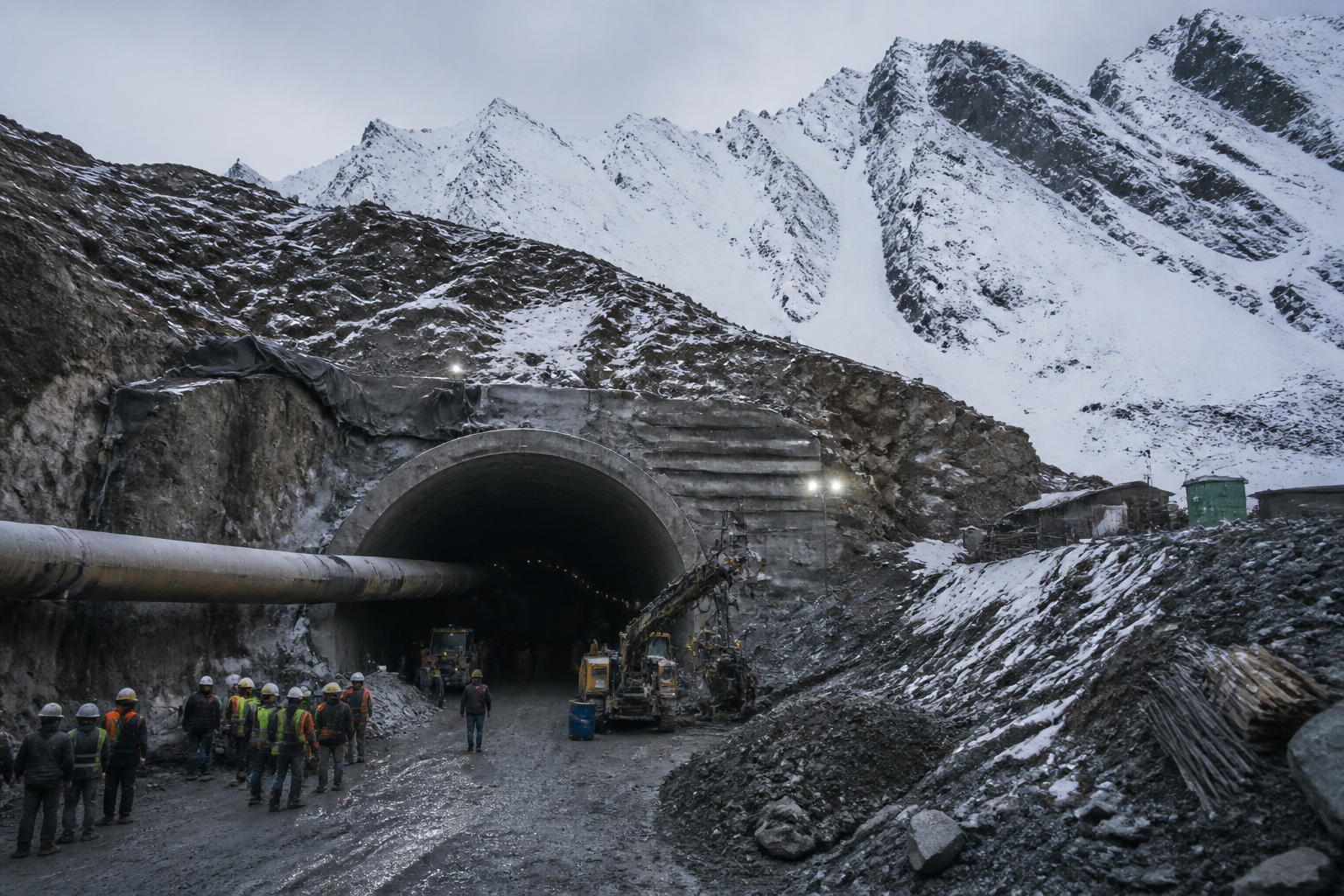
The Zojila Tunnel is being built as more than a 13-km passage through the Himalayas. In the account of Harpal Singh, project head and general manager of Megha Engineering and Infrastructures Ltd (MEIL), it is an attempt to change how Ladakh remains connected to the rest of India when winter closes the mountain pass.
That distinction matters because the project is not simply about shortening a journey. It concerns whether residents of Dras, Kargil and Ladakh can access medicines, food, fuel, education and employment without depending on a seasonal road or emergency air transport. It also shows why large infrastructure projects in the Himalayas cannot be judged only by length, excavation rates or construction cost. Their real test lies in whether they can provide dependable public access in a region where geography, weather and geology regularly disrupt the basic systems of urban and regional life.
Singh, who graduated from Thapar Engineering College in Patiala in 1984, began his career when highway and railway tunnelling were not yet a prominent part of India’s engineering landscape. Tunnel construction was more closely associated with hydropower, irrigation and some urban sewerage projects. Four decades later, he is overseeing work on one of the country’s most demanding road tunnel projects, with MEIL executing the Zojila Tunnel Project.
For Singh, the project represents a shift in both engineering ambition and public purpose. He describes the tunnel as “a monument”, but his explanation of that monument is practical: the Zojila Pass has historically remained closed for three to five months during winter, while the closure period has now reduced to two to three months. The proposed all-weather connection is intended to reduce the isolation created by that seasonal interruption.
The importance of the tunnel is therefore distributed across several systems. A road closure affects not only commuters and freight operators, but also hospitals, schools, markets, fuel distribution and government services. Singh refers to patients from Dras being airlifted to Srinagar and children from Kargil travelling for examinations. These examples illustrate how a transport bottleneck can become a social-service bottleneck. When access is uncertain, every trip involving healthcare, education or supplies becomes dependent on weather, aircraft availability and the condition of mountain roads.
The tunnel could also alter the economic geography of the region. Singh expects improved connectivity to create opportunities in tourism and employment in Sonamarg, Dras and Kargil. The interview does not establish the scale or timing of those benefits, and it does not provide a detailed economic assessment. What it does establish is the mechanism through which connectivity can influence local economies: a longer operating season, more reliable movement of people and goods, and lower dependence on emergency modes of transport.
Yet the physical difficulty of building the tunnel is precisely what makes its public purpose difficult to deliver. Singh describes Zojila as a “geological laboratory”, where the ground can change over short distances. Hard rock may give way to squeezing or crumbling ground, water-bearing strata and different underground stresses. According to his account, conditions can change every 10 metres. The tunnel is also located in a seismic zone, adding another layer of risk to excavation and structural support.
This variability challenges the assumptions that often accompany linear infrastructure projects. A tunnel may have a defined length and two fixed ends, but the ground between them is not uniform. Construction methods must respond to changing rock behaviour, water ingress and pressure. The work cannot be reduced to repeating the same operation along 13 km. Instead, each section may require a different combination of excavation, initial support and stabilisation before the permanent lining can be installed.
The sequence is particularly hazardous during excavation. Singh says the permanent lining follows the initial support only after the tunnel has stabilised. Until then, workers operate beneath ground that may be cracked, affected by water seepage or otherwise unstable. He recalls a worker being killed when a section collapsed and the machine he was operating was trapped beneath the fallen roof. That account places the safety challenge at the centre of the project rather than treating it as a secondary construction concern.
Weather compounds the geological risk. Temperatures can fall to minus 30 degrees Celsius, pipelines can freeze, heavy snowfall can block access roads and the movement of workers between camps and the tunnel can become difficult. At an altitude Singh places at about 11,000 feet, even routine site logistics acquire an operational dimension. Maintaining access, supplying equipment and moving people are not separate from construction progress; they determine whether construction can proceed at all.
The geography also limits how the project can be organised. Singh says the 13-km tunnel could not be approached through multiple access points because of the terrain. Work therefore progressed from two fronts, one from the Kashmir side and the other from Ladakh. This arrangement concentrates the operation around two principal approaches and makes every access disruption more consequential. It also requires the two work fronts to function within a common technical and logistical framework despite the isolation of the site.
The project reveals a less visible infrastructure issue: the workforce required to build strategic connections is itself dependent on temporary settlements and support systems. Engineers, technicians and workers have come from different parts of India, while their families remain elsewhere. Singh says families face limited access to schools, colleges and the everyday support networks that households rely on. In his view, the families staying behind make the greater sacrifice.
That human dimension is relevant to the delivery of difficult infrastructure because high-altitude construction depends on retaining skilled workers in conditions that are physically and socially demanding. Singh argues that salary alone cannot motivate people to work at 11,000 feet. He emphasises purpose, shared hardship and leadership by participation, saying that he stays with workers and eats in the same mess. He also describes senior staff reaching the site early and helping clear roads when necessary.
These details do not substitute for formal safety systems, engineering controls or institutional accountability. The supplied interview does not provide data on accident rates, safety audits, contract value, construction milestones or the project’s scheduled completion. It also does not establish whether the tunnel has been opened or how its operating arrangements will be managed after construction. Those remain important questions for assessing the project as public infrastructure.
What the interview does show is how a major Himalayan tunnel combines several forms of state capacity and private execution. A transport connection intended to serve Ladakh requires geological investigation, construction management, worker safety, winter logistics and coordination across the Kashmir and Ladakh approaches. Its public value depends on all of these elements functioning together. A tunnel that is technically complete but repeatedly inaccessible through its approaches would not deliver the same connectivity as an integrated, reliable route.
The Zojila project also illustrates why infrastructure in mountain regions must be understood as a continuity problem. In flatter urban environments, road capacity is often discussed through traffic volumes, travel times and junction performance. At Zojila, the central question is whether a route remains usable through extreme winter conditions and whether communities can maintain access to essential services. The relevant measure is not only how quickly vehicles move, but whether people can move at all when the conventional route is under stress.
The evidence available in the interview points to a project with a clear strategic and social rationale, but it also identifies the constraints that could shape its eventual performance. The pass has historically closed for months; the tunnel is 13 km long; the ground changes rapidly; the site is seismic; temperatures can reach minus 30 degrees Celsius; and work is taking place from two fronts at high altitude. These are not peripheral construction difficulties. They define the infrastructure problem the project is intended to solve.
The next stage of scrutiny should therefore focus on verifiable implementation details: the project’s construction status, safety record, opening timeline, approach-road readiness, operating arrangements and performance during winter. Until those details are available, the Zojila Tunnel can be understood as an ambitious attempt to convert a seasonally vulnerable mountain corridor into a more dependable connection. Its lasting significance will ultimately depend on whether the completed system can provide the year-round access that its engineers and intended users expect.
