


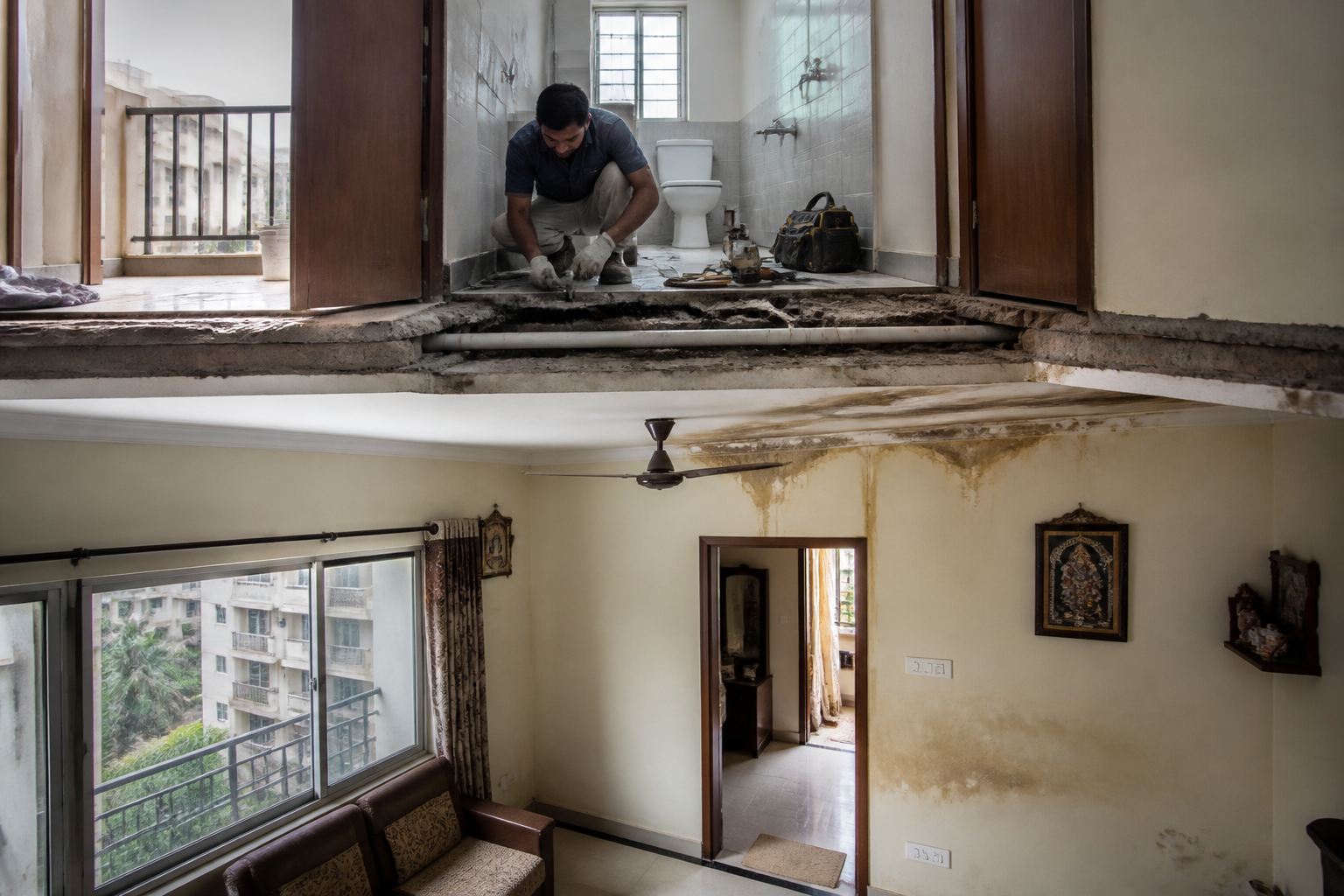
A Maharashtra Co-operative Appellate Court order in a prolonged water leakage dispute shows how a basic apartment maintenance problem can become an eight-year legal battle when residents, flat owners and housing societies cannot agree on responsibility, access and repair costs. The case involved leakage from a first-floor flat into the ground-floor home below, but its larger significance lies in the way privately occupied apartments remain dependent on shared rules and cooperation for basic building upkeep.
The dispute began in July 2012, when the owner of the ground-floor flat started experiencing water seepage from the flat immediately above. According to the account placed before the court, the upper flat had previously undergone civil work involving bathroom floor tiles before it was sold. The ground-floor resident believed that work had contributed to the leakage. The housing society was informed, but no immediate resolution followed.
The upper flat changed hands in September 2014. The leakage subsequently worsened, according to the ground-floor owner, who again approached the society. Repairs were arranged at a cost of Rs 4,500 and completed on May 22, 2016. The lower-floor resident was willing to pay the entire amount. The repair appeared to work temporarily, but the leakage returned in 2018.
At that point, the ground-floor owner arranged for a contractor to carry out work inside the upper flat and paid Rs 36,750. That intervention also failed to provide a lasting solution. The upstairs owner later refused to allow further workers into the flat, leaving the leakage unresolved from 2018 onwards.
The dispute therefore moved beyond the technical question of where water was entering the building. It became a conflict over who could enter a privately occupied home, who would control the repair process, whether earlier contractors had caused damage, and how much inconvenience a resident could be required to tolerate in the interests of another flat owner.
The access problem in apartment buildings
The upper-floor owner did not oppose repairs in principle, according to the case record described in the report. The objections related to the manner of the earlier work and the consequences of allowing contractors into the flat. The owner alleged that the 2018 repairs had damaged floor tiles and caused financial loss. Concerns were also raised about the privacy and peaceful occupation of the home, where elderly family members and a minor child lived.
The owner sought an examination by an independent structural auditor or architect appointed by the society before any further work was permitted. This request reflected a central difficulty in multi-storey housing: the source of a leak may not be visible from the flat where the damage appears. Water can travel through floors, walls, pipes, bathrooms or concealed building elements. A resident suffering the damage may therefore need access to another person’s home before the cause can be established or repaired.
That dependence creates a governance problem inside what appears to be a private dispute. Individual flat ownership gives residents control over their homes, but the physical operation of a multi-storey building means that one flat cannot always be maintained in isolation. A bathroom, floor slab, drainage line or waterproofing layer can affect multiple homes. Repair rights and repair duties therefore become matters of collective administration, not just neighbourly cooperation.
In this case, an independent engineer was brought in to address the competing claims. The engineer was selected from a list suggested by the upstairs owner and inspected the flats before submitting a report to the court in a sealed envelope. The report confirmed the existence of leakage in the ground-floor flat but did not identify precisely where the water originated.
That finding left an important technical uncertainty unresolved. It established the damage but not its exact source. The upstairs owner relied on that limitation while continuing to object to access. The appellate court nevertheless took the view that the family in the ground-floor flat could not be required to live indefinitely with the problem. It also noted, on a prima facie basis, that the leakage appeared to be coming from the flat above.
The court’s approach was not to disregard the concerns of the upper-floor owner. Instead, it balanced those concerns against the continuing damage reported by the lower-floor resident. The order directed the upstairs owner to allow repair work to be carried out, while the question of responsibility was considered alongside the society’s governing rules and its specific resolution on leakage repairs.
Why society bye-laws became decisive
The case illustrates the practical importance of housing society bye-laws. In a co-operative housing society, these rules help determine how common responsibilities are distributed among members. They can cover repairs, access, maintenance obligations and the treatment of costs that affect more than one dwelling.
The appellate court noted that society members are generally responsible for repairs at their own cost, except for matters covered by Bye-law No. 159(a), as described in the report. The society’s records also contained an annual general meeting resolution stating that the cost of repairing water leakage would be shared equally by the two flat owners.
The court held that the resolution was binding on both sides. This was significant because the ground-floor owner had earlier indicated a willingness to bear the full cost. The final arrangement did not depend solely on that offer. It depended on the society’s adopted rule for dealing with leakage and the court’s finding that the resolution applied to the dispute.
This distinction matters in apartment governance. Informal arrangements may help resolve an isolated problem, but they can become difficult to enforce when ownership changes, contractors differ or the repair fails. A recorded society resolution creates a common framework, although its application may still require inspection, cooperation and, in contentious cases, judicial intervention.
The case also shows why maintenance records can become important evidence. The dispute involved earlier complaints, repairs in 2016, work arranged in 2018, payments of Rs 4,500 and Rs 36,750, an engineer’s inspection and a society resolution. Each item helped establish the sequence of attempts to address the leakage and the reasons the conflict remained unresolved.
The institutional gap between damage and remedy
A water leak is often treated as a small household inconvenience, but the case demonstrates how quickly it can expose institutional gaps. The lower-floor resident could see the consequences, but not necessarily the source. The upper-floor resident controlled access to the location where the cause might have been found, but also faced legitimate concerns about privacy, damage and disruption. The society had a role in arranging repairs and framing cost rules, yet the problem continued for years.
The dispute also reveals the limits of repeated repairs without a settled diagnostic process. The 2016 work cost Rs 4,500 and provided only temporary relief. The 2018 work cost Rs 36,750 and also failed to resolve the leakage. The report does not establish why either repair failed, and the engineer’s inspection did not conclusively identify the exact source. What it does establish is that multiple interventions took place without producing a durable settlement.
This is where building maintenance becomes a governance issue. A society needs more than a general expectation that residents will co-operate. It needs a credible process for identifying the source of damage, selecting qualified professionals, recording consent, protecting occupied homes during work and allocating costs. The court order addressed the immediate access barrier, but the underlying technical uncertainty was still part of the case.
The eight-year timeline is itself a measure of the cost of unresolved maintenance. The dispute began in 2012, repairs were attempted in 2016 and 2018, and the appellate court granted relief after years of litigation. During that period, the reported leakage remained unresolved from 2018 onwards. The financial cost included repair expenses and legal proceedings, while the household cost involved continued occupation of a home affected by water ingress.
For housing societies, the case raises a structural question: when should a repair dispute be treated as an urgent building-maintenance matter rather than a private disagreement between neighbours? The answer may depend on the risk of continuing damage, the evidence available, the society’s bye-laws and whether access is necessary to inspect or repair a suspected source.
The larger lesson for apartment governance
The ruling does not create a general licence for one resident to enter another person’s flat or carry out work without safeguards. The court considered privacy, safety and the possibility of damage before directing access. The independent inspection and the society’s rules formed part of the process through which that access was ordered.
Its broader lesson is that apartment ownership combines private occupation with shared physical systems. A resident may own a flat, but the consequences of water, drainage, structural elements and building services can cross property boundaries. When internal rules are unclear or ignored, a technical defect can become a dispute over rights, evidence and authority.
The Maharashtra case confirms three facts. The leakage in the ground-floor flat was established; its precise source was not conclusively identified by the engineer; and the court nevertheless directed the first-floor owner to permit repairs because the lower-floor family could not be expected to endure the problem indefinitely. It also confirmed that the society’s cost-sharing resolution applied to both owners.
The next stage, according to the order described in the report, is for repair work to proceed with access to the first-floor flat and for the costs to be shared equally under the society’s resolution. The case leaves housing societies with a clear administrative challenge: prevent routine maintenance disputes from becoming long-running legal battles by documenting defects, using independent technical assessments and applying their own repair rules consistently.
