


New Town’s Durga Puja landscape is entering a politically charged phase, with three prominent committees placing heavyweight BJP-linked figures at the centre of their organisation, sponsorship or public identity. The development is more than a contest between themed pandals: it shows how a rapidly expanding planned township is building its public culture through a combination of block-level participation, large open spaces, institutional permissions and political association.
The three pujas described in the report are New Town Sarbojanin at City Square, Sanatani Durga Puja at the New Town Mela Prangan and the older DB Block puja. Their organisational structures differ, but each is being presented through influential public figures. At New Town Sarbojanin, the report says control has shifted from the wife of former HIDCO chief Debashis Sen to Rinku Majumdar, wife of state minister Dilip Ghosh. Dilip Ghosh is serving as chief adviser, while committee president Lakshmikanta Kar has sought his approval several times.
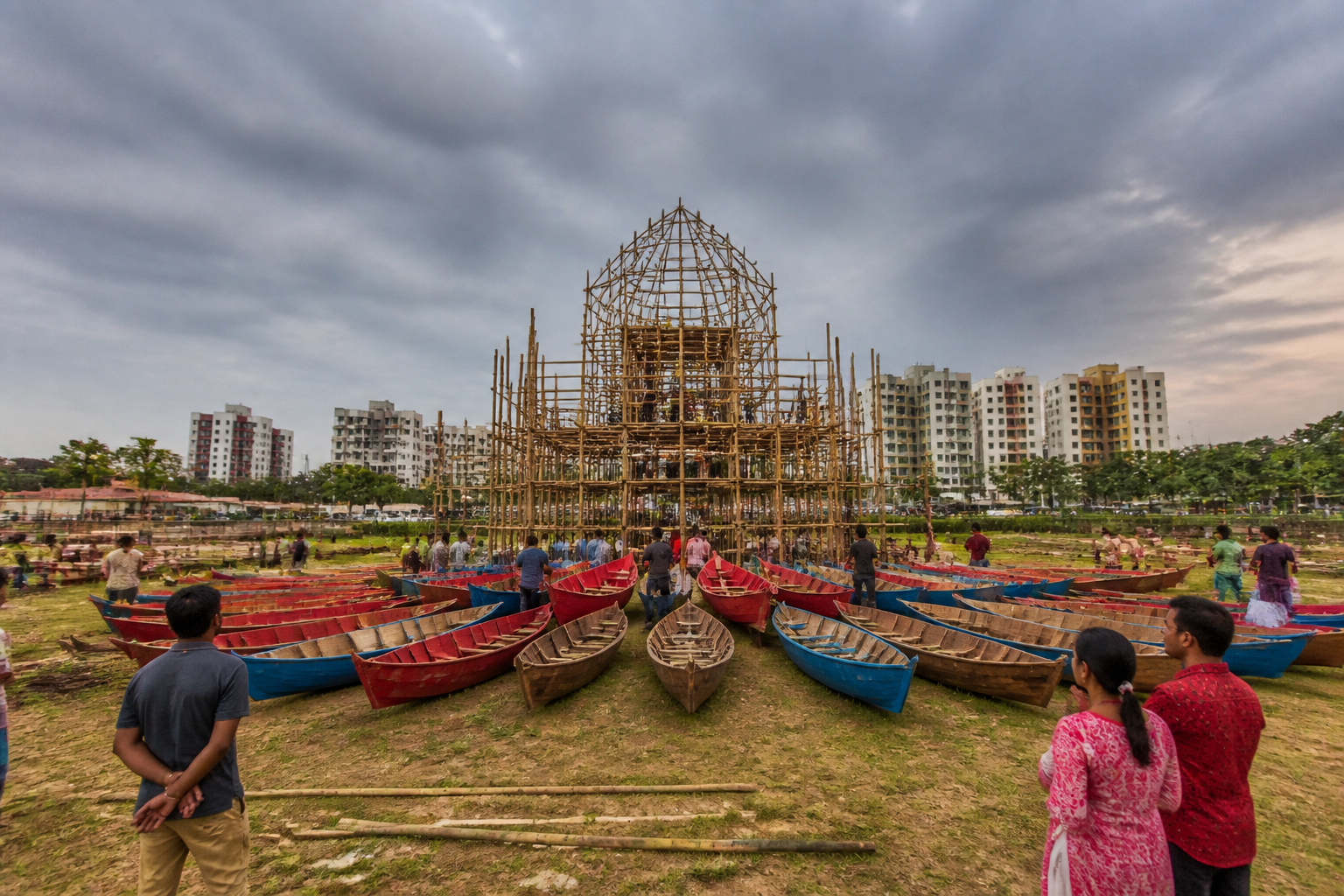
The arrangement also reveals the administrative importance of land in New Town’s festival economy. The puja is being held across the City Square ground, where the committee reportedly needed permission from HIDCO. According to the report, Majumdar helped secure the approval. The presence of rows of boats at the site has become a visible sign of the coming installation, although the committee has not disclosed the full design. The stated theme is “Lotus”, with the boats intended to become the petals of a lotus.
This is a distinct institutional setting from the block-based pujas that are common in planned townships. New Town has pujas organised within individual blocks, but New Town Sarbojanin was created as an event beyond the boundaries of one block. That distinction matters. A block puja is primarily rooted in residents’ everyday association with their immediate neighbourhood. A township-wide puja depends more heavily on access to common land, permissions, public visibility and the ability to attract visitors from beyond the host community.
The second event, Sanatani Durga Puja, began as a counterpoint to the City Square puja and is located about 1.25 kilometres away at the New Town Mela Prangan. The report says the puja was inaugurated by Suvendu Adhikari in 2022, held again the following year, and then did not take place for two years. Organiser Barun Biswas alleged that the administration had opposed the puja and said it could not be held in 2024 despite a court ruling because of administrative non-cooperation. He also said the organisers did not approach the court in 2025.
The committee now presents Subrata Gupta, the chief adviser to the chief minister, as its public face. Swami Pradiptananda, also known as Kartik Maharaj, is the principal patron, while actor George Baker is the president. Baker was a BJP candidate from Howrah in the 2014 Lok Sabha election and was later a nominated member of Parliament under the Anglo-Indian quota, according to the report.
The third puja is the DB Block celebration, which is older than the other two. Its principal organiser is Anupam Ghosh, a member of the BJP’s state committee who has recently been appointed convenor of the party’s media cell. His wife, Pramita Saha Ghosh, is joint secretary. This year, Ashok Lahiri, former BJP MLA from Balurghat and vice-chairman of NITI Aayog, has joined as chief adviser. Lahiri lives in the DE Block, which does not have its own puja, and many residents of that block participate in the DB Block event.
The three committees reject the description of a direct political contest. Biswas said Sanatani Durga Puja had no competition with the other events and that Gupta was chosen because he was a respected New Town resident. He described Kartik Maharaj as a prominent figure in the defence of Sanatani traditions and said Baker’s presidency represented an inclusive festival. Ghosh also denied that the objective was to compete, while arguing that the character of Bengali Durga Puja in New Town could be found at the DB Block event in a way that might not be present at the other prominent pujas.
Yet the competitive element is visible in the organisation and presentation of the events. All three are associated with BJP-linked public figures, and all three have selected themes based on tradition, heritage or large-scale civilisational narratives. New Town Sarbojanin is using a lotus installation. Sanatani Durga Puja plans to connect Sanatan tradition with modern science, moving from figures such as Aryabhata, Kanada and Sushruta to the modern period and the origins of the universe. The DB Block puja has chosen the Mahakumbh, using installations, lighting and sound to depict the gathering at Prayagraj and the story of the Samudra Manthan.
These themes show how festival space is being used to construct competing narratives of identity. The committees are not merely decorating neighbourhood grounds. They are creating public-facing interpretations of history, tradition, science and religious belonging. The source report does not establish how many visitors each puja expects, how the events are funded, or whether the committees have received public grants. It does, however, show that the prominence of the individuals attached to the committees has become part of the events’ public value and visibility.
The governance question is equally important. New Town’s public spaces are not simply vacant plots available for community use. The City Square ground and the Mela Prangan are civic spaces whose use requires administrative coordination. The report specifically identifies HIDCO’s permission as important for New Town Sarbojanin. This places festival organisation within the same institutional framework that manages land, public access and planned development in the township.
That framework can produce unequal advantages. A committee with access to influential political or administrative figures may find it easier to secure visibility, permissions or institutional attention, even when no formal preference is documented. The supplied report does not prove that any committee received preferential treatment. It does show, however, that organisers themselves foreground the names and positions of their advisers, patrons and presidents. In a planned township, where public land is limited and common spaces serve multiple neighbourhoods, that association is part of how civic legitimacy is communicated.
The history of New Town’s pujas also reflects the township’s changing social structure. The City Square event reportedly drew attention five years ago as a large Durga Puja outside the boundaries of an individual block. Sanatani Durga Puja emerged as a counter-event nearby, while the DB Block puja retained its base in an established residential community. The result is not one uniform festival system but several overlapping models: a township-wide event, a festival built around a distinctive ideological identity and a block-based celebration rooted in residents’ participation.
This distinction is crucial for understanding public culture in a planned city. New Town was developed through formal planning and large-scale infrastructure, but social belonging is built through institutions that residents recognise and use. Block associations, festivals and open grounds help convert a planned layout into a lived neighbourhood. When high-profile political figures enter that process, the festival can become both a community institution and a platform for public influence.
The report also places New Town within a broader Kolkata pattern in which political leaders have been associated with prominent pujas. It refers to earlier competition among Trinamool Congress-linked organisers over the scale and popularity of major Kolkata celebrations, as well as allegations that political influence was used to affect crowd movement. Those allegations are not independently established in the supplied material. The wider pattern, as presented, is that major public festivals have long been connected to political networks, and New Town is now developing its own version of that relationship.
What remains unclear is how these three events will be assessed beyond their political associations. The report does not provide budgets, attendance figures, crowd-management plans, traffic arrangements, fire-safety clearances or details of waste management. Those practical questions will determine how the events affect residents and visitors. A festival may be publicly prominent because of its advisers and patrons, but its urban performance will also depend on access, safety, transport, sanitation and the management of shared land.
New Town’s three pujas therefore point to a larger urban question: who gets to define the identity of a growing township, and through which institutions? The answer is being shaped not only by elected representatives or planning agencies, but also by festival committees that occupy public space and present themselves as representatives of neighbourhood, tradition or the wider city. The immediate contest may be over themes and attendance, but the deeper issue is how civic culture and political influence are being organised in New Town.
The available evidence confirms the growing prominence of BJP-linked figures in the three committees and the importance of HIDCO-controlled or administered public spaces to at least one of the events. It does not establish preferential treatment, funding arrangements or final visitor numbers. Those details, along with the administration’s response to the competing claims about permissions and past disruption, will determine whether this year’s Durga Puja marks only a new chapter in New Town’s festival culture or a more lasting change in the township’s civic landscape.
