


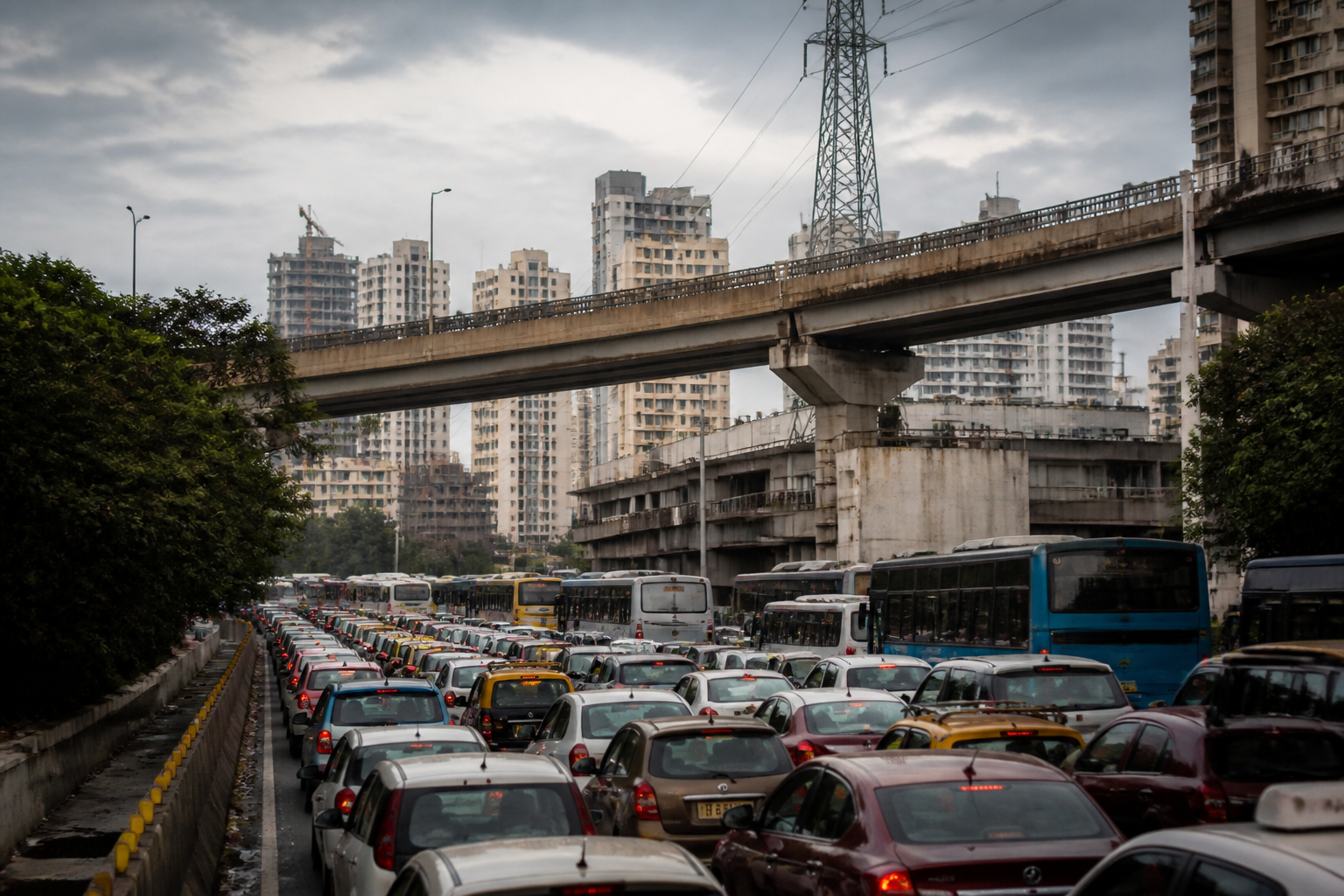
Union Road Transport and Highways Minister Nitin Gadkari’s reported proposal for modern multilevel flyovers in Mumbai is less a confirmed project announcement than a signal of how severely the city’s road network is being tested. After being delayed by about an hour while travelling from Worli to an event, Gadkari referred to the limitations of older flyovers and said he had advised Maharashtra Chief Minister Devendra Fadnavis to consider replacing some existing structures with infrastructure based on newer construction technology.
The immediate incident is familiar to millions of Mumbai commuters: a journey that should be predictable becomes dependent on congestion at a few critical junctions and corridors. Its significance lies in who experienced it. Gadkari used the delay to discuss infrastructure he had helped oversee as Maharashtra’s public works minister between 1995 and 2000, including 55 flyovers, the Bandra-Worli Sea Link and the Mumbai-Pune Expressway. His comments therefore connect a present-day traffic failure with the limits of infrastructure designed for an earlier phase of the city’s growth.
The reported proposal, however, should not be confused with an approved Mumbai project. The source report does not provide a government notification, detailed alignment, traffic study, project cost, land requirement, tender schedule or construction timeline. It says Gadkari advised the chief minister to consider replacing existing flyovers with modern structures and referred to technology acquired from Malaysia that could allow multiple flyover levels to be built on a single set of pillars. The practical question is whether that technology can be adapted to Mumbai’s roads, utilities, buildings, junctions and traffic-management needs.
That distinction matters because Mumbai’s congestion is not caused by one missing flyover. The city’s road network operates within an unusually constrained physical environment, with limited road space and intense competition between through traffic, local access, buses, taxis, two-wheelers, pedestrians, deliveries and construction activity. Adding another elevated level can increase movement capacity at a particular point, but it does not automatically resolve queues that form before or after the structure.
A flyover is effective only when its approaches, exits and connecting roads can handle the traffic released by it. If a structure removes a bottleneck at one junction while transferring vehicles to a narrower road, the congestion can move rather than disappear. The report does not include a traffic model for the proposed multilevel approach, so it is not possible to establish whether the suggested technology would reduce total travel time, improve traffic flow across a corridor or simply create additional capacity at selected locations.
Gadkari’s account also highlights a recurring problem in urban infrastructure: projects built to solve the demand of one period eventually become part of the constraints of another. The flyovers he referred to were developed during a phase when Mumbai required rapid improvements to road connectivity. Since then, the source report says, traffic movement has expanded across South Mumbai, the western suburbs, Thane, Navi Mumbai and surrounding areas. The result is a network in which older structures are expected to carry volumes and patterns they were not originally designed to manage.
The issue is not only the age of concrete or steel. Infrastructure has a functional life shaped by changing land use, employment locations, vehicle ownership, public transport availability and travel behaviour. A flyover can remain structurally sound while becoming operationally inadequate. Its ramps may be too short for current traffic volumes, its junction design may create merging conflicts, or its location may no longer match the main movement of people and goods.
This is why the reported reference to new construction technology needs to be assessed alongside transport planning. A multilevel flyover can make better use of scarce horizontal space, particularly in a dense city where widening roads may require demolition, land acquisition or disruption to established neighbourhoods. But vertical expansion also creates new engineering, maintenance and safety responsibilities. The supplied report does not establish how the proposed structures would address pedestrian access, bus operations, emergency movement, drainage, utility lines, noise or the visual impact on adjoining areas.
The same gap applies to the question of cost. No estimate is provided for replacing existing flyovers or building multilevel structures. There is also no information on whether the proposal would be funded by the Union government, the state government, the municipal corporation, a transport agency or a combination of institutions. These details are not administrative footnotes. They determine who will prepare the project, who will approve it, who will acquire land, who will maintain it and which agency will be accountable if implementation is delayed.
Mumbai’s transport infrastructure is managed through multiple authorities and project-level arrangements, but the supplied report does not identify the institutional route for this proposal. That makes the next stage especially important. A public statement can initiate discussion, but a formal project requires a feasibility assessment, traffic data, structural evaluation of existing flyovers, environmental and utility clearances, cost approval and an implementation agency. Until those steps are documented, the proposal remains at the level of policy advice rather than a committed construction programme.
The reported remarks also mention a proposed infrastructure programme of Rs 50,000 crore for Pune, with an emphasis on newer technologies and infrastructure models. The report does not provide a project list, funding structure, delivery period or official document for that programme. Its relevance to Mumbai is that it shows the minister framing congestion as a question of infrastructure capacity and technology across major Maharashtra cities. It does not, by itself, establish that the same financial or delivery model will be applied in Mumbai.
The evidence currently available supports three conclusions. First, congestion on Mumbai’s existing road network has reached a level that affects even high-profile official travel and is being discussed as a systemic infrastructure problem. Second, the road structures created during the 1990s are now being reassessed against a much larger and more interconnected metropolitan travel pattern. Third, the proposed multilevel flyover solution has not yet been accompanied, in the supplied material, by the technical and administrative details needed to judge its feasibility.
The evidence does not yet answer several essential questions. Which flyovers would be replaced? Would replacement mean demolition, strengthening or reconstruction around existing structures? Which corridors would receive priority? How would construction affect traffic during the transition? Would the plan include bus lanes, pedestrian improvements or junction redesign? What is the expected reduction in travel time, and how would that be measured? Without these answers, the technology itself cannot be treated as proof of a transport solution.
Mumbai’s larger urban challenge is therefore not simply whether it can build higher roads. It is whether new capacity can be integrated into a network whose problems occur across multiple levels: road design, junction management, regional commuting, public transport connections and limited urban space. The reported proposal brings that challenge into focus, but it does not settle it.
The next meaningful development will be an official project document or announcement specifying the locations, design, cost, authority and timeline for any multilevel flyover plan. Until then, Gadkari’s reported intervention is best understood as a call to reassess Mumbai’s ageing road infrastructure, not as evidence that a new traffic system has been approved or that congestion will soon be resolved.
