


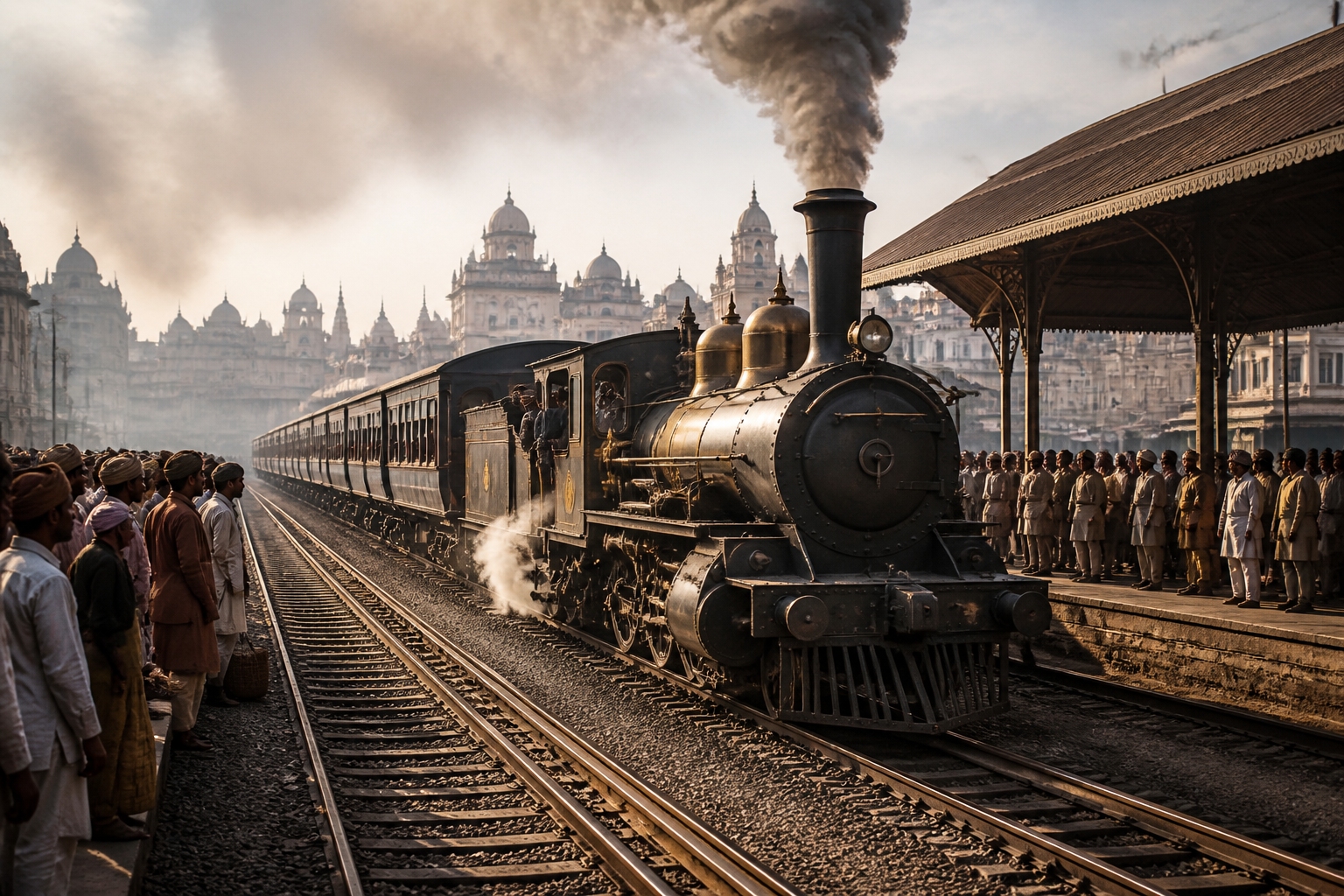
Mumbai’s railway network began with a 34-kilometre journey that carried around 400 passengers from Bori Bunder to Thane on April 16, 1853. The steam-powered service was a modest beginning in scale, but it established a transport link whose consequences would extend far beyond the one-hour-and-15-minute ride: it connected a growing port city to Thane and created the first commercial passenger railway service in India.
The train was operated by the Great Indian Peninsula Railway, or GIPR, and left from Bori Bunder, near the site of present-day Chhatrapati Shivaji Maharaj Terminus. It consisted of 14 passenger carriages and was initially documented as being hauled by three steam locomotives named Sahib, Sindh and Sultan. The route covered approximately 21 miles, equivalent to 34 kilometres.
The journey was not treated as an ordinary transport operation. Bombay declared April 16 a public holiday, drawing large crowds to Bori Bunder. A 21-gun salute accompanied the departure, turning the launch into a civic spectacle as well as a railway milestone. The public ceremony reflected the scale of the change being introduced: a new form of transport was being placed directly into the life of the city.
The significance of the Bombay-Thane line lies in the way it combined infrastructure, administration and urban growth. A railway is not only a vehicle moving between two points. It requires a defined corridor, stations, operating authority, timetables, rolling stock and a system capable of carrying passengers in an organised manner. The 1853 service brought these elements together for commercial passenger travel, establishing a model that could later be extended beyond the first short route.
The railway did not begin in a spatial vacuum. Bombay was already a growing port city, while Thane formed part of the wider regional landscape beyond the island city. The new connection made movement between the two locations faster and more structured than before. The source material describes the line as helping connect the port city with Thane and demonstrating how rail transport could improve the movement of people and goods.
That distinction matters because the first railway route was not simply an isolated engineering achievement. It was an early example of transport infrastructure shaping the relationship between a dense urban centre and its surrounding areas. As the GIPR expanded its network, the railway became connected with industrial areas and towns across the region. The initial 34-kilometre stretch therefore functioned as the beginning of a wider network rather than a self-contained service.
Historical accounts often describe April 16, 1853, as the start of the railways in India. The more precise description is that it marked the beginning of commercial passenger railway service in the country. Earlier railway experiments and train operations had taken place for purposes including the movement of construction material. The Bombay-Thane journey was different because it carried passengers as a formal commercial service.
That distinction also shows how public transport systems develop in stages. The first stage is often an experiment in technology or construction. The next is the creation of a reliable operating service for the public. The 1853 journey represented the second stage: a railway moved from demonstration and practical experimentation into a public transport system with passengers, coaches, a destination and a scheduled journey.
The details of the service underline how different the scale was from Mumbai’s current railway reality. The inaugural train carried around 400 passengers in 14 carriages. The journey lasted about 1 hour and 15 minutes and covered 34 kilometres. More than 170 years later, Mumbai’s suburban railway system has grown into one of the world’s busiest, with the city’s daily relationship with trains extending far beyond the ceremonial departure from Bori Bunder.
The contrast is not only a story of technological change. It is also a record of urban expansion. The source material describes Mumbai’s present railway network as carrying millions and as having developed alongside the city itself. As the urban area expanded and employment, industry and settlements became more closely connected, the railway’s role changed from a new mode of transport into an essential part of everyday urban movement.
This is the institutional legacy of the first line. GIPR’s original route created a foundation for network expansion. The railway eventually connected Bombay with industrial areas and towns across the region, allowing the transport system to become part of the wider geography of economic activity. The line’s importance therefore came not only from its first passengers, but from the network logic it introduced: a central city could be linked to places beyond its immediate limits through a permanent, organised transport corridor.
The Bombay-Thane route also offers a useful way to understand the relationship between transport and urban identity. Mumbai’s railway story is frequently associated with the packed suburban services of the present, but those services are the outcome of a much longer institutional evolution. The modern system cannot be separated from the decision, in 1853, to create a commercial passenger connection between Bori Bunder and Thane.
The original railway was built around steam locomotives and a limited number of coaches. Today’s railway environment bears little resemblance to that first service in physical appearance, operational scale or passenger demand. Yet the central urban function remains recognisable: the railway connects people across a corridor and supports movement between the city and the wider region.
This continuity helps explain why the first journey remains relevant to the built environment. Roads, stations and rail lines do more than provide mobility. They organise how urban areas relate to one another. A transport corridor can create regular movement, support access to employment and connect settlements that may otherwise function as separate places. In the case of the Bombay-Thane line, the initial connection became part of the foundation for a railway network that would later be central to Mumbai’s growth.
The source material does not establish every stage of the line’s later expansion or provide a detailed account of its subsequent passenger volumes. What it does establish is the sequence: a 34-kilometre passenger service in 1853, the expansion of the GIPR network, the railway’s connection with industrial areas and towns, and the emergence of Mumbai’s suburban railway system as a defining element of the city.
It also establishes an important limit to the popular version of the story. The 1853 train was not the first train ever to operate in India. Its historical importance lies in the fact that it was the first commercial passenger train service. Accurate distinctions of this kind matter because transport history is also institutional history. The form of service, the users it was designed for and the system it created are as important as the technology itself.
Mumbai’s railway legacy therefore began neither with the millions who use suburban trains today nor with the later expansion of the regional network. It began with a publicly marked journey between Bori Bunder and Thane, operated by GIPR and completed by a steam train with 14 carriages. The route was short, but it demonstrated how a railway could connect a port city with its surrounding region and turn transport infrastructure into a framework for urban growth.
More than 170 years later, the enduring fact is not simply that a train once left Bori Bunder. It is that the first passenger corridor created a transport relationship that continued to expand as Mumbai grew. The next chapters of that railway story belong to the suburban network and its millions of passengers, but its institutional starting point remains the same 34-kilometre line to Thane.
