


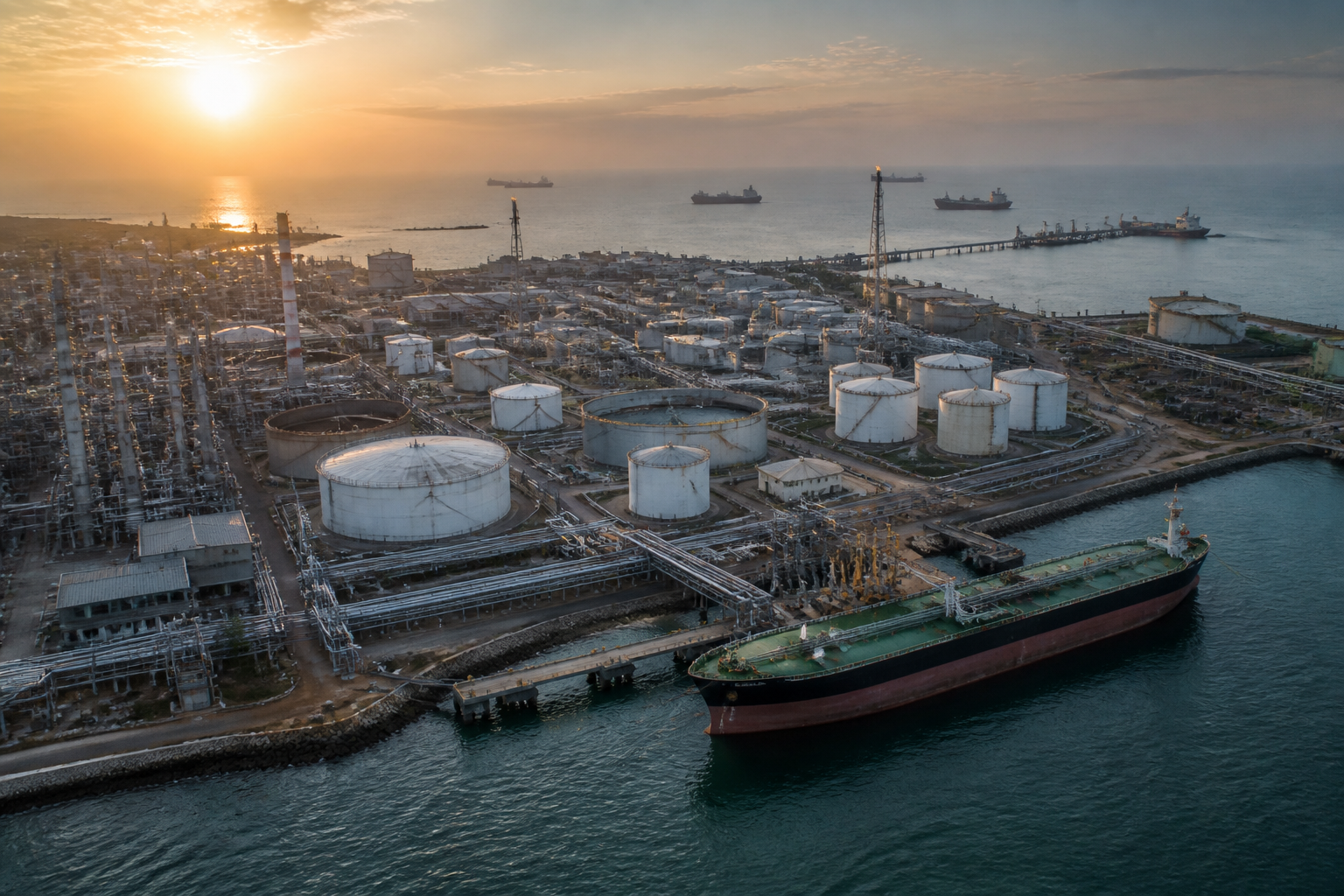
Nayara Energy’s Russia exports have become a sharp indicator of how sanctions, refinery ownership and maritime logistics are reshaping the international fuel trade. The Rosneft-backed company shipped roughly 120,000 tonnes of petrol from its Vadinar refinery in Gujarat to Russia in August 2026, helping India account for about 70 per cent of Moscow’s refined petroleum imports that month.
The figures, reported by the Finland-based Centre for Research on Energy and Clean Air (CREA) and published by The Hindu BusinessLine, describe more than a single export transaction. They show a circular energy relationship in which Russian crude is processed at an Indian refinery partly owned by Russia’s state-controlled oil company, then converted into fuel and shipped back to the Russian market.
That flow places Vadinar at the centre of a wider system involving crude procurement, refinery capacity, sanctions compliance, ship-to-ship transfers and Russian fuel shortages. It also highlights how India’s large coastal refineries are operating not only as domestic supply assets but as nodes in a changing global energy network.
## A refinery-to-market loop
CREA said Russia imported around $132 million worth of refined petroleum products in August. India supplied approximately $92.50 million of that total, or about 70 per cent. India’s contribution included roughly 120,000 tonnes of gasoline, valued at €78 million, all loaded at the Vadinar refinery and sold by Nayara Energy to Rosneft, according to the report.
Rosneft owns 49.13 per cent of Nayara Energy. The ownership structure is important because it links the refinery directly to a Russian oil company at a time when sanctions and attacks on Russian energy infrastructure have disrupted conventional fuel supply chains. The refinery is not merely processing crude for an unrelated overseas market; the reported trade connects an asset partly owned by Rosneft with crude sourced from Russia and fuel purchased by Rosneft.
CREA described the arrangement as Russia paying a refinery it partly owns to process its own crude into fuel that it can no longer produce domestically at the required level. The report said every cargo exported from Vadinar to Russia was transferred between vessels in a ship-to-ship operation at the Damietta Lightering Zone off Egypt before being unloaded at Russia’s Arctic port of Beloe More.
The route illustrates the logistical complexity now built into the refined-fuel trade. The movement is not a direct refinery-to-port delivery. It involves multiple vessels, a transfer point outside India and a final delivery to a Russian port. Each stage adds operational significance to the maritime infrastructure supporting the trade, including coastal terminals, tankers, lightering zones and receiving facilities.
## Why August was an outlier
The scale of Russia’s August imports was unusual by recent standards. CREA said Russia imported 172,000 tonnes of oil products in the month, valued at €114 million. The volume was more than seven times the previous monthly high recorded since the full-scale invasion of Ukraine and three times Russia’s total import volume for all of 2025.
Gasoline made up 74 per cent of Russia’s total oil-product imports in August. Between 2023 and 2025, gasoline had accounted for only 6 per cent of such imports. The change indicates that the August movement was not simply a continuation of Russia’s normal trade pattern. It reflected an abrupt increase in demand for imported petrol within a market that had generally relied far less on seaborne refined-product imports.
CREA said Russia typically imported less than 5,000 tonnes of refined oil products per month by sea between 2023 and 2025. Imported fuels were not unloaded at Russian ports in 13 of those 36 months. Most of the refined products previously arriving from countries aligned with Ukraine consisted of gasoil and other clean products from South Korea, often serving Russian Pacific ports that are difficult to reach through alternative routes.
The reported rise in gasoline imports followed repeated waves of Ukrainian drone strikes targeting Russia’s energy and refining infrastructure. According to CREA, Russia had been facing severe domestic fuel shortages. The available evidence therefore connects the August import spike to a disruption in Russian refining and fuel availability rather than to a long-established import programme.
The data does not establish how long the elevated import requirement will continue. It does, however, show the speed with which a refinery outside Russia can become important to Russian fuel supply when domestic refining capacity is disrupted.
## India’s changing role in Russian oil flows
The Vadinar shipments also sit within a broader pattern of continued Russian crude purchases by Indian refineries. CREA said Vadinar obtained 100 per cent of its crude from Russia during the first eight months of 2026, compared with 81 per cent across 2025.
That increase suggests a deeper dependence on Russian crude at the refinery level. The same report said India’s shipments of Russian crude fell 24 per cent in August from the previous month after two consecutive months of record-high imports. The decline was therefore month-on-month, but crude inflows remained substantial across the country’s largest Russian-oil-importing refineries.
Imports at the Jamnagar refinery fell 15 per cent month-on-month in August, while Vadinar’s imports rose 5 per cent and Paradip’s increased by 1 per cent, CREA said. The IndianOil Vadinar SMPL installation recorded a much sharper reduction, with Russian crude imports down 48 per cent from the previous month. Imports at the smaller HPCL Mittal Energy refinery’s Mundra Oil Terminal fell 34 per cent.
These different movements matter because India’s Russian crude trade is not concentrated in one uniform operating pattern. Large refineries and associated terminals are adjusting their intake differently, depending on crude requirements, storage, shipping arrangements and product markets. Vadinar’s reported increase in Russian crude receipts in August occurred alongside a major export of petrol back to Russia.
The result is a two-way energy relationship: crude moves from Russia to India, while refined fuel moves from India to Russia. Such a system makes refinery location and port connectivity strategically important. Vadinar’s coastal position enables it to receive seaborne crude, process it at scale and send refined products into international markets.
## The infrastructure behind the trade
The reported trade draws attention to infrastructure that is usually invisible in headline coverage. A refinery’s commercial role depends not only on its processing units but also on crude berths, product-storage facilities, pipelines, marine terminals, vessel availability and export procedures. International cargoes also rely on trans-shipment and lightering facilities beyond the refinery’s immediate geography.
The ship-to-ship transfer off Egypt shows how the route depends on infrastructure outside both the origin and destination countries. A cargo loaded in Gujarat was not delivered directly to Russia. It was transferred between vessels before reaching the Arctic port named in the CREA report. This adds another layer to the physical and regulatory chain through which fuel reaches its final market.
The episode also demonstrates how ownership and logistics interact. Rosneft’s 49.13 per cent stake in Nayara Energy gives the Russian company a direct connection to a major Indian refining asset. The report’s account of Russian crude supplying the Vadinar refinery, followed by petrol exports to Russia, makes the refinery a critical link between upstream supply and downstream fuel availability.
At the same time, the available material does not establish whether the reported shipments represent a permanent change in Nayara Energy’s export strategy, a short-term response to Russian shortages or a combination of both. It also does not provide details of the commercial terms, insurance arrangements or the legal basis under which the transactions were completed. Those questions remain relevant to understanding the durability and compliance framework of the trade.
## What the numbers confirm—and what they do not
The numbers confirm an unusually large Russian import requirement in August 2026 and a dominant Indian contribution to that requirement. They also confirm Vadinar’s role in supplying the gasoline and the refinery’s increased reliance on Russian crude during the first eight months of the year.
They do not, by themselves, establish that India’s overall refining system is being reoriented exclusively towards Russia. The report covers specific refineries, cargoes and monthly movements. Nor does it show how the exports affected India’s domestic petrol availability, prices or inventories. No such domestic impact is stated in the supplied material.
What is clearer is the emergence of a more complicated energy geography. Russia, traditionally a major producer and exporter of petroleum products, imported unusually large quantities of gasoline after attacks on its refining infrastructure. India, a major crude importer with large coastal refining capacity, supplied much of that fuel while also receiving Russian crude.
This arrangement places industrial infrastructure at the intersection of energy security and geopolitical restrictions. Refinery capacity can absorb crude from one market, produce fuels for another and use maritime routes that involve several jurisdictions. The physical infrastructure remains fixed, but the commercial direction of its output can change quickly when supply disruptions and sanctions alter market incentives.
For policymakers and infrastructure planners, the Vadinar episode raises questions about the resilience and transparency of cross-border fuel networks. The immediate evidence is limited to August trade flows and the first eight months of 2026. Further cargo data, official disclosures and primary documentation would be needed to determine whether the pattern has become sustained.
For now, the evidence points to an important shift in the function of India’s refining assets. Vadinar is not only processing imported crude for conventional export markets. In August, it became a significant source of petrol for a Russian market facing domestic fuel shortages, demonstrating how India’s coastal energy infrastructure is being integrated into a rapidly changing global supply chain.
