


Maharashtra Tourism Growth Is Testing the State’s Urban Capacity
The state’s foreign tourist numbers have risen sharply, but the more important question is whether its cities, heritage sites and regional destinations are equipped to absorb that growth.
Maharashtra reported lakh foreign tourist visits in 2025, placing it second among Indian states, according to figures cited by Loksatta from the Union Tourism Ministry. The same report said domestic tourist visits reached 27.56 crore in 2025, up from 4.36 crore in 2021. Together, the figures point to a tourism economy expanding across Mumbai and Pune, heritage destinations such as Ajanta and Ellora, hill stations, the Konkan coast, religious sites and wildlife reserves.
The immediate event is the publication of the latest state-level tourism figures. The larger urban issue is capacity. Tourism growth is not measured only by the number of visitors who arrive. It also depends on whether airports, railway stations, roads, hotels, water systems, waste-management networks, public spaces and heritage-management institutions can handle more people without reducing the quality of the visitor experience or placing additional pressure on residents.
The data cited in the report presents a dramatic post-pandemic recovery. Foreign tourist visits reportedly increased from 15.12 lakh in 2022 to 44.97 lakh in 2025. Domestic visits, meanwhile, rose from 4.36 crore in 2021 to 27.56 crore in 2025. The comparison spans different years and different stages of the pandemic recovery, so it should not be read as a simple measure of uninterrupted annual growth. The supplied report does not provide the intervening yearly figures, a state-wise table or the methodology used to count visits.
There is also a numerical issue that requires attention. The report describes the increase in foreign tourist visits between 2022 and 2025 as 2,322 per cent. However, an increase from 15.12 lakh to 44.97 lakh represents an increase of approximately 197 per cent, or nearly three times the 2022 level. The underlying figures and the percentage claim should therefore be checked against the Tourism Ministry’s original dataset before being used for detailed comparisons or policy conclusions.
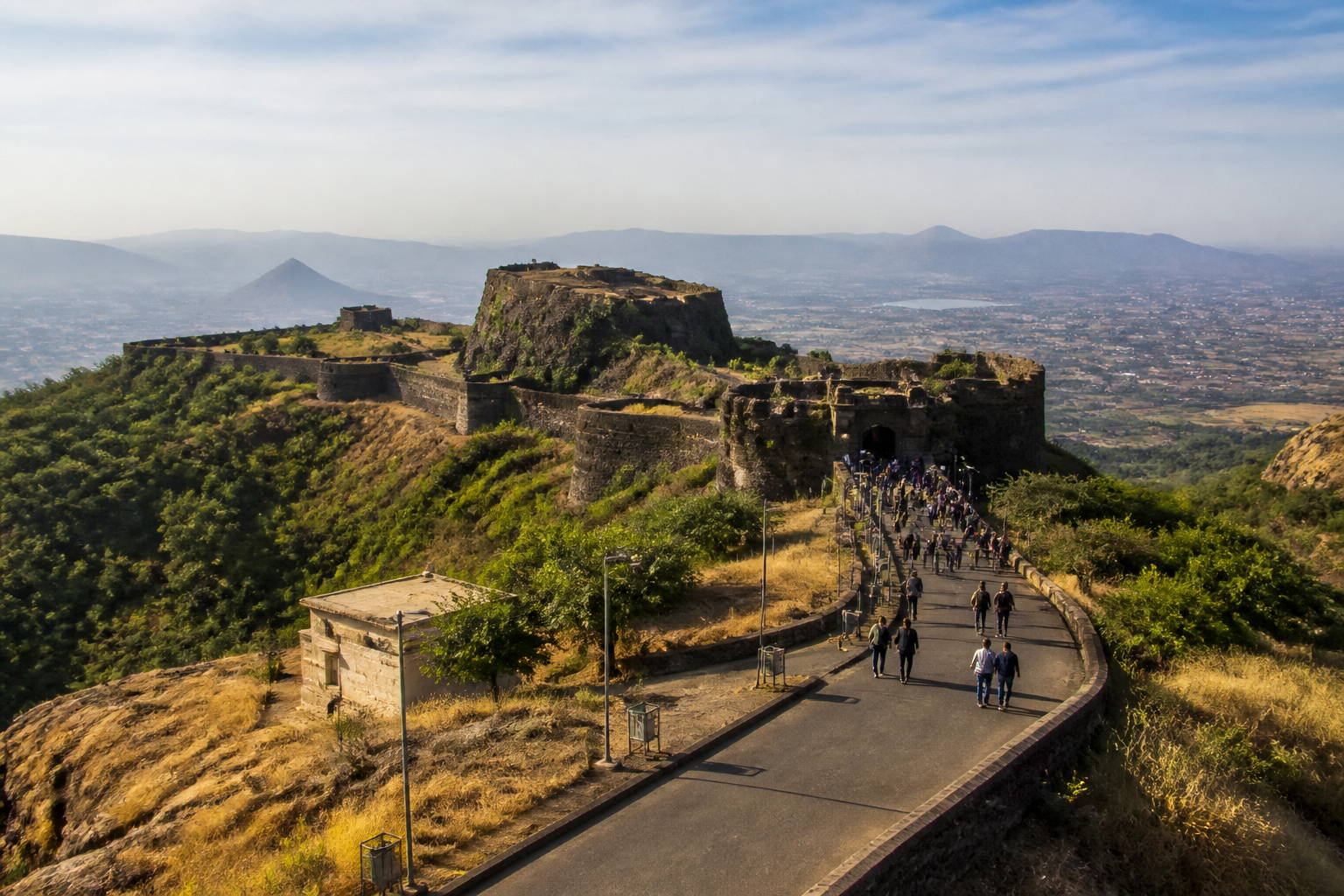
Even with that qualification, the direction of the reported trend is clear: Maharashtra is being positioned as a major multi-destination tourism state rather than a market centred on a single city. Mumbai remains the principal metropolitan gateway and a destination in its own right. Pune adds an urban, educational and cultural dimension. Beyond the two cities, the state’s tourism geography includes the Ajanta and Ellora caves, forts in the Sahyadris, the Konkan coastline, religious destinations and tiger reserves such as Tadoba-Andhari, Melghat and Navegaon-Nagzira.
That spread creates a distinctive infrastructure challenge. A visitor arriving in Mumbai may depend on an international airport, suburban rail, metro corridors, taxis and hotels. The same visitor may then travel to a heritage site, a hill station or a protected forest through a chain of roads and local transport services managed by different public agencies. The quality of the overall journey is consequently determined by the weakest link in that chain. A well-connected gateway cannot compensate for poor last-mile access, inadequate sanitation or unmanaged congestion at a destination.
The report also links tourism growth to accommodation capacity. It says Maharashtra recorded the opening of the highest number of hotels in the previous year, adding 10,000 rooms. This is a significant supply-side development, but the supplied material does not identify the locations, ownership patterns, approval status, occupancy rates or distribution of these rooms. Without that information, it is not possible to determine whether new capacity is concentrated in Mumbai and other major cities or whether it is reaching smaller destinations that receive seasonal visitor surges.
The distinction matters for urban planning. Hotel rooms are not isolated pieces of real estate. They require reliable water supply, sewage treatment, electricity, solid-waste collection, road access and emergency services. In coastal and hill destinations, construction can also interact with fragile landscapes and limited land availability. In heritage areas, new accommodation can generate demand while intensifying pressure on conservation zones and surrounding settlements. The number of rooms therefore indicates potential capacity, but not necessarily adequate or sustainable capacity.
The institutional framework described in the report includes the Maharashtra Tourism Development Corporation, which is conducting media campaigns, and the state tourism department, which has adopted what Additional Chief Secretary Sanjay Khandare described as an inclusive tourism policy. Khandare attributed the increase in foreign and domestic visitors to the state’s attractions, promotional activity and the new policy. These are official statements, but the supplied report does not detail the policy’s provisions, funding arrangements, implementation schedule or measurable targets.
That absence is important because tourism policy operates across several administrative boundaries. The tourism department and the tourism development corporation may promote destinations and develop selected assets, but municipal corporations control many urban services in cities. District administrations, public works agencies, transport authorities, forest departments, archaeology bodies and local governments may be responsible for roads, protected areas, monuments, visitor facilities and regulation. A rise in visitors can expose gaps between these institutions even when the headline numbers are positive.
Maharashtra’s tourism model is also geographically unequal by design. Mumbai offers the state’s strongest international connectivity and a large hospitality market. Pune is connected to a broad metropolitan and regional economy. Destinations such as Lonavala and Mahabaleshwar are more dependent on road travel and weekend demand. Forts, beaches, religious sites and wildlife reserves have different visitor seasons, carrying capacities and service requirements. Treating all of them as a single tourism market can obscure the operational needs of individual places.
The domestic tourism figures underline the scale of this challenge. The report says visits rose to 27.56 crore in 2025 from 4.36 crore in 2021. These figures are described as tourist visits rather than necessarily unique individuals, and the supplied material does not explain the counting method. A person visiting more than one destination may generate multiple visits. That distinction affects how authorities estimate demand for transport, accommodation and public services. It also affects comparisons between states and between domestic and foreign tourism.
Foreign tourist figures present a similar measurement question. The report refers to visits and places Maharashtra second nationally, but it does not provide the state ranked first, the source table or a breakdown by nationality, purpose, length of stay or destination. Those variables would help determine what kind of infrastructure is required. Business travellers in Mumbai, heritage tourists visiting Aurangabad and wildlife visitors travelling to Vidarbha may have different mobility patterns and different requirements from local authorities.
The available evidence therefore supports a narrower conclusion than the promotional language surrounding the figures. Maharashtra appears to be experiencing strong tourism growth across both domestic and foreign segments, and the state has added hotel capacity while promoting a broad portfolio of destinations. The material does not yet establish whether public infrastructure has expanded at the same pace, whether benefits are distributed across regions or whether the increase has produced sustained local employment and revenue.
For cities, the central question is not simply how to attract more visitors. It is how to manage tourism as an urban and regional system. Mumbai’s role as a gateway connects it to destinations far beyond its municipal boundaries. Transport bottlenecks, airport access, intercity rail services and road conditions can determine whether visitors disperse across the state or remain concentrated in a few established centres. At destination level, crowd management, parking, sanitation, conservation and public safety become as important as marketing.
The next stage of scrutiny should focus on the original Tourism Ministry data, the methodology behind the visit counts, the distribution of the reported 10,000 hotel rooms and the operational details of Maharashtra’s new tourism policy. These would clarify whether the reported growth represents a durable expansion of the state’s tourism economy and whether its infrastructure institutions are prepared for the demand. The figures show momentum; they do not, on their own, show capacity.
