


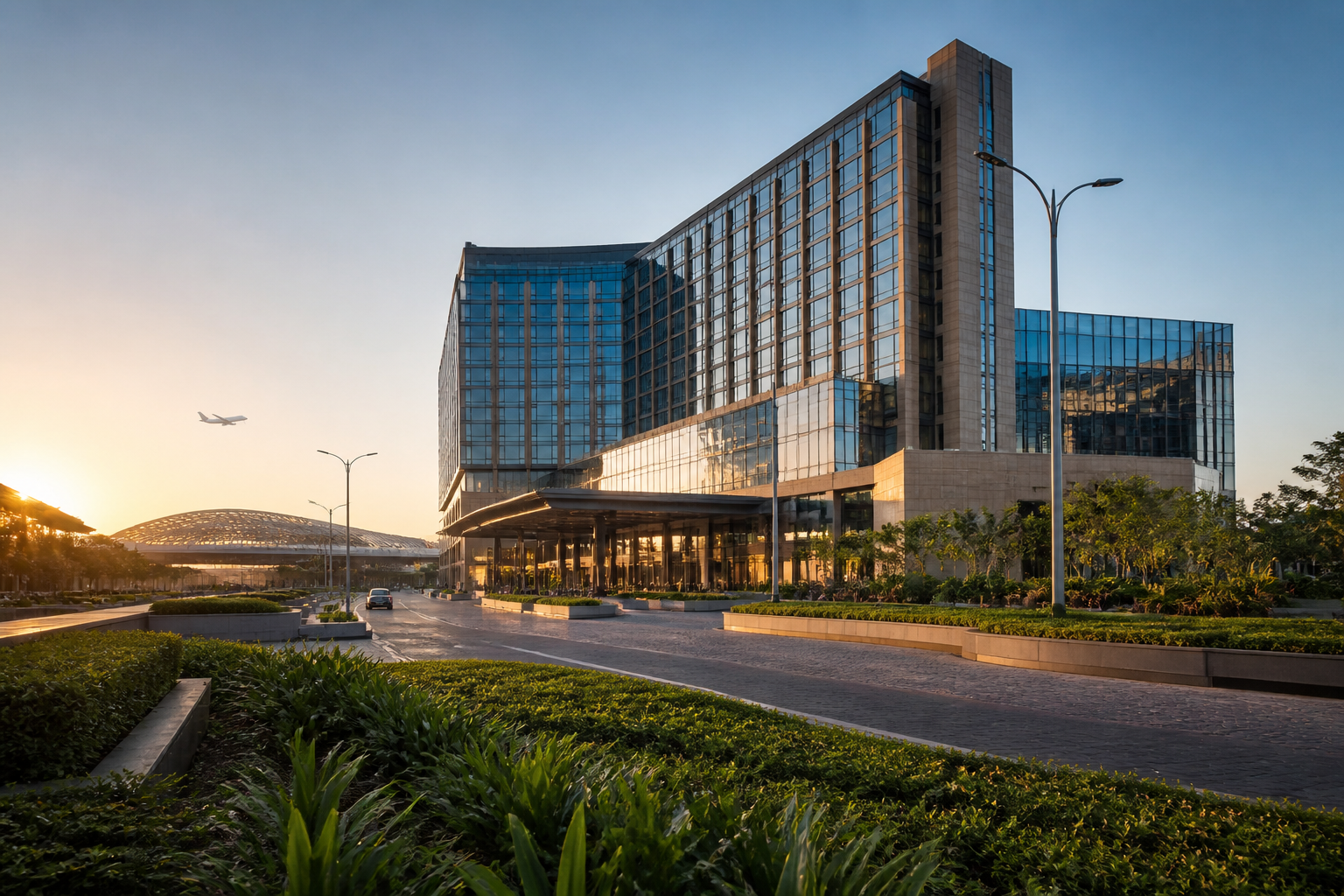
Chalet Hotels’ plan to reach about 5,500 hotel keys by FY30 is more than a capacity expansion. It marks a change in how the company intends to participate in India’s urban hospitality and commercial real estate markets: not only by owning hotel assets, but also by combining third-party operations, franchise agreements and properties under its own Athiva brand.
The company currently has approximately 3,389 operational keys and an announced pipeline of close to 2,300 keys, according to managing director and chief executive officer Shwetank Singh, who spoke to PTI in an interview reported by Moneycontrol. If the announced projects are completed as stated, Chalet’s total portfolio would rise to around 5,500 keys by FY30.
That shift places the company’s expansion at the intersection of two different businesses. One is the capital-intensive ownership and development of hotel assets. The other is the operation or branding of hotels where the company may not carry the same level of ownership exposure. Singh described the company as having moved beyond a “pure asset-ownership model” and said all three formats would remain in play.
The distinction matters because hotels are urban infrastructure as well as commercial assets. Their development depends on airport access, business districts, transport networks, land availability and the emergence of new employment and consumption centres. A hotel portfolio spread across airports, suburban business districts and emerging urban locations reflects the changing geography of commercial activity, even when the company’s immediate objective is financial and operational growth.
Chalet’s announced projects include a 380-room Taj hotel at Delhi Airport. Approximately 70 rooms are expected to open by the end of the current financial year, according to the company. The project is a franchise-led example of the model Singh outlined, with the property operating under the Taj brand rather than Chalet’s own Athiva identity.
Other projects are scheduled across different locations and timelines. Ritz-Carlton Hyderabad, Hyatt Regency Airoli and a hotel in Udaipur are expected to come online in FY29. The Pune Yerawada project, which was recently announced, is targeted for FY31. The dates indicate that the announced pipeline is not a single construction cycle but a sequence of projects at different stages of development and expected delivery.
The geographic spread also shows how hotel development is being linked to multiple urban contexts. Delhi Airport represents a major aviation and business gateway. Airoli is part of the extended Mumbai metropolitan region’s commercial landscape, while Pune Yerawada sits within a city that has developed as a significant technology, manufacturing and services centre. Hyderabad and Udaipur bring different demand profiles and urban settings into the company’s portfolio. The supplied company disclosures do not provide project-level details on land, approvals, construction progress or expected investment, so the precise status of each development remains unstated.
Athiva is central to Chalet’s attempt to build a proprietary brand. Launched in 2025, the brand initially had a pipeline of around 900 keys. The company has since added approximately 380 keys through recently announced projects in Pune and Hyderabad, taking the Athiva pipeline to around 1,200-1,300 keys, Singh said.
The decision to concentrate on one in-house brand rather than introduce another suggests a preference for building scale around a defined operating platform. Singh said Chalet was not conceptualising another hotel brand and that its focus was entirely on establishing Athiva. The company’s remaining projects will continue to include hotels operated by established third-party brands or developed through franchise arrangements.
This creates a portfolio with different forms of control and exposure. A hotel such as the Ritz-Carlton can give the owner access to an established international brand and operating system. A franchise property such as the Taj hotel can use a recognised customer-facing identity while remaining part of Chalet’s development portfolio. Athiva, by contrast, gives Chalet greater responsibility for defining the brand and building its operating presence. The interview does not disclose how revenue, margins, capital costs or operating responsibilities differ across the three formats.
The hotel expansion is taking place alongside a sizeable commercial real estate portfolio. Chalet currently has around 2.4 million square feet of commercial space in operation and another 900,000 square feet under construction. The overall portfolio is expected to reach approximately 3.2-3.3 million square feet of commercial space.
Singh said hospitality would remain the company’s mainstay despite this commercial real estate presence. That statement establishes the hierarchy within Chalet’s portfolio: commercial space is a significant part of the business, but hotel development and operations remain the primary strategic identity. It also separates the company from a pure office or commercial property developer, even as both segments may depend on similar urban growth patterns.
The relationship between hotels and commercial space is important in locations where business districts, airports and mixed-use developments reinforce one another. Commercial buildings can generate weekday demand from employees, visitors and corporate travel, while hotels can support conferences, business meetings and short-term stays. The supplied material does not establish whether Chalet’s hotels and commercial assets are integrated within the same developments, so any such relationship cannot be assumed for the announced projects.
The expansion plan is also notable for what the company has not quantified. Chalet is evaluating additional greenfield and brownfield opportunities, but it has not set a separate target beyond the announced pipeline. Greenfield projects typically involve developing a new asset on a previously undeveloped or unused site, while brownfield opportunities involve existing or previously developed sites; however, the company has not provided a breakdown of the opportunities under consideration.
Singh said the company had multiple conversations underway at any given time, while reiterating that the announced pipeline remained the immediate focus. This keeps the formal growth target tied to projects already disclosed rather than to possible acquisitions or future announcements. It also leaves open the question of how much additional capacity could eventually be added, since no separate target has been set for the opportunities being evaluated.
Funding is another constraint that can shape the pace and structure of hotel expansion. Singh said Chalet was well funded on its balance sheet and believed it could execute the announced projects without substantially increasing debt. The company did not provide, in the supplied interview, a project-by-project funding plan, capital expenditure figure or updated debt number. The statement therefore establishes management’s position on funding capacity, but not the detailed financial requirements of the pipeline.
For urban markets, the significance of the plan lies in the range of assets and operating arrangements it brings together. The portfolio is not being built around one hotel category, one city or one ownership structure. It includes an airport hotel, properties associated with established international and domestic brands, a proprietary brand pipeline, and a commercial real estate platform that is still expanding.
The plan also illustrates how hospitality companies can grow without relying exclusively on direct ownership. Third-party operations and franchise arrangements can allow a company to participate in hotel development while using external brands or operating platforms. An owned brand can pursue a different form of scale, but it also requires the company to build recognition and operational consistency over time. Chalet’s stated three-model approach therefore spreads its expansion across different forms of brand and operating control.
What the evidence confirms at this stage is a clear numerical and strategic ambition: approximately 5,500 hotel keys by FY30, based on 3,389 operational keys and a pipeline of about 2,300 keys. It also confirms the planned role of Athiva, the schedule disclosed for several projects, the growth of the company’s commercial space portfolio and management’s assertion that the announced expansion can be funded without a substantial increase in debt.
What remains uncertain is equally important. The supplied material does not establish construction progress for every project, approval status, expected investment, operating performance by brand, or the financial contribution of the commercial portfolio. It also does not indicate whether the company’s evaluation of additional greenfield and brownfield opportunities will result in further announcements. The next milestones are the opening of the initial rooms at the Delhi Airport Taj hotel, progress on the FY29 projects and further development of the Athiva pipeline.
