


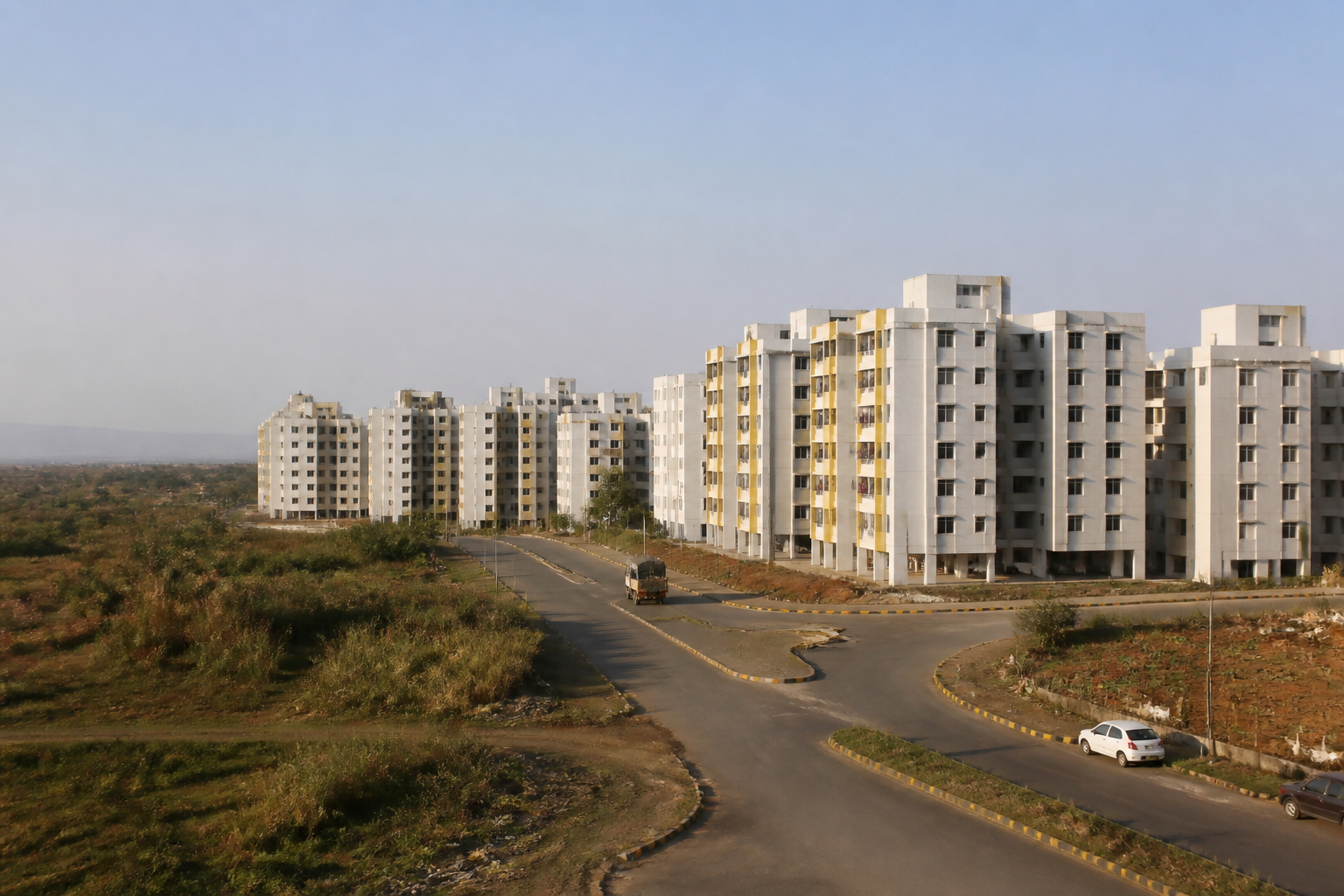
A proposal to offer 6,500 vacant Pradhan Mantri Awas Yojana homes in Khoni and Shirdhon to Mumbai’s mill workers has brought an old housing dispute into sharper focus. The homes are being considered for a group that has waited for rehabilitation for years, but the same stock has also been proposed for the resettlement of encroachers from the Sanjay Gandhi National Park.
The immediate question is whether these homes will go to mill workers or to the Forest Department for rehabilitation. The larger issue is how MHADA allocates housing when public stock remains unsold, multiple claimant groups require resettlement and the authority is under pressure to recover the cost of completed projects.
According to the report, the Konkan Board has built a large number of PMAY homes in Khoni and Shirdhon, located in the Mumbai Metropolitan Region. The homes have reportedly been offered through more than two lotteries, but some units remain unsold. They are also being offered under a first-come, first-served arrangement. Despite these efforts, approximately 6,500 homes remain vacant.
The reported size of the homes is about 350 square feet. Their inability to sell has become a concern for the board, which is now considering alternative institutional buyers. The Forest Department has asked MHADA for vacant homes to rehabilitate people described in the report as encroachers from the national park area and has indicated its willingness to purchase the units.
The Konkan Board has consequently sent a proposal for the 6,500 homes to the Forest Department. The reported value of the transaction is between Rs 1,000 crore and Rs 1,100 crore. However, the Forest Department has not yet granted final approval. The proposal therefore remains subject to an administrative decision and cannot be treated as a completed transfer.
At the same time, the same housing stock has now been placed before mill worker organisations. The proposal was discussed at a meeting between the Konkan Board and representatives of mill workers. The organisations have not given final approval, and their responses have reportedly been mixed. Some have expressed support for the option, while others have opposed it.
The price is central to that response. MHADA Konkan Board chief officer Dr Vishal Rathod said the original cost of the homes is approximately Rs 17.5 lakh per unit. The board is examining whether all applicable subsidies can be applied to bring the price down to about Rs 9.5 lakh. That figure is described as a possible price, not a final approved rate.
This distinction matters. A housing proposal can be publicly discussed before the eligibility criteria, subsidy structure, payment schedule, location terms and allotment process are settled. In this case, the available information establishes that MHADA has presented the option to worker organisations, but it does not establish that the workers have accepted it or that a final allotment decision has been issued.
The mill workers’ housing question has remained unresolved for more than one lakh workers, according to the report. The search for alternatives reflects the difficulty of addressing that demand through a single redevelopment or rehabilitation route. The Khoni-Shirdhon proposal offers an available pool of completed homes, but it also raises questions about location, affordability and whether the units meet the expectations of beneficiaries who have historically sought housing connected to Mumbai’s mill lands.
The dispute is therefore not only about the number of homes. It is also about the relationship between housing stock and housing need. MHADA has vacant units that it wants to sell. Mill workers represent a long-standing claimant group seeking homes. The Forest Department represents another public authority seeking accommodation for a rehabilitation programme. Each claim is connected to a different administrative objective, even though all three depend on the same 6,500 units.
The report indicates that MHADA’s immediate concern is to sell the vacant homes. Dr Rathod said the units would be given to whichever party first takes a final decision to purchase them. This approach places speed of disposal at the centre of the allocation process. It also means that the outcome may depend on which institution completes its approval and financing process first, rather than on a final, publicly settled hierarchy among the claimant groups.
That creates a policy tension. Housing built under a public scheme is expected to serve an identified social purpose, but completed units also carry financial and operational costs when they remain vacant. The longer the homes remain unsold, the longer the board’s capital remains tied up in inventory. The available report does not provide details of the construction cost, maintenance burden, subsidy accounting or the reasons why earlier lotteries failed to sell all the units. Those gaps are important for understanding the full economics of the proposal.
The reported price difference also shows why the homes may now be more attractive to mill workers. A reduction from an original price of about Rs 17.5 lakh to a possible subsidised price of Rs 9.5 lakh would materially change affordability. However, the report does not specify which subsidies would apply, whether every eligible worker would receive the same benefit or how the final price would be calculated. Until those details are confirmed, the lower figure remains an objective under consideration rather than a guaranteed purchase price.
The location of the homes is another unresolved part of the policy question. Khoni and Shirdhon are outside the traditional mill districts of central Mumbai, where many mill workers and their families have historically lived and worked. The supplied report does not provide travel times, transport connectivity, social infrastructure or employment access for the proposed sites. It therefore cannot establish whether the location would be practical for beneficiaries. Those factors would need to be part of any final assessment by worker organisations and authorities.
For the Forest Department, the proposed purchase would provide a ready-made stock of homes for a rehabilitation exercise linked to the Sanjay Gandhi National Park. The report does not state the number of households to be rehabilitated, the eligibility rules or the implementation timeline. It also does not say whether the Forest Department has secured the funds required for a purchase estimated at Rs 1,000 crore to Rs 1,100 crore. The absence of final approval leaves the proposal at the discussion stage.
The competing proposals illustrate a recurring administrative challenge: a single housing project can become the solution to several different public problems. Vacant homes may be treated as unsold real estate, rehabilitation stock or an answer to a historic worker entitlement. Each description carries different eligibility rules and public expectations. Without a clearly stated allocation framework, the same units can remain subject to competing claims even after construction is complete.
The case also highlights the limits of using lotteries and first-come, first-served sales to dispose of affordable housing. The homes have reportedly been offered through more than two lotteries and later through a first-come, first-served system, yet approximately 6,500 remain vacant. The available evidence does not explain whether the issue was price, location, documentation, financing, lack of awareness or beneficiary eligibility. It does show that releasing homes through repeated sales mechanisms has not resolved the underlying mismatch between the units and potential buyers.
For mill workers, the next step is a final decision by their organisations. For MHADA, the immediate task is to determine whether the proposed price and subsidy structure can be approved and whether the worker option can be implemented before another institution purchases the homes. For the Forest Department, the pending decision is whether to accept and finance the proposal for rehabilitation.
What is confirmed is that MHADA has presented the 6,500 Khoni-Shirdhon homes as an option for mill workers while a separate proposal involving the Forest Department remains pending. What is not confirmed is the final price, the allotment mechanism, the beneficiary list or the identity of the eventual purchaser. The next decisive development will be the final response from the worker organisations and the Forest Department’s decision on whether to approve the purchase.
