


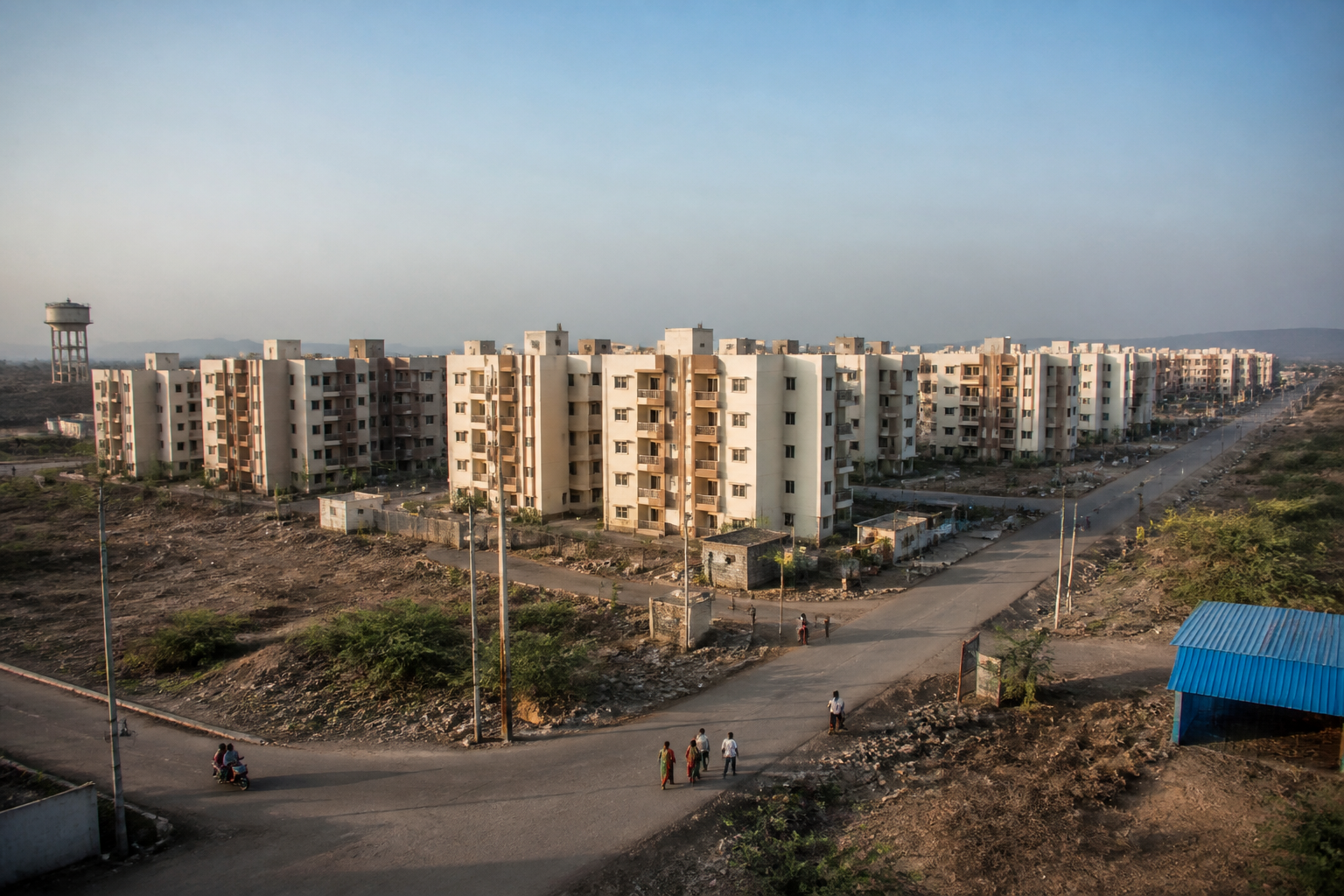
A housing project can be physically complete and still fail to become a neighbourhood. That is the central lesson emerging from Solapur’s Ray Nagar housing project, where around 14,000 beneficiaries have reportedly taken possession of homes but only an estimated 600 to 650 families are actually living there. The project was designed to provide 30,000 homes for unorganised and powerloom workers under the Pradhan Mantri Awas Yojana (Urban). Its current problem is not simply a shortage of houses. It is the absence of the economic and civic conditions that make those houses usable.
The project is located at Kumbhari, on a 350-acre site outside Solapur. According to the report, 15,000 homes in the first phase have been completed, and possession of approximately 14,000 homes has been handed over. Yet most beneficiaries have declined to move in. The reported reasons are direct: employment remains concentrated in the city, public bus services are inadequate, and essential services such as hospitals, markets and primary and secondary schools are not operating in the housing complex.
This produces a striking divergence between administrative completion and lived completion. On paper, a household has received a house when construction is finished, a key is handed over and possession is recorded. In practice, a household can occupy that home only when it can reach work, educate children, access healthcare, buy daily necessities and travel at a cost compatible with its income. Ray Nagar’s experience suggests that the first definition of delivery has advanced much faster than the second.
The distance involved is central to the problem. The complex is reported to be between 12 and 20 kilometres from Solapur city. Residents who continue to work in the city must therefore make a daily journey between Ray Nagar and their workplaces. The report cites travel costs of about Rs 200 to Rs 250 a day. For a worker earning between Rs 350 and Rs 400 in daily wages, that transport bill can consume more than half of the day’s income before food, education and other household expenses are considered.
One beneficiary quoted in the report describes the basic contradiction: a family may receive a legally secure home, but cannot live there if there is no work nearby. This is not an unusual tension in large peripheral housing schemes. Land is often cheaper at the urban edge, allowing authorities to assemble large sites and build at scale. But the same peripheral location can separate residents from the labour markets on which their livelihoods depend. When transport is unreliable or costly, the housing subsidy does not compensate for the recurring cost of reaching employment.
Ray Nagar was conceived as a large public housing intervention. The state and central governments decided to build 30,000 homes for unorganised and powerloom workers at Kumbhari. The Maharashtra Housing and Area Development Authority, or MHADA, was appointed the special planning authority for the area. MHADA distributed housing assistance to beneficiaries, while construction and other responsibilities were assigned to the Ray Nagar Federation, according to the report. The project was inaugurated in 2019, and a ceremonial distribution of keys took place in January 2024.
The sequence is important. The project had a formal beginning, a construction phase, a possession process and a public handover. But the low occupancy rate indicates that settlement has not followed automatically from these milestones. Of the 15,000 homes reported to have been completed, only about 600 to 650 families are presently living in the complex. That represents roughly 4 to 4.3 per cent of the completed first-phase homes, based on the figures cited in the report. The number of people who have accepted possession is therefore more than twenty times the number of families reportedly residing there.
The project does have some physical infrastructure. The report mentions water supply, electricity, broad roads, a water-treatment plant and anganwadis. These facilities matter, but they do not by themselves create an urban settlement. A road can connect a housing complex to the city, but its usefulness depends on regular and affordable transport. An anganwadi can support young children, but older children still need schools. Electricity and water can make a dwelling habitable, but a family also needs income, healthcare, food shops and public services close enough to use.
This is why the response now being planned by MHADA is focused on employment. The authority is preparing a framework to create jobs within or near the housing complex, using plots originally designated for different uses. The report says the state government has approved changes in the use of 30 to 40 plots, clearing the way for service industries. Proposed activities include textile work, bidi production, papad, pickle and spice production, garment activity and other non-polluting small industries. MHADA is expected to handle the permissions required for these uses.
The proposed approach reflects a shift from a housing-only model towards a walk-to-work model. Instead of expecting workers to move first and solve their livelihood problem later, the plan is to bring employment closer to the homes. The idea is particularly relevant for a population that includes unorganised workers and powerloom labourers, whose incomes may be daily or irregular and for whom transport costs are especially significant.
However, the source material does not establish how many jobs the proposed industries could create, when they would begin operating, how plots would be allocated, or whether the proposed activities would provide incomes comparable to existing employment. It also does not establish whether the transport and social infrastructure identified as missing has already been funded or delivered. These gaps matter because employment planning can fail in the same way as housing planning if it is treated as a land-use adjustment rather than as a functioning economic ecosystem.
The district administration has reportedly begun coordinating a broader response. A review meeting on Ray Nagar was held four days before the report, according to the Ray Nagar Federation. The meeting considered small industries such as papad, incense sticks, bidi and garments. It also included instructions to start new municipal bus services, complete the Kumbhari-to-Ray Nagar road urgently and begin Marathi, Telugu and Urdu-medium schools from the next academic year. The report also mentions a recent provision of additional funding for the new road.
These measures reveal the scale of the settlement challenge. The response is not limited to constructing commercial space. It requires transport, roads, schools and local economic activity to arrive together. If any one of these systems is delayed, the incentive to relocate remains weak. For households already employed in Solapur, moving to Ray Nagar before these systems are operational could mean accepting higher costs and longer journeys. For households that do not move, the project risks remaining a collection of occupied units rather than a functioning neighbourhood.
The Ray Nagar case also raises questions about how public housing success is measured. Construction targets and possession numbers are relatively easy to count. They are visible administrative outputs. Occupancy, commuting cost, school access, healthcare access and household income after relocation require longer-term monitoring. Yet these are the indicators that show whether a housing project has actually improved urban living conditions.
The difference between possession and occupancy is especially significant. Possession indicates that a beneficiary has received access to a dwelling. Occupancy indicates that the dwelling fits into the household’s economic and social life. In Ray Nagar, the reported figures show that these two stages remain far apart. The result is a large investment in housing that has not yet produced a correspondingly large resident population.
The project’s location also illustrates the trade-off between scale and integration. A 350-acre site can support tens of thousands of homes, but its success depends on its relationship with the surrounding city. If employment remains elsewhere, the settlement needs reliable and affordable mobility. If the distance makes daily travel unaffordable, employment must be brought closer. If families are expected to stay, schools, markets and healthcare must be available. These are not supplementary amenities; they are part of the practical infrastructure of housing.
What the available evidence confirms is that Ray Nagar’s immediate problem is under-occupancy linked to the lack of local employment, transport and services. It also confirms that authorities are attempting to address the problem through land-use changes, small-industry planning, bus services, road improvements and schools. What remains uncertain is whether these interventions will be implemented at the required speed and scale, how many households will ultimately relocate, and whether the planned industries will provide stable livelihoods.
The next milestones are therefore operational rather than ceremonial: the start of local industries, the approval and execution of plot-use changes, new bus services, completion of the Kumbhari-Ray Nagar road, and the opening of the proposed schools. Until those systems are functioning, the gap between the homes handed over and the families living in them will remain the clearest measure of the project’s unfinished urbanisation.
