


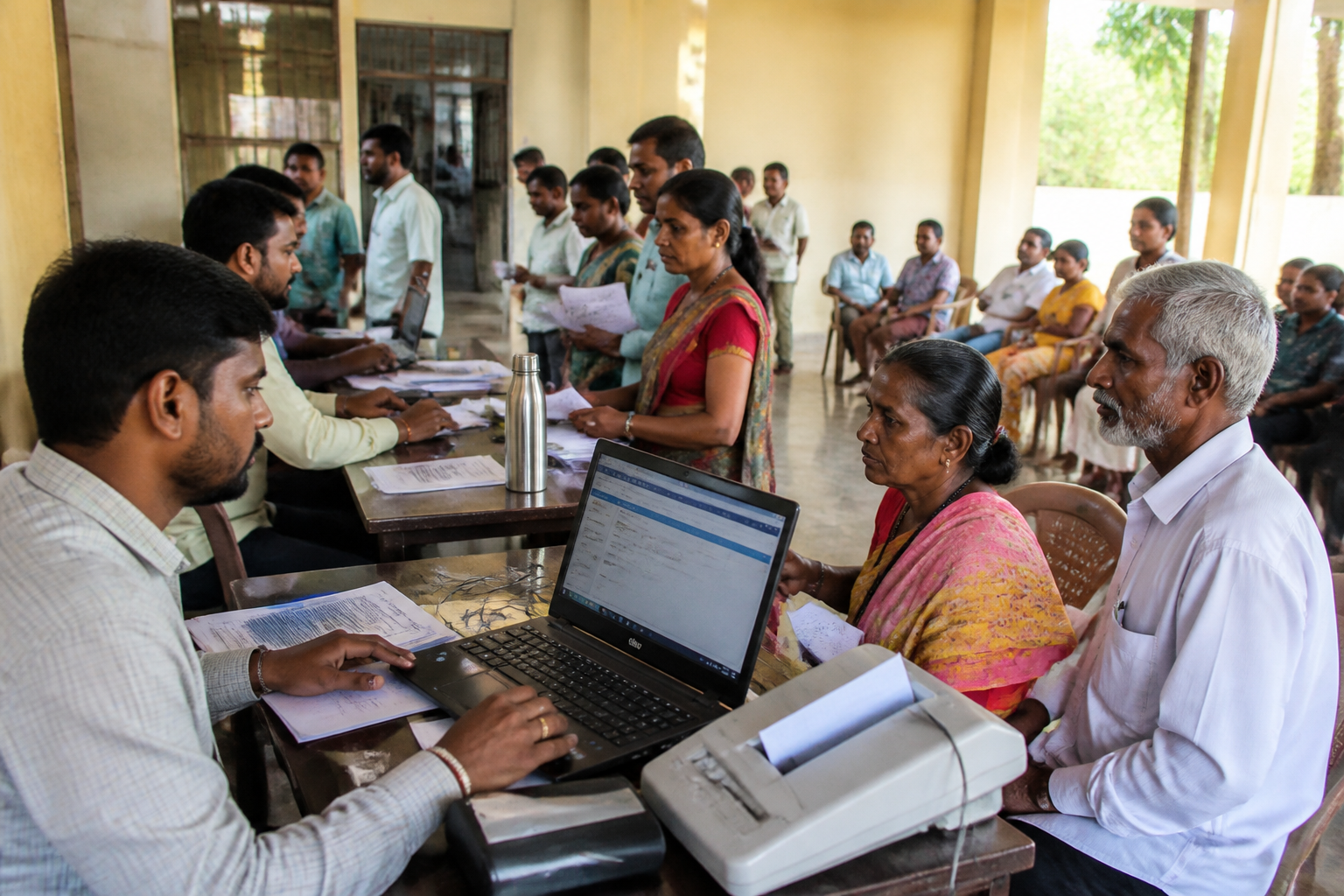
Karnataka’s Praja Seva campaign has been launched as an attempt to move routine government access away from distant offices and closer to citizens in villages, hoblis and taluks. The initiative, announced at Kudligi in Vijayanagara district, is intended to cover all 224 taluks and bring ministers, legislators and officials into regular public grievance meetings.
The programme is significant not because it creates a new entitlement by itself, but because it proposes a different delivery channel for existing government services. Applications relating to pensions, land disputes, government benefits, khata transfers, guarantee schemes, houses and residential sites are to be received, examined and, where possible, resolved through local meetings. The campaign also promises legal assistance to poor and marginalised applicants involved in cases before the tahsildar, assistant commissioner or deputy commissioner.
The model places public access at the centre of administrative performance. District in-charge ministers are expected to visit their districts twice a month, while ministers and legislators are to lead meetings at taluk, hobli and panchayat levels. Where elected representatives are unavailable, officials are expected to travel to panchayat centres and conduct smaller meetings with residents.
That arrangement reflects a familiar problem in Indian urban and rural administration: the formal existence of a service does not guarantee that people can reach the office, understand the process or obtain a decision. A resident seeking a pension, land record correction or housing-related approval may have to identify the correct department, submit documents, track the application and respond to objections. For people with limited income, mobility, legal knowledge or access to digital systems, each additional step increases the cost of securing a public service.
Praja Seva is designed to reduce some of those access costs by bringing multiple officials and service interfaces into a single local setting. The guidelines reported by Prajavani require Gram One and Karnataka One centres to be opened at campaign meetings so that applications received from the public can be digitised. This is an important operational feature: the campaign is not intended only as a public hearing, but also as an intake and registration mechanism.
The distinction matters. A public meeting can collect complaints without creating a reliable administrative record. Digitisation can create a traceable application, but only if the information is accurately entered, assigned to the correct authority and followed through to a documented decision. The campaign’s effectiveness will therefore depend on what happens after the meeting rather than on attendance figures or the number of applications received.
The reported guidelines establish a review schedule for applications and complaints received on Saturdays. Their status is to be examined on the following Wednesday. The tahsildar and taluk panchayat executive officer are assigned the 9 a.m. to 11 a.m. review window, the assistant commissioner is to examine cases from 11 a.m. to 1 p.m., and the district commissioner’s level is scheduled to review matters from 3 p.m. to 5 p.m.
This timetable creates an administrative chain for escalation. It also separates newly received complaints from older unresolved cases, requiring the two categories to be managed independently. That separation could help identify accumulated backlogs instead of allowing fresh applications to be mixed with cases that have remained pending for longer periods. However, the supplied account does not establish how many unresolved cases currently exist, what service-level standards apply to each category or how departments will report their disposal rates.
The campaign also provides for applicants dissatisfied with the disposal of a complaint to appear again and present their grievance in person. This offers a second opportunity for review, but the quality of that process will depend on whether applicants receive clear written reasons when their requests are rejected. The reported programme specifically states that applicants should be told why an application was rejected. Such explanations are essential in land, housing and welfare matters, where an unclear refusal can force a citizen to repeat the same process without knowing what must be corrected.
The promise of free legal services adds another layer to the programme. Land disputes, revenue matters and access to government benefits often involve procedures that are difficult for applicants to navigate without assistance. Providing legal support could help people distinguish between a missing document, an administrative delay and a dispute requiring formal adjudication. At the same time, the report does not specify the number of lawyers involved, the eligibility process, the legal services authority responsible or how cases will be tracked after referral. Those details will determine whether the legal assistance is a functioning service or only a referral promise.
The campaign’s stated philosophy is that government services are a right and should reach people at their doorstep. In practical terms, that philosophy shifts the burden of access from the applicant to the administration. Instead of expecting citizens to repeatedly travel to offices, the state is expected to organise meetings, provide local registration facilities and coordinate decisions across administrative levels.
That shift is particularly relevant to land and housing administration. The services listed in the campaign include land disputes, khata transfers, housing and site applications, and an initiative described as “Bhoomi Guarantee” under which property e-khatas are to be prepared and delivered to residents. Property records are a core part of the built environment: they shape ownership claims, taxation, access to loans, transfers and the ability to obtain approvals. Errors or delays in those records can prevent households from using property securely even when they physically occupy it.
Yet the source material does not provide details about the e-khata rollout, the number of properties covered, the responsible agencies or the technical system being used. It therefore establishes the government’s stated objective but not the scale or current performance of the property-record effort. That distinction is important when assessing the campaign’s broader claims.
Praja Seva also connects governance with political representation. Ministers and legislators are expected to participate at different administrative levels, while officials retain responsibility for receiving and resolving complaints. This creates a hybrid structure in which elected representatives provide public access and administrative officers process or decide cases. The arrangement may make government more visible to citizens, but it also requires clear boundaries. A public representative can help raise a complaint, while the legally competent official must still apply the relevant rules and record the decision.
The launch included video conferences with officials and representatives involved in programmes in Tumakuru, Dharwad, Hassan, Kalaburagi, Davanagere and Mysuru districts. The reported interaction indicates an effort to connect local meetings to state-level monitoring. However, the account does not provide a common dashboard, district-wise targets or a public reporting format. Without those elements, it may be difficult for residents to compare performance across districts or determine whether a complaint has moved from reception to resolution.
The campaign’s own stated measure of success is the number of people whose problems are resolved, rather than the number of people who attend or the number of applications submitted. That is a useful test because high footfall can show demand but cannot show administrative performance. A credible assessment would need to distinguish between applications accepted, cases transferred, cases resolved, cases rejected with reasons and cases still pending.
The programme also contains proposals outside the immediate grievance-redressal framework. These include an internal reservation for students educated exclusively in rural government schools within an existing rural reservation provision, and the proposed use of the honorific “Tr” by teachers after a cabinet discussion. The report does not indicate that either measure has been finally implemented. They should therefore be treated as announcements or proposals, not established policy outcomes.
For cities and towns, the campaign is relevant even though its launch is rooted in a rural district. Taluk headquarters, municipal areas and expanding settlements are often where land records, housing applications, welfare access and local administration intersect. As Karnataka’s urban edges grow, disputes over sites, property records, public services and eligibility can become more complex. A system that coordinates these issues closer to residents could reduce administrative friction, but only if records are accurate and departments act within defined timelines.
The available evidence confirms the launch, the stated geographic coverage, the proposed meeting structure and the review timetable. It does not yet confirm how many applications have been resolved, whether officials have sufficient staff, how cases will be audited or whether the public can track individual applications online. Those are the indicators that will show whether Praja Seva becomes a durable administrative system or remains a recurring public-contact exercise.
The next stage is therefore implementation. The campaign’s Saturday meetings, Wednesday reviews, local digitisation centres and escalation procedures will create the first operational record. That record will reveal whether doorstep governance can convert access into decisions, and whether the promise to bring government closer to citizens is matched by measurable resolution of their problems.
