


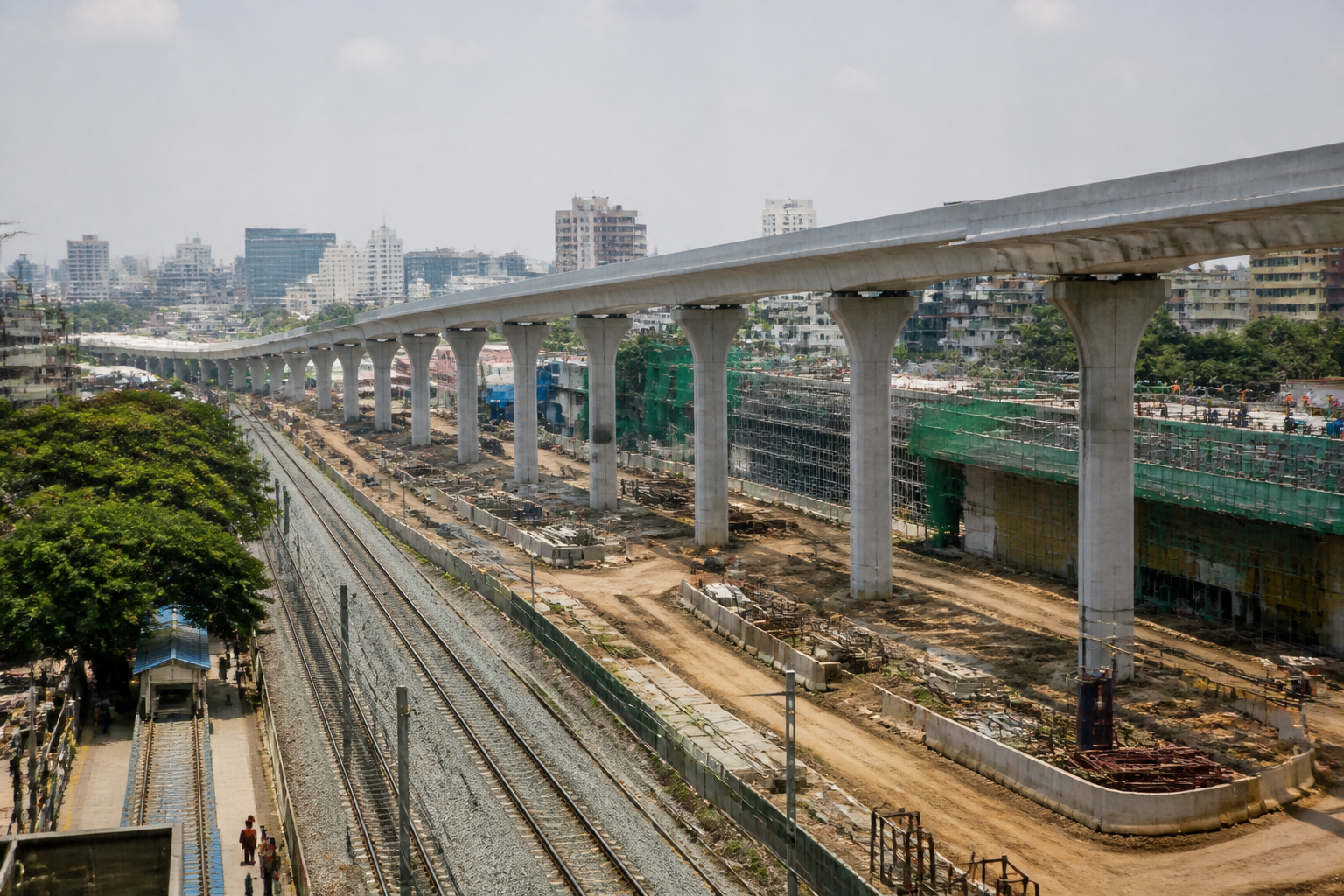
Bengaluru’s suburban railway project has entered a more active construction phase after years of delay, with work advancing on the Mallige and Kanaka corridors. The reported progress includes station construction, elevated and ground-level sections, bridge works, land acquisition and plans for a depot. But the same update also points to a familiar infrastructure problem: completing civil works does not automatically guarantee that a railway will begin operations on schedule.
The immediate development is significant because the project is intended to add a regional rail layer to Bengaluru’s overburdened transport system. According to the report, the 27-kilometre Mallige corridor between Baiyappanahalli and Chikkabanawara and the 46-kilometre Kanaka corridor between Heelalige and Rajanukunte are both seeing construction activity. Together, the two corridors involve 30 stations, with a mix of elevated and ground-level infrastructure.
The Karnataka Rail Infrastructure Development Company, or K-RIDE, has completed the land acquisition required for the two corridors and their stations, the report said. Land required for some road overbridges and railway overbridges remains to be acquired. That distinction is important. Land acquisition for the core alignment and stations can allow visible construction to proceed, while unresolved parcels at crossings and bridge locations can still interrupt continuity across the route.
The Mallige corridor illustrates this uneven progression. Its 12 stations include Benniganahalli, Kasturi Nagar, Seva Nagar, Banaswadi, Nagawara, Kanakanagar, Hebbal, Mattikere, Yeshwanthpur, Shettihalli, Mederahalli and Chikkabanawara. Construction has been divided into two packages, with Cemindia and NCC identified as contractors for station works.
K-RIDE is targeting the start of suburban train services between Chikkabanawara and Yeshwanthpur in 2028. That section is approximately seven kilometres long. The report also identifies a 5.80-kilometre ground-level and elevated section between Yeshwanthpur and Chikkabanawara, for which work is estimated at Rs 106.29 crore. The target depends not only on the physical completion of this section but also on the integration of track, stations, signalling, testing and train supply.
The project carries the imprint of an earlier setback. Larsen & Toubro, which had initially secured contracts for parts of the work, withdrew from the contract, bringing construction to a halt. Work that the company left incomplete between Benniganahalli, Banaswadi and Hebbal is now being continued, according to the report. Small and large bridges, drainage and retaining walls are under construction, with completion targeted within two years.
A double-decker structure between Yeshwanthpur and Mattikere has been awarded to Cemindia, and a work order is expected shortly. At Soladevanahalli, a tender has been issued for a depot on 26 acres. The depot is estimated to cost Rs 200 crore. These components are not peripheral additions. A railway needs operating and maintenance facilities, safe transitions between structures, drainage and crossing infrastructure before passenger service can be sustained.
The Kanaka corridor is at a different scale. Its 46-kilometre alignment includes ground-level station works at Heelalige, Singena Agrahara, Hoskuru, Ambedkar Nagar, Carmelaram, Bellandur, Doddanekkundi, Kaggadasapura, Channasandra, Horamavu, Thanisandra, Jakkur, Muddanahalli and Rajanukunte. Elevated stations are planned at Marathahalli, Hennur, Hegde Nagar and Yelahanka. K-RIDE officials told the publication that the station civil works have been taken up in two packages.
The contrast between the two corridors shows why project progress must be read as a series of linked deliverables rather than a single construction percentage. A station may be under construction while bridge land is pending. An elevated structure may advance while the depot tender remains unresolved. Civil works may approach completion while rolling stock and signalling remain on a separate schedule. The project’s actual opening date will be governed by the slowest critical component.
K-RIDE managing director Lakshman Singh said several processes are still pending but that progress over the past few months showed the project was moving in the right direction and at the required pace. He attributed the work to coordination among the state government, the Railway Ministry and partner institutions. That statement identifies coordination as a central implementation condition. The project crosses institutional boundaries, and its completion depends on decisions that cannot be taken by a single construction contractor alone.
The next phase of the suburban railway plan is also being shaped by sequencing. K-RIDE is currently giving greater priority to the C-2 and C-4 routes, represented in the report by the Mallige and Kanaka corridors. The Sampige corridor, planned to connect KSR Bengaluru with Devanahalli through Kempegowda International Airport, is expected to be taken up later. That corridor is 41 kilometres long. The Parijata corridor, connecting Kengeri and Whitefield over 35.5 kilometres, is expected to follow.
The Sampige and Parijata corridors have received approval from Indian Railways, but they are not yet at the same implementation stage as the active packages. A joint survey for land acquisition has been undertaken. After the survey is completed, the land acquisition process is expected to begin under the Karnataka Industrial Areas Development Board Act. The report says statutory notification could take about a year, with the acquisition process expected to start by the end of the year or early the following year.
This sequencing has a practical consequence for Bengaluru. The city is not receiving one finished suburban rail network at once. It is receiving a staged programme in which the first operating sections must establish the system while later corridors move through approval, survey and acquisition. That makes the performance of the initial corridors especially important: delays in the first phase can affect public confidence in the entire network, while successful commissioning can provide a working base for expansion.
The most immediate risk identified in the report concerns trains themselves. A rolling-stock supply contract has only recently been signed, with delivery expected to begin in 18 months. The report also cites transport expert Rajkumar Dugar, who warned that delivery could take more than two years. He compared the risk to the delay experienced on Bengaluru’s Yellow Line, where infrastructure completion was followed by a wait for trains.
The comparison is not a claim that the suburban railway will necessarily face the same outcome. It highlights a broader project-management issue: construction and operations are separate timelines. Even if stations, bridges and track works progress according to schedule, passenger service requires trains to be available, tested and compatible with the signalling system. The report says the project is adopting a European signalling model, creating additional requirements related to trial operations and other technical processes.
That issue changes the meaning of the 2028 service expectation for the Chikkabanawara-Yeshwanthpur section. The date is best understood as a stated target rather than a guaranteed opening. The supplied report establishes that civil works are progressing, land acquisition is largely complete for the two main corridors and contracts or tenders are moving forward. It also establishes that bridge land, train delivery and technical testing remain potential sources of delay.
The evidence therefore presents a project that has moved beyond prolonged inactivity but has not yet reached operational certainty. The visible acceleration in construction is important, particularly after the withdrawal of an earlier contractor. Yet the project still has to convert separate packages into a functioning railway. That conversion will require alignment among K-RIDE, the state government, Indian Railways, contractors, rolling-stock suppliers and technical agencies.
For Bengaluru’s transport planning, the larger question is whether infrastructure delivery can be synchronised across the full system. The suburban railway’s value will depend on more than route length or station count. It will depend on whether completed sections can begin service, whether unresolved land parcels are cleared, whether depots and bridges are delivered, and whether trains and signalling are ready when civil works finish.
The current update confirms genuine movement on the Mallige and Kanaka corridors. It does not yet establish a final commissioning date for the wider network. The milestones to watch are the completion of the Chikkabanawara-Yeshwanthpur section, issue of pending work orders, progress on bridge-related land acquisition, the Soladevanahalli depot tender, rolling-stock delivery and signalling trials. Those milestones will determine whether Bengaluru’s suburban railway moves from construction progress to passenger service.
