


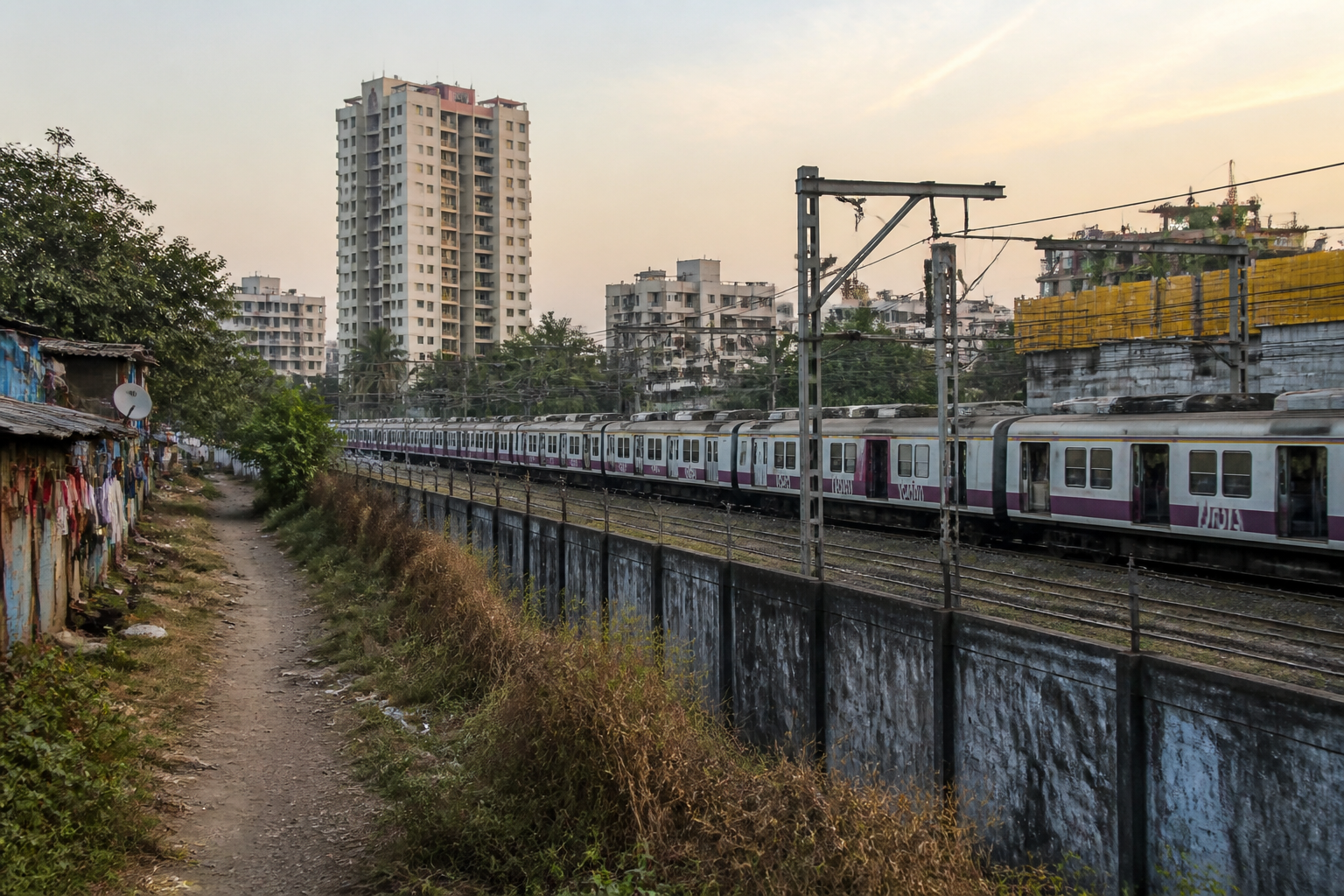
A 14-year-old boy’s death after he climbed onto a local train in the Thakurli Chole railway yard has brought attention to the risks created when railway land becomes part of the informal movement network of a growing suburb. The incident, reported by Loksatta, was recorded by Vishnunagar police as an accidental death. It also raises questions about how railway yards are accessed, monitored and separated from nearby residential areas.
According to the report, Yagnesh Suresh Shetty, a resident of Rajvaibhav NX housing society in the Ganeshnagar area of Dombivli West, went to the yard with two friends on Thursday evening instead of attending his regular private tuition class. The three boys reportedly entered an area where local trains kept aside from service at Kalyan railway yard are parked. Yagnesh then climbed onto the roof of one of the coaches using the coach ladder and a window for support.
His two friends were standing beside the coach and intended to take photographs of him on the roof, the report said. As Yagnesh tried to steady himself, his hand came into contact with a live electrical line on the roof. He was thrown to the ground after receiving an electric shock. His friends informed his family, following which relatives and residents of the housing society reached the railway yard. He was taken to the Kalyan-Dombivli Municipal Corporation’s Shastrinagar Hospital, where doctors declared him dead.
The account was provided by Yagnesh’s father, Suresh Shetty, to Vishnunagar police. The police registered an accidental-death case. Senior Police Inspector Ramchandra Chopde, Police Inspector Armya Kshirsagar, Assistant Police Inspector Abhijit More and Sub-Inspector Ravindra Lone reportedly visited the site after being informed of the incident.
The immediate facts establish the sequence described by the family and reported by the newspaper. They do not, by themselves, establish whether the boy entered through a breach, an open access point or another route, nor do they establish how frequently people enter the yard. Those details would require confirmation from the railway authorities and a site inspection. The available report does, however, identify a clear spatial problem: the yard is described as an open area located close to residential settlements and used by some residents as a route to Thakurli railway station.
That informal route is central to understanding the incident. The report states that many working residents from Ganeshnagar use the area as a middle route while travelling to the station. It also says that some young people visit the location for walking or recreation. A railway yard, however, is not simply an open urban passage. It contains parked rolling stock, tracks and live electrical infrastructure. When such a space is treated by residents as a shortcut or informal public area, the distinction between a restricted operational zone and a neighbourhood access route becomes difficult to enforce.
The account also points to a second layer of risk: the presence of parked trains may make railway infrastructure appear inactive or harmless. A stationary coach can be read as an object to climb, photograph or explore, particularly by children and teenagers. The presence of overhead electrical equipment is not necessarily visible as a danger to someone who does not understand the clearance and current involved. The report does not say whether warning boards, physical fencing, locked gates or other preventive measures were present at the point where the boys entered. That absence of information is itself important, because responsibility for safety cannot be assessed without knowing how the boundary was designed and maintained.
The incident therefore cannot be reduced only to a question of individual behaviour. The reported plan to take a mobile-phone photograph was a direct factor in the chain of events, but the opportunity to reach the roof of a parked train depended on access to the yard and to the coach. Urban safety is shaped by both behaviour and the environments in which behaviour occurs. Where restricted infrastructure is visually and physically accessible, warnings alone may not prevent entry, especially when a route has become familiar to local residents.
The report says that railway security personnel patrol the area. It also describes the yard as open and used by residents for movement. These two details need to be examined together. Patrols may deter some forms of trespassing, but they do not necessarily replace continuous physical separation at points where people regularly pass. Nor does the existence of a commonly used route mean that the route is authorised or safe. A route can become embedded in daily travel without being formally recognised in a station plan, municipal road network or railway access map.
This creates an institutional coordination problem. The surrounding housing societies and residents experience the space as part of the neighbourhood. The railway system operates it as a yard containing trains and electrical infrastructure. The police respond after an incident and record the death. The municipal hospital provides emergency care. Each institution has a different role, but the safety of the interface between them depends on whether the boundary is clearly identified and actively managed.
The supplied report does not identify the railway division responsible for the yard, the owner of the land, the agency responsible for fencing or whether any prior complaints had been made. It also does not state whether the railway authorities issued a response after the death. These are important unresolved facts. Without them, it would be premature to conclude that a particular agency failed in its duty. It is equally premature to assume that the incident was unforeseeable if the area had, as reported, become a regular passage for residents.
The location’s seasonal and local uses add to the complexity. The report says that vegetable cultivation is carried out in the area by some commercial growers between October and May. This suggests that the land is not experienced solely as railway operational space. Different users may enter or occupy the area for commuting, recreation or cultivation. Each additional use increases the importance of a clearly enforced boundary, because informal activity can normalise access to a place where trains and electrical systems remain present.
For residents, the practical concern is not limited to the death already recorded. It is whether the same access conditions remain after the incident. If the reported route continues to be used, children and adults may still approach parked coaches or cross railway land. If patrols are intermittent, the preventive system may depend too heavily on people recognising hazards that are not obvious. If a route is necessary for residents travelling to the station, closing it without providing a safe alternative could simply shift the problem to another informal crossing or path.
The evidence currently supports a limited but significant conclusion. The Thakurli railway yard accident occurred in a setting where a restricted railway space was close to housing and reportedly functioned as an informal route and recreational area. A teenager then climbed onto a parked local train and suffered a fatal electric shock. The incident shows how public movement, neighbourhood growth and railway operations can overlap in ways that create acute safety risks.
What remains uncertain is equally important. The available account does not establish the condition of the boundary, the location of entry, the presence or visibility of warnings, the frequency of patrols, or the railway authority’s response. Those questions should be answered through an official site assessment and direct responses from the railway administration and local authorities. The next stage of public scrutiny should focus not only on the circumstances of Yagnesh Shetty’s death, but also on whether the access conditions that made the incident possible have been identified and addressed.
