


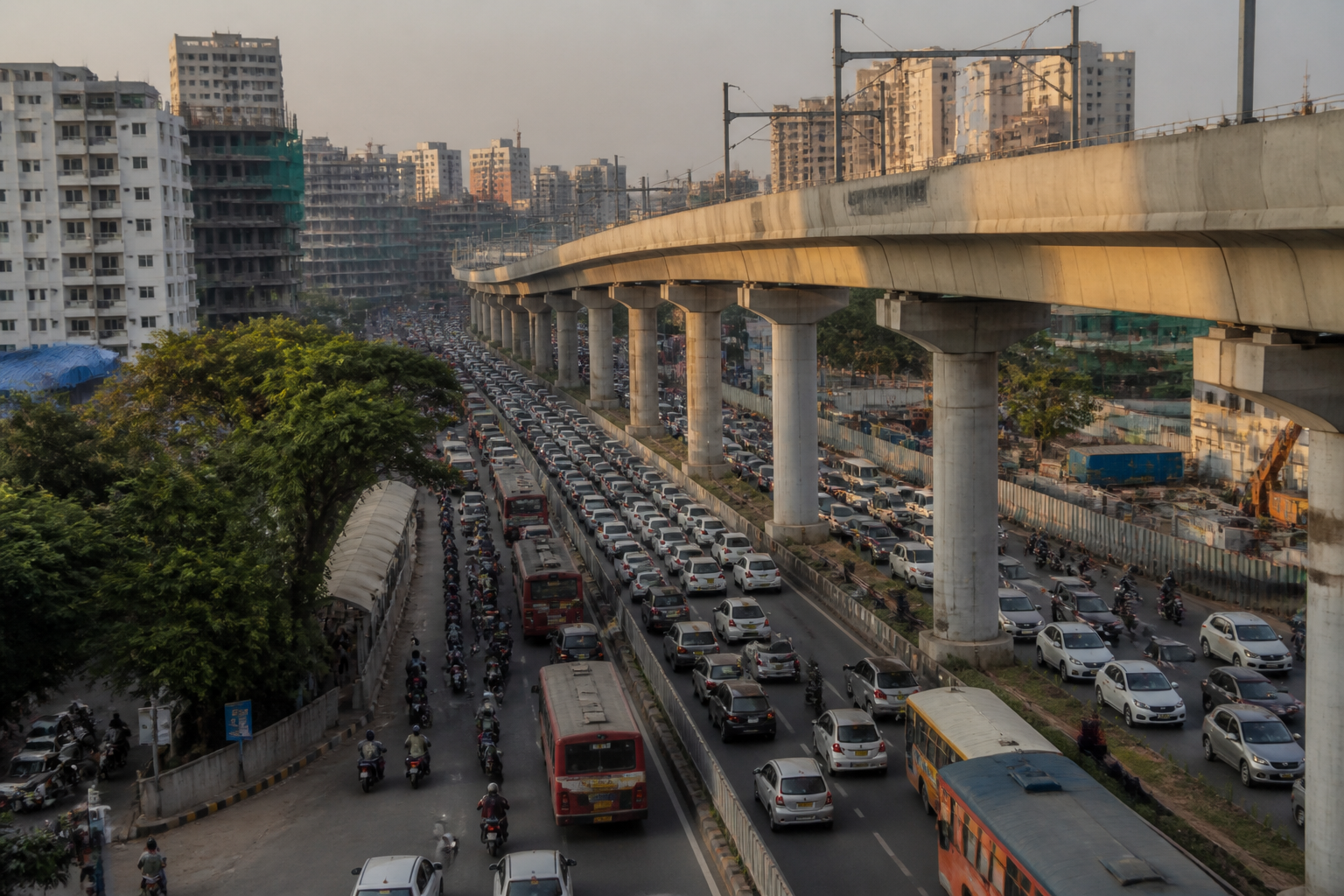
Pune’s transport crisis has produced another ambitious government promise. Speaking at the foundation-laying ceremony for Bajaj Finserv’s headquarters, Maharashtra Chief Minister Devendra Fadnavis said the city would become India’s fastest-transport city within the next three to four years. The claim rests on a broad package of infrastructure projects: an outer ring road, an inner ring road, underground routes, high-capacity express corridors, a rapidly expanding metro network and a stronger Pune Mahanagar Parivahan Mahamandal Limited, or PMPML.
The announcement is significant because it recognises that Pune’s congestion cannot be addressed through a single road, a single transit line or a limited set of junction improvements. The chief minister’s description presents the city’s mobility challenge as a network problem. Roads, mass transit, bypass infrastructure and bus services are expected to work together. But the same announcement also exposes the central difficulty facing Pune: a vision has been stated, while the operational details needed to judge its feasibility remain largely unspecified in the supplied report.
Fadnavis said several infrastructure works were already under way and that the remaining projects were being accelerated. The report identifies four major road-related components: the outer ring road, the inner ring road, underground routes and high-capacity express corridors. It also says that metro expansion is progressing and that PMPML is being strengthened. No project-wise completion dates, construction milestones, budgets, financing arrangements, route lengths or capacity figures were provided in the announcement as reported by Loksatta.
That absence matters. Transport performance is not measured only by the number of projects announced. It depends on whether each project reaches completion, how the components connect, how quickly people can transfer between modes and whether the network serves the locations where travel demand is concentrated. A ring road may divert through traffic and reduce pressure on central corridors, but it does not automatically improve daily journeys within the urban area. A metro line can move large numbers of passengers, but its effect depends on station access, service frequency, interchange design and connections to buses and other modes.
The same principle applies to high-capacity roads. They can add movement capacity in selected corridors, but their effect on congestion depends on junctions, bottlenecks, land-use patterns and the volume of new traffic generated around them. The chief minister’s announcement places these projects in a single mobility package, yet the available information does not explain how they will be sequenced or integrated. Without that information, the promise of a faster city remains a statement of intent rather than a measurable transport programme.
Pune’s transport problem has become more visible as the city’s employment and residential geography has expanded. The report links the government’s announcement to the city’s growing congestion and to the need to strengthen infrastructure. It also connects transport planning to the development of Bajaj Finserv’s new headquarters. The headquarters is expected to involve approximately 40,000 employees, according to the report. A road connecting the headquarters to the Mundhwa area and an additional bridge are to be constructed before the headquarters project is completed.
This commitment illustrates how large employment centres can influence public infrastructure priorities. A workplace with tens of thousands of employees can generate substantial daily travel demand. The access road and bridge may improve connectivity to the site, but the report does not specify whether the broader mobility plan will include a substantial public transport strategy for these workers. It also does not state how the additional demand will be distributed across roads, buses, metro services, walking routes or other modes.
The relationship between private development and public infrastructure therefore becomes an important part of Pune’s transport question. When major offices, technology districts and housing areas expand, public agencies must account for their combined impact rather than treating each project as an isolated access problem. In the supplied report, the immediate road and bridge commitment is clear, while the wider institutional arrangement for managing the site’s travel demand is not established.
The announcement also places metro expansion and PMPML strengthening alongside road construction. That combination is important because a city’s transport system needs both high-capacity corridors and flexible services that reach areas beyond fixed rail lines. Metro infrastructure can provide a rapid trunk connection, while buses can offer wider coverage and last-mile access. However, the report gives no details on the scale of PMPML’s proposed strengthening, such as fleet additions, route changes, operating frequency, depots or financial support.
The lack of such details makes it difficult to determine whether the proposed system is being planned as an integrated network or as a collection of parallel projects. Integration requires more than placing roads, metro lines and buses in the same announcement. It requires common planning, coordinated interchanges, compatible service patterns and clear responsibility for implementation. The chief minister’s statement indicates that the state government sees these elements as part of Pune’s future mobility system, but the available evidence does not yet show how that system will operate in practice.
Institutional coordination will be especially important. The event was attended by the Pune municipal commissioner, the district collector, the mayor and senior representatives of the Bajaj group, among others. Their presence reflects the number of public and private institutions involved in the city’s transport and development decisions. State authorities, the municipal corporation, district administration, metro agencies, PMPML and private developers each influence different parts of the urban system.
Such a multi-agency structure can make large infrastructure programmes difficult to deliver. Land acquisition, permissions, construction schedules, utility shifting, traffic management and funding decisions may fall under different authorities. The report does not identify a single delivery body for the complete transport package, nor does it describe a unified timetable. That is a key uncertainty because the three-to-four-year target covers a period in which several projects would need to advance simultaneously if the promised transformation is to be visible across the city.
The announcement also places Pune within Maharashtra’s wider economic strategy. Fadnavis said Mumbai and Pune were leading India’s financial technology ecosystem. He cited the state’s position in fintech investment and said the sector should also expand to Nashik, Chhatrapati Sambhajinagar and Nagpur. He further said Maharashtra had become a leading financial technology centre and that a special policy had been prepared to strengthen the state’s position in financial services, insurance and digital lending.
That economic context helps explain why Pune’s transport capacity has become a strategic issue. The city is not being discussed only as a congested urban area; it is also being positioned as an employment and investment centre. New offices and business activity can increase the need for reliable movement of workers, goods and services. At the same time, economic expansion can intensify congestion if transport capacity, housing and land use are not planned together.
The transport promise therefore has two distinct tests. The first is physical: whether the announced roads, metro expansion and underground or high-capacity routes are completed. The second is functional: whether they reduce travel friction for residents across the city rather than improving only selected development corridors. The supplied report establishes the government’s objective and lists the broad infrastructure response, but it does not yet provide the indicators needed to evaluate either test.
A credible assessment would require project-level information. That would include approved routes, construction status, expected opening dates, funding sources, land requirements, responsible agencies and links between each project. It would also require public information on metro and bus integration, the proposed role of PMPML, and the transport arrangements for major employment sites such as the Bajaj Finserv headquarters. None of those details should be inferred from a general political commitment.
For now, the evidence supports a narrower conclusion. Maharashtra’s government has acknowledged Pune’s congestion as a major urban challenge and has presented a multi-modal infrastructure response intended to transform the city within three to four years. The plan brings together ring roads, underground routes, high-capacity corridors, metro expansion and bus services. It also links transport delivery to the growth of large employment centres and to the state’s ambitions for Pune’s economic role.
What remains uncertain is whether the projects have the approvals, financing, institutional coordination and implementation schedules required to meet the stated target. The next meaningful developments will be project-specific: formal timelines, tender and construction milestones, details of the Mundhwa connection and bridge, and measurable plans for metro and PMPML integration. Until those are available, Pune’s promise to become India’s fastest-transport city is best understood as a broad policy direction awaiting a detailed delivery framework.
