


Huawei Enterprise AI Push Is Reshaping Industrial Infrastructure
The company is combining 5G, autonomous vehicles, cloud systems and operating software to build integrated technology platforms for mines and other industrial operators.
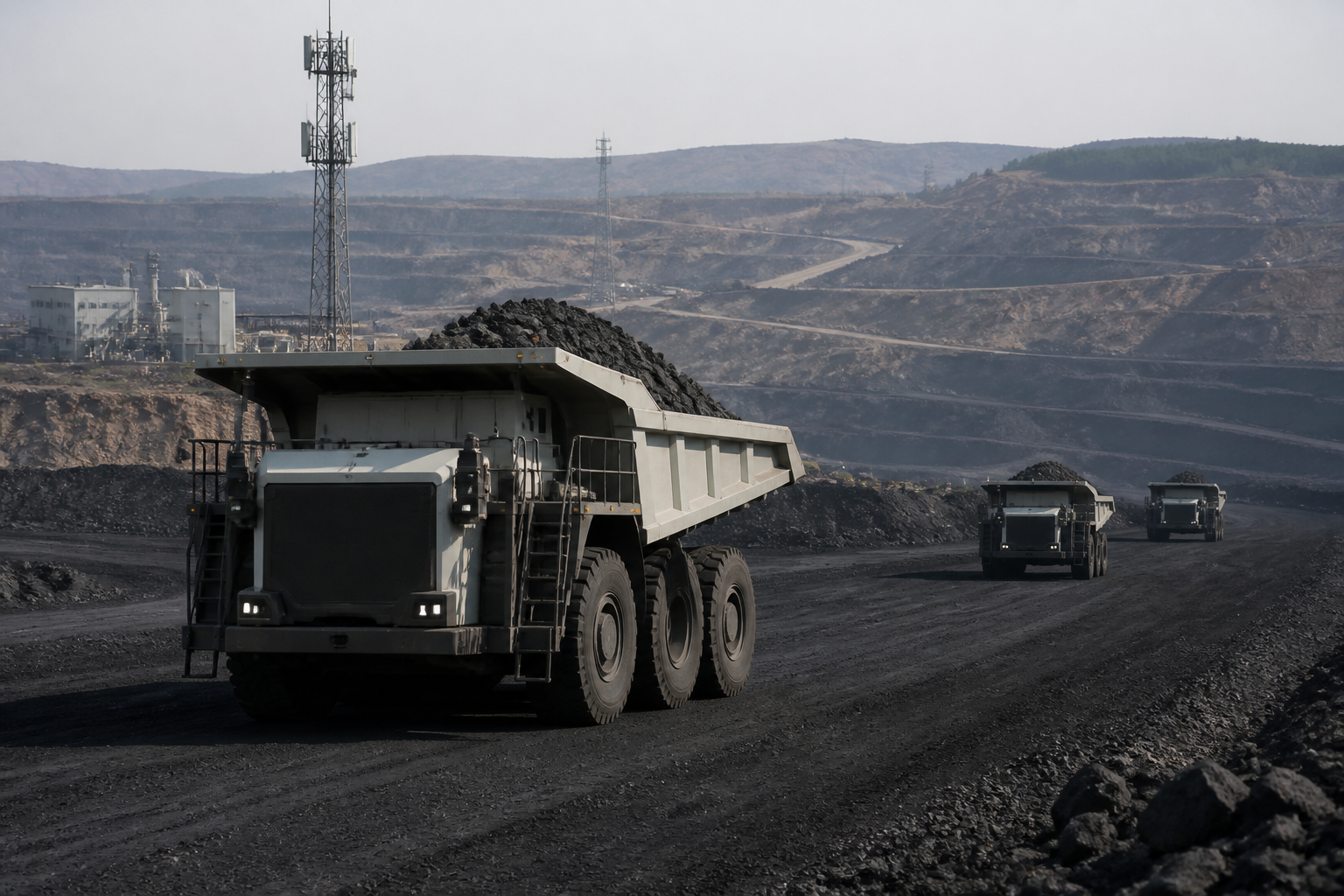
Huawei’s expanding enterprise business is becoming a test of how China’s industrial infrastructure may be reorganised around connected machines, artificial intelligence and fewer workers in hazardous environments. At the Yimin coal mine in China’s far north-east, about 100 autonomous lorries transport coal without drivers. The vehicles can operate through the night and in poor weather, and can change their own batteries.
The mine, operated by state-owned power utility Huaneng, covers about 42 square kilometres. Each autonomous lorry can carry 90 tonnes of coal. According to Zhao Yaozhong, a Huaneng manager cited in the supplied report, the deployment has allowed 120 workers to move to posts outside the pit, reducing their exposure to dust and danger. If the planned expansion proceeds, another 300 autonomous lorries could be added over the next three years, with most people eventually removed from operations inside the pit.
The significance of Yimin is not limited to the vehicles themselves. The mine demonstrates Huawei’s attempt to sell a connected industrial system rather than a single piece of equipment. Base stations provide 5G coverage across the site, enabling the autonomous-driving system to function. The driving technology was developed from Huawei’s automotive work and adapted to the size of the lorries and the conditions inside the mine. An operating system called Mine HarmonyOS controls the mine’s operations, while artificial-intelligence software from Huawei’s cloud division is used in some underground mines to interpret geological data and monitor equipment remotely.
This integration reflects a strategy Huawei announced in 2021, when it created specialised enterprise teams known as juntuan, or “army corps”. These teams were designed to combine capabilities from across the company for particular customer groups, including airport operators and oil-and-gas companies. The mining unit is one example of how telecommunications, vehicles, cloud computing, artificial intelligence and consumer software can be assembled into a common industrial platform.
The approach marks a shift from the way technology infrastructure is usually purchased. A mine, airport or transport operator may traditionally buy network equipment, vehicles, monitoring software and industrial controls from separate suppliers. Huawei’s model seeks to connect those layers through its own hardware and software ecosystem. The potential value is not simply faster communication or more efficient vehicles, but the ability to coordinate an entire operation through shared data and automated controls.
The Yimin deployment also illustrates the physical conditions that make industrial automation attractive. Open-pit mines are large, repetitive and potentially dangerous workplaces. Their vehicles follow defined routes and perform tasks that can be measured continuously. Removing drivers from the pit does not eliminate the labour requirement; in the account supplied, workers were reassigned to positions outside the most hazardous area. But it changes where people work and how operations are supervised. More vehicles can operate for longer periods, while control and monitoring functions increasingly move away from the site itself.
That pattern has implications beyond mining. Huawei’s enterprise teams are aimed at industries where infrastructure is already being digitised or where the operating environment is difficult for people. Transport systems, airports, energy facilities and manufacturing plants all depend on networks of machines, sensors and control rooms. In such settings, the usefulness of artificial intelligence depends not only on the quality of a model but also on reliable connectivity, compatible software, physical equipment and institutional willingness to automate.
The report presents Huawei’s enterprise division as a response to pressure on its traditional businesses. American sanctions have restricted the company’s access to some advanced technologies, including leading-edge semiconductors. Western governments have also imposed restrictions on Huawei products because of concerns that they could be used for Chinese state surveillance. Those restrictions have contributed to a decline in the company’s foreign sales over the past decade.
At the same time, China’s nationwide 5G build-out is described as having largely concluded. That reduces the scope for growth based solely on selling network infrastructure. The enterprise business gives Huawei another route into the domestic market by applying its existing communications expertise to mines, transport systems, electricity grids and other physical operations.
The financial information in the supplied report points to both the importance and the limits of this strategy. Huawei last separately disclosed enterprise revenue in 2022, when the division accounted for about one-fifth of total sales and was the fastest-growing part of the group. Andy Wu, who runs the mining unit, said the business was profitable but operated on extremely thin margins. The limited disclosure makes it difficult to assess the division’s current scale or its contribution to Huawei’s overall performance.
Huawei reported on August 31 that net profit fell 37% year on year in the first half of 2026 even as revenue increased 10%. The company attributed pressure in its consumer division to higher memory-chip prices linked to the data-centre boom. Huawei also spent a quarter of its revenue on research and development during the first six months of the year, as it worked to replace American technology it could no longer access.
These figures help explain why enterprise infrastructure matters to the company. Industrial systems can create longer-term relationships with customers than consumer electronics, because they are integrated into operations and may require continuing software, maintenance and network support. But thin margins indicate that growth in this area does not automatically translate into high profitability. The business must absorb the cost of adapting general-purpose technologies to specialised industrial environments.
The policy environment in China is nevertheless supportive. The government is promoting practical applications of artificial intelligence in manufacturing, transport and electricity-grid operations. That creates demand for systems that connect public or industrial infrastructure to automated decision-making. It also gives technology companies a domestic market in which large deployments can be tested across strategically important sectors.
For cities, the most important lesson is that automation is increasingly being built into infrastructure rather than added as a separate digital service. Driverless transport, remote equipment monitoring and AI-assisted logistics depend on the same basic urban systems: dependable communications networks, electricity, data centres, control rooms and clear lines of institutional responsibility. As these systems expand, the boundary between technology infrastructure and public infrastructure becomes less distinct.
The model also raises questions that the supplied material does not resolve. It does not establish how reliably the autonomous lorries perform over longer periods, how many workers may be displaced as the system expands, or how responsibility is assigned when automated equipment fails. Nor does it provide independent comparisons with other suppliers or details of the safety standards governing the deployments. Those gaps matter because industrial automation transfers some risks from human operation to software, networks and remote supervision.
What the Yimin mine confirms is narrower but significant: Huawei is using its telecoms, automotive, cloud and software capabilities together to enter the operating systems of physical industries. The company’s enterprise strategy is therefore not simply a search for new customers. It is an attempt to make its technology central to how mines, transport systems and other infrastructure-intensive businesses function. The next indicators will be the scale of new deployments, the economics of the enterprise division and the extent to which the model moves from individual industrial sites into wider transport and urban systems.
