


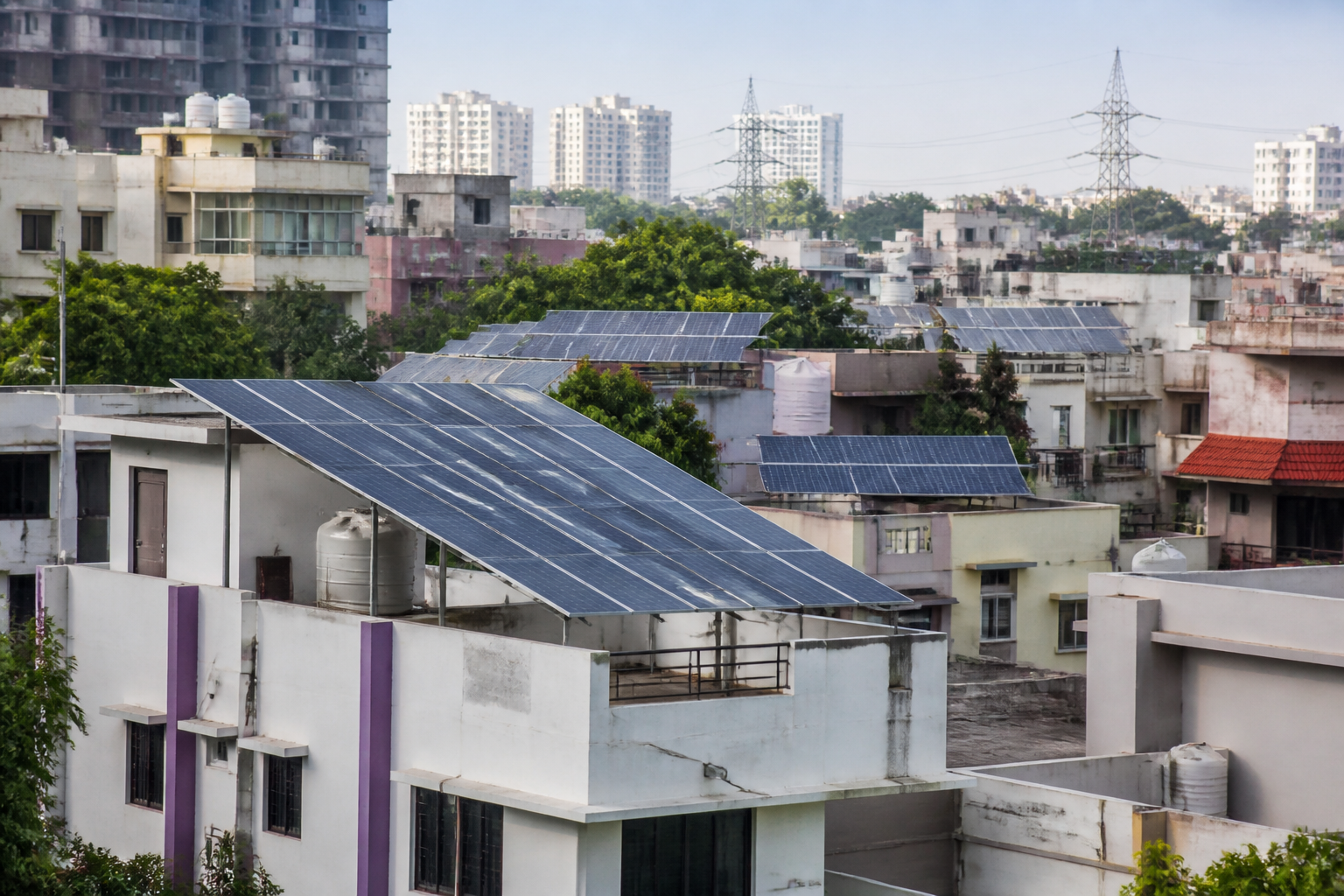
The latest data from the PM Surya Ghar: Muft Bijli Yojana places India’s residential rooftop solar programme at a significant but uneven stage of expansion. Uttar Pradesh and Maharashtra led installations in August, while the national monthly installation pace declined from July. The contrasting signals rapid cumulative growth alongside a month-on-month slowdown show that India’s household energy transition is moving beyond policy announcement and into the more difficult phase of scaling delivery.
The programme had crossed 16,000 MW of installed residential rooftop capacity by August, according to data reported by The Hindu BusinessLine and compiled by JMK Research & Analytics. The monthly figures put pan-India installed capacity at 16,185.48 MW, covering 54,65,417 households. A later cumulative figure cited in the same report places total installed capacity at 16,369 MW, with installations covering roughly 55.28 lakh households. The difference appears to reflect different reporting points or scopes within the available programme data, but both figures indicate the scale reached by the scheme.
The more important story is the pace at which the programme has grown. More than 80.62 lakh applications have been received for residential rooftop solar plants, while installations have crossed 46.44 lakh. The programme has released more than ₹30,885 crore in subsidy. The reported figures indicate that demand is substantially larger than completed installations, leaving a sizeable pipeline between households expressing interest and systems being commissioned.
That gap is visible in the August numbers. India recorded around 1,407 MW of residential rooftop capacity installed during the month, down approximately 11.6 per cent from the 1,592 MW recorded in July. At the same time, more than 4.48 lakh applications were received, compared with over 3.57 lakh installations. The fall in monthly additions therefore did not represent a collapse in demand. Instead, it suggests that the programme’s next challenge is converting applications into functioning rooftop systems at a consistent rate.
The state-level figures underline how uneven that conversion process can be. Uttar Pradesh led August installations with 228.95 MW, followed by Maharashtra at 212.51 MW and Andhra Pradesh at 192.39 MW. Uttar Pradesh received 89,901 applications and recorded 73,709 installations during the month. Maharashtra received 79,679 applications against 61,110 installations. Andhra Pradesh recorded 22,557 applications and 14,648 installations.
These numbers show both demand and delivery, but they do not establish why the gap differs between states. The supplied data does not identify whether the causes lie in installer availability, approvals, financing, subsidy processing, distribution-company procedures, consumer readiness or other implementation constraints. That limitation matters because rooftop solar is not delivered through a single national mechanism. The household, installer, subsidy system and local electricity distribution network all have to function together before an application becomes an operating asset.
The programme’s cumulative figures nevertheless indicate a sharp acceleration. The reported installation rate rose from 5,038 installations per day in October 2025 to nearly 16,328 a day in July 2026, an increase of about 3.2 times over three quarters. The scheme is described as benefiting roughly 1 lakh households every six days. Even with the August slowdown, this trajectory suggests that rooftop solar has moved into a mass-adoption phase rather than remaining limited to early adopters or demonstration projects.
The structure of the subsidy is central to that expansion. Under the scheme, households can obtain up to 300 units of free electricity each month, depending on system capacity, generation and consumption. The value available to each household is therefore linked not only to the installation of panels, but also to how much electricity the system produces and how the household uses power. Where applicable, surplus electricity can be exported to the distribution network, creating an additional channel of value for the consumer.
This arrangement changes the relationship between households and the electricity system. A rooftop installation is not only a private energy asset; it can also become a point of interaction with the distribution network. The official description of participating households as “prosumers” both consumers and producers of electricity captures that shift. However, the available report does not provide state-level information on how much surplus power is being exported, how many systems are using net metering or how distribution companies are managing the additional two-way flow.
That missing information is important for understanding the programme’s infrastructure implications. Residential rooftop solar places new demands on installation networks, subsidy administration, inspection and connection procedures. It also requires distribution systems to accommodate electricity generated at multiple household locations. The August gap between applications and installations, and the difference between applications and completed systems in the leading states, show that the programme’s performance cannot be measured by applications alone.
The national renewable-energy context adds another layer to the story. India added 35.13 GW of net new power-generation capacity in the first half of 2026, according to figures cited from the Institute for Energy Economics and Financial Analysis. Renewables accounted for more than 87 per cent of that addition, or 30.58 GW, while solar alone contributed 26.34 GW. These figures describe the broader power system rather than only household rooftops, but they place the residential programme within a larger expansion of renewable generation.
Residential rooftop solar has a distinctive role in that expansion. Large renewable projects add generation at utility scale, while household systems distribute generation across the built environment. The latter can connect energy production to electricity demand where people live, but it also makes implementation dependent on millions of individual decisions and local service networks. The programme’s large application pipeline reflects household interest, while its installation data reflects the capacity of the system to respond.
The geographical concentration of August installations also raises questions about the institutional conditions that support adoption. Uttar Pradesh, Maharashtra and Andhra Pradesh together accounted for the leading reported installation figures, but the supplied material does not establish whether their performance resulted from larger populations, stronger administrative execution, higher installer capacity, greater consumer demand or other factors. Without that additional evidence, the state rankings should be read as a description of current deployment, not as a definitive comparison of programme effectiveness.
The figures also show why monthly performance needs to be treated cautiously. A single month’s decline from 1,592 MW to around 1,407 MW does not erase the three-quarter acceleration in daily installations. Nor does a large application count guarantee that all interested households will receive systems within a specific timeframe. The programme is simultaneously expanding quickly, carrying a substantial backlog of applications and experiencing fluctuations in monthly additions.
The central urban and infrastructure question is therefore not whether rooftop solar has found demand. The data clearly shows that it has. The question is whether the administrative, commercial and distribution systems around the household can scale at the same speed. For cities and towns, this means the transition is being built not only through large power plants, but also across roofs, local contractors, electricity connections and household consumption patterns.
The available figures confirm strong cumulative growth, a sharp increase in the daily installation rate and leading contributions from Uttar Pradesh, Maharashtra and Andhra Pradesh. They also confirm a monthly decline in August, a substantial difference between applications and installations, and a large public subsidy commitment. What remains unclear from the supplied data is how the programme is performing on completion times, system quality, electricity exports, distribution-network readiness and the reasons for state-level variation. Those measures will determine whether the PM Surya Ghar scheme can turn its exceptional application pipeline into a durable household energy infrastructure.
