


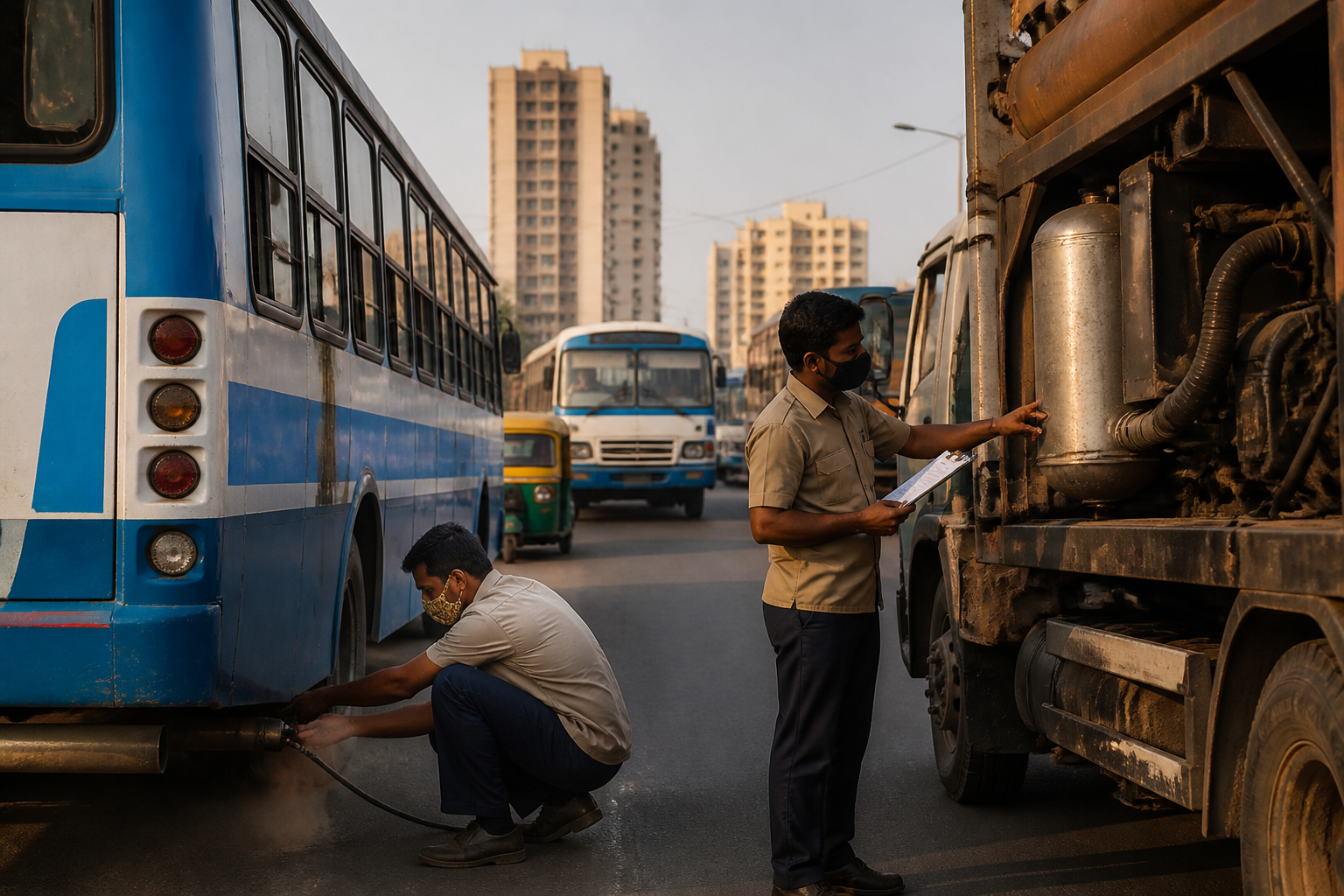
A proposed retrofit programme for ageing diesel trucks and buses marks a significant shift in how India may address transport emissions: instead of relying only on scrappage and replacement, the government is considering whether older vehicles can be brought closer to current emission standards through relatively inexpensive technology. The proposal, announced by Road Transport Minister Nitin Gadkari, centres on retrofit emission-control devices developed from an innovation at IIT Delhi.
The devices are intended for BS-IV, BS-III and older diesel vehicles. According to the minister’s remarks, they can reduce particulate matter emissions by up to 90% and nitrogen oxide emissions by 60%, potentially bringing the emissions performance of older vehicles closer to that of BS-VI vehicles. The reported cost is around Rs 4,000-5,000 per device. The technology has completed testing, and the road transport ministry is preparing to notify Automotive Industry Standard 228, which would establish technical specifications and performance requirements for the devices.
That regulatory step is central to the proposal. A retrofit device is not simply a pollution-control product that can be installed uniformly across every vehicle. Its effectiveness would depend on the vehicle type, engine condition, maintenance practices, fuel quality, installation standards and continued monitoring. The proposed standard is therefore expected to determine not only whether the technology works in controlled tests, but also how it will be approved, fitted and assessed in daily commercial operation.
The policy is being presented as a supplement to the government’s existing programme to scrap and replace old heavy vehicles. That distinction matters. India’s ageing trucks and buses are part of a wider urban problem in which pollution control, freight movement, public transport availability and the cost of fleet renewal overlap. Replacing every older vehicle can reduce emissions, but it requires vehicle owners and public agencies to mobilise substantial capital. Retrofitting offers a lower-cost intervention, although its environmental value will depend on whether it delivers consistent reductions across a large and diverse fleet.
The announcement also exposes the limits of treating vehicle age as the only measure of transport pollution. Older diesel vehicles generally carry greater emissions risks, but their actual impact is shaped by how much they operate, where they operate and how well they are maintained. A heavily used city bus, an intercity truck and a lightly used commercial vehicle may have very different pollution profiles. A national retrofit framework would need to account for those differences while ensuring that devices are not used to postpone necessary vehicle replacement indefinitely.
The urban transport context is especially important because the same announcement highlighted India’s shortage of buses. Gadkari said the country has two buses for every 1,000 people, compared with a global benchmark of eight. The figure, cited in the report, points to a capacity problem that cannot be solved through emission control alone. A cleaner old bus is still part of an inadequate public transport system if there are too few buses, insufficient routes or unreliable services.
This is why the retrofit proposal sits at the intersection of air-quality policy and mobility policy. Cities need to reduce pollution, but they also need enough buses to provide an alternative to private vehicles. In Tier-II, Tier-III and smaller cities, the minister argued that innovative public transport models may be more practical than metro systems, whose capital costs can be high. If bus fleets remain too small, residents may continue to depend on motorcycles, cars and informal transport even when older commercial vehicles become cleaner.
The policy choice is therefore not simply between an old polluting vehicle and a new clean vehicle. It is also between different ways of allocating scarce public and private capital. Scrappage and replacement can accelerate fleet renewal but may be unaffordable for many operators. Retrofit devices can be deployed at a lower upfront cost, but their performance depends on standards, installation, inspection and enforcement. New buses and expanded services can improve mobility and reduce dependence on private vehicles, but they require operating funds, depots, routes and institutional capacity.
The government’s proposed Automotive Industry Standard 228 could become the mechanism that connects these elements. Technical requirements would need to establish the permissible performance range and the conditions under which a device qualifies for use. They would also need to clarify responsibility among manufacturers, installers, vehicle owners and enforcement agencies. Without reliable compliance checks, a retrofit programme could produce uneven results: some vehicles may achieve substantial reductions while others carry devices that are poorly installed, inadequately maintained or no longer effective.
The reported proposal also reflects a broader shift towards managing the entire vehicle life cycle rather than relying on a single intervention. At the same event, the minister discussed a future expansion of Bharat NCAP, India’s vehicle safety assessment programme, from October 2027. He said the proposed system would evaluate the entire safety chain. The safety discussion is separate from the emissions retrofit plan, but together the announcements show the government’s interest in using regulation and technology to address risks associated with vehicles, drivers and road operations.
That broader approach is necessary because transport-related urban harm is not confined to emissions. The minister cited five lakh road accidents and 1.80 lakh deaths annually, with many victims in the 18-36 age group. He also discussed a proposed negative-points system under which repeated traffic violations could lead to licence suspension or cancellation, while responsible drivers could receive incentives. These measures remain proposals in the supplied report, not implemented systems, and their effectiveness would depend on enforcement, data quality and administrative coordination.
For the retrofit programme, the immediate question is whether the ministry can convert a tested innovation into a credible national system. Testing establishes an important technical basis, but large-scale implementation introduces practical challenges: identifying eligible vehicles, certifying installers, tracking device performance and ensuring that pollution reductions persist throughout the vehicle’s operating life. The supplied report does not establish the final notification date, the size of the initial rollout, the enforcement mechanism or whether financial support will be offered to fleet owners.
Those unanswered details will determine whether the proposal becomes a meaningful urban pollution intervention or remains a limited technical option. The reported cost of Rs 4,000-5,000 is relatively modest compared with the cost of replacing a truck or bus, but the total programme cost would include inspection, installation, maintenance, certification and enforcement. Public agencies would also need to decide how retrofitted vehicles are treated in areas with stricter emission restrictions and how compliance is verified during roadside checks.
The evidence currently supports a cautious conclusion. Retrofit emission-control devices could give governments and operators another tool for reducing pollution from older diesel fleets, particularly where immediate replacement is financially difficult. But the devices cannot substitute for adequate bus supply, reliable public transport, fleet renewal or effective traffic and vehicle regulation. Their value will ultimately be measured not by the announcement of a low-cost technology, but by whether a transparent standard and enforceable operating system can deliver the claimed reductions across real urban fleets. The next significant milestone is the ministry’s proposed notification of Automotive Industry Standard 228, which should clarify how the technology is to move from testing into regulated use.
