


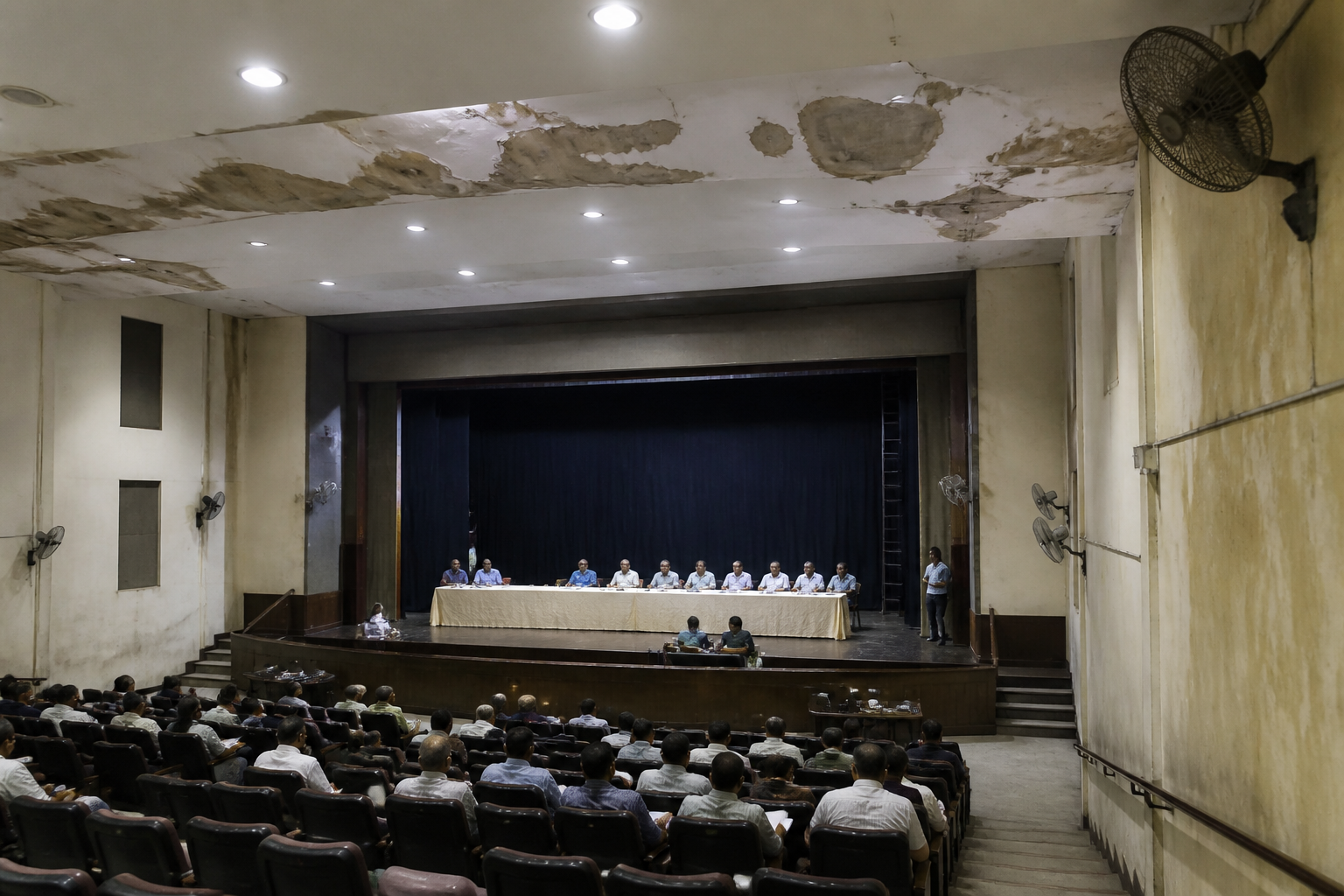
Subheadline: A special meeting moved to a theatre after leakage in Ambernath’s relatively new municipal headquarters has brought construction quality and civic asset management into focus.
Standfirst: Ambernath Municipal Council’s decision to hold a special meeting at the Dharmaveer Anand Dighe Theatre was presented as a practical response to leakage in the civic body’s new administrative building. But the temporary relocation has exposed a more persistent problem: the condition and performance of a public building inaugurated only two to three years ago. The reported leakage, falling plaster of Paris, repeated sound-system failures and air-conditioning problems point to difficulties that go beyond one disrupted meeting. At the same time, the council gathering became the setting for a renewed dispute between its ruling Bharatiya Janata Party and Shiv Sena groups. This analysis examines what the episode reveals about public construction, unfinished civic premises, municipal operations and the relationship between infrastructure failure and political conflict.
The immediate event was straightforward. Ambernath Municipal Council shifted a special meeting from its own hall to the Dharmaveer Anand Dighe Theatre after leakage affected the new administrative building during the monsoon. According to the Loksatta report, the building had been inaugurated only two to three years earlier. The council had planned a two-storey building with a meeting hall at the same location, while work on two additional floors was still under way. During the rainy season, leakage reportedly affected both the municipal offices and the main hall.
The relocation was therefore not prompted by a planned civic or cultural partnership. It was a response to a municipal building being considered unsuitable for a meeting. The theatre, normally used for cultural programmes and plays, became the venue for councillors and political leaders. The change of venue converted a problem of building performance into a visible public event. A civic institution had to use a cultural facility to conduct its own statutory business.
That distinction matters because a municipal headquarters is not simply an office block. It is the physical setting in which public administration, council deliberations and citizen-facing services operate. When leakage affects the meeting hall or offices, the impact is not limited to inconvenience. It can interfere with the regular functioning of the council, create uncertainty over the safety and suitability of the premises, and require public authorities to find alternative space for essential proceedings.
The report describes the building’s condition as part of a wider pattern of defects. Plaster of Paris reportedly fell in several offices and in the hall. The sound system frequently stopped working, while the air-conditioning system faced repeated breakdowns. These details are significant because they suggest that the issue is not restricted to rainwater entering the building. They point to problems across the building’s finishes, technical systems and operational readiness.
The supplied report does not establish the precise cause of the leakage, identify the contractor responsible, state the project cost, or indicate whether an independent structural or quality audit has been ordered. It also does not provide an official explanation from the municipal council, its engineering department or the construction agency. Those gaps prevent a definitive conclusion about whether the defects resulted from design, workmanship, material quality, incomplete construction, maintenance failures or the sequencing of work on the additional floors.
What is established is the timing. A building inaugurated roughly two to three years ago has reportedly experienced leakage and several functional failures. The fact that construction on two more floors was continuing at the site provides an important context, but it does not by itself explain the condition of the completed offices and hall. Nor does the report establish whether the ongoing work directly caused or worsened the leakage. That question requires technical documentation and an official response.
The episode also illustrates the operational consequences of constructing or occupying a civic building in stages. Ambernath’s municipal headquarters was planned with two floors initially, while two additional floors were being built. A phased project can allow an authority to expand capacity over time, but it also creates an interface between completed and active construction. Waterproofing, drainage, service connections, access control and protection from monsoon conditions become particularly important when occupied areas coexist with ongoing work.
The report does not say whether the building was formally handed over in a fully functional condition, whether defect-liability provisions were invoked, or whether the council had documented the earlier problems. These are central administrative questions. Public authorities generally need clear records of project completion, inspections, warranties, maintenance obligations and remedial action. Without such records, responsibility can become difficult to establish when defects emerge soon after inauguration.
The meeting’s relocation also raises a question about the management of public spaces. A theatre is a civic asset designed primarily for performances and cultural activity. The report says the venue is widely used for cultural programmes and theatrical productions. Using it for a municipal meeting may be necessary in an emergency, but it can affect its normal schedule, technical systems, maintenance requirements and public access. The report further says that some art-loving residents expressed anger over the use of the cultural building as a political arena.
That reaction reflects a conflict between two legitimate civic needs. The council required a functioning venue for its special meeting, while residents expected the theatre to serve its cultural purpose. The underlying problem was not the theatre itself, but the failure of the municipal building to provide a reliable space for council business. The temporary solution made the institutional weakness visible without resolving it.
The meeting also became a stage for conflict between the ruling BJP and Shiv Sena groups. Shiv Sena councillor Rajendra Walekar reportedly argued that action should be taken if officials did not follow the municipal president’s orders. BJP councillors objected, and verbal clashes followed. The dispute is presented as evidence that tensions between the two groups had not ended, despite discussions of a settlement in the preceding days.
The political dispute should be separated from the infrastructure issue. The report does not establish that the building defects were caused by factional conflict, nor does it show that the political confrontation directly blocked repairs. However, both developments occurred in the same institutional setting. When a council is dealing with a visibly defective public building, disagreements over authority and compliance can influence how responsibility is assigned and how quickly corrective action is pursued. That possibility remains a matter for further reporting, not a conclusion established by the supplied material.
The Ambernath case therefore brings together three layers of municipal functioning. The first is construction: whether a recently inaugurated public building meets expected standards. The second is administration: whether offices and council proceedings can continue safely and reliably. The third is governance: whether elected representatives and officials can resolve operational problems while managing internal political differences.
The evidence supplied confirms the disruption, identifies several reported defects and records the decision to move the meeting. It does not confirm the project’s cost, the names of the contractor and supervising agency, the number of affected offices, the duration of repairs, or the technical remedy proposed. It also does not establish whether any inspection or disciplinary process has begun. Those are the next facts required to assess the scale of the failure.
For now, the most important lesson is institutional rather than theatrical. A municipal council meeting held in a theatre is a visible symbol of a civic building that was not functioning as expected. The immediate milestone to monitor is the restoration of the council’s own meeting facility, alongside any official findings on the leakage, the other reported failures and responsibility for repairs. Until those details are made public, the episode remains evidence of a serious municipal infrastructure and oversight problem, but not yet a fully documented account of its cause.
