


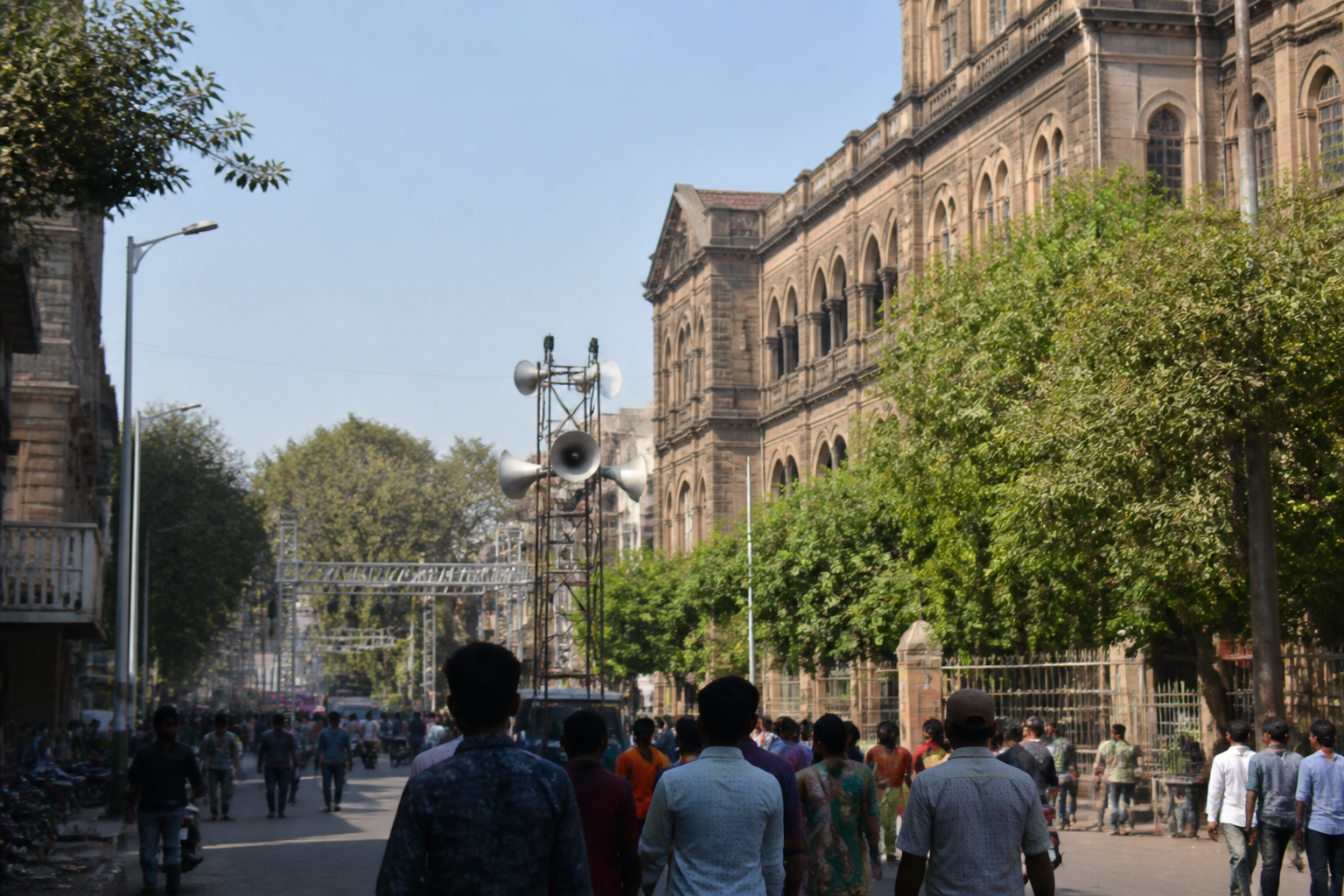
A proposed march to the Pune Municipal Corporation, following an assault on activist Vidyanand Bapat and his criticism of loud music and loudspeakers during public festivals, has brought an old urban conflict back into view: who controls the use of public space when celebration creates costs for residents who are not participating?
The report by Loksatta – Pune says Bapat was attacked on Tilak Road on August 3 while opposing noise pollution associated with Ganesh festival activity. It also says a march in support of Bapat and for a “DJ-free” public environment is planned for Sunday. At a press conference, Bapat argued that noise from public celebrations had become a form of “soft violence” and said some residents were being forced to leave their homes and neighbourhoods because of the disturbance.
The report does not establish the precise location, duration or measured intensity of the noise at issue. It does not provide decibel readings, the number of complaints received by authorities, details of permissions granted to organisers, or the findings of a police investigation into the assault. Those gaps matter because the dispute is not only about competing opinions on festivals. It is also about how a city defines, monitors and enforces the boundary between a public cultural event and an activity that affects people who have not consented to it.
That boundary becomes difficult to manage when festivals occupy roads, public squares and residential edges at the same time. A celebration may be organised by a particular group, but its sound, traffic and operating hours can extend well beyond the event site. The report frames the issue primarily through noise, but it also records Bapat’s criticism of the wider disorder associated with public festivals. In that sense, the dispute raises questions about the administration of shared urban space rather than about music alone.
Pune’s cultural identity is part of the argument. Bapat questioned whether the city’s claim to being Maharashtra’s cultural capital is compatible with the current condition of its festivals. That statement turns the debate from a narrow complaint about loudspeakers into a disagreement over what public culture should look like in a dense city. The report does not provide responses from festival organisers or municipal officials to that criticism, so their position cannot be assessed from the available material.
The immediate political and administrative significance lies in the fact that the proposed response is directed at the municipal corporation. That choice places the city government at the centre of a problem that can involve several institutions, including civic authorities, police, event organisers and residents. The report does not specify which authority approved the activities described, who is responsible for enforcing applicable restrictions, or whether any formal complaint or legal proceeding has been filed. Without that information, responsibility remains unclear.
This lack of institutional detail is a recurring weakness in urban disputes. Public debate often compresses a complex regulatory chain into a simple confrontation between residents and festival participants. Yet an effective system would require clarity at every stage: permission for an event, conditions attached to that permission, monitoring during the event, a mechanism for complaints, and consequences when conditions are breached. The supplied report identifies the conflict but does not establish how each of these stages currently operates in Pune.
The episode also illustrates the difference between the existence of a rule and the experience of enforcement. Bapat’s remarks, as reported, describe a situation in which residents experience festivals as coercive rather than voluntary. Whether that description applies broadly across the city cannot be determined from one report. But it identifies the central administrative test: residents need to know whether restrictions on public noise are real, measurable and enforceable, rather than merely stated in principle.
The report records strong language from Bapat, including his comparison of festival enthusiasts with a militant organisation and his description of an “army of festivals”. These are political and rhetorical characterisations, not verified findings. They should not be treated as evidence that festival activity is uniformly harmful or that organisers share responsibility for the assault. The report separately says that an accused person, Santosh Chavan, was in police custody and attributes to him a statement attacking Bapat. It does not provide the police version, charges, witness accounts or the status of the case.
That distinction is important for urban coverage. A physical attack on a person expressing opposition to noise is a law-and-order matter. The regulation of loudspeakers and public events is a governance matter. The two issues became connected because the assault followed Bapat’s public criticism, but one cannot be used as proof of the other without evidence. The available material supports reporting the sequence and the public reaction; it does not support assigning wider culpability.
The proposed march may give the issue an organised form. Bapat said he was considering creating an organisation around the campaign, but that no formal announcement had been made. This suggests that the dispute could move from an individual protest to a civic mobilisation. Whether that happens, and whether it attracts support beyond those already opposed to loud public celebrations, remains unknown. The report provides no information about the expected size of the march, participating groups, route, municipal permission or security arrangements.
Those missing details are not peripheral. A march to a municipal office is itself an occupation of public space and therefore subject to the same questions of permission, access, traffic management and public impact that surround festivals. A movement seeking stricter regulation will be judged partly by whether it makes its own demands through transparent and lawful civic processes. The source material does not indicate how the organisers plan to conduct the march.
The broader urban question is how cities can accommodate collective celebration without shifting all of its costs onto nearby residents. The report presents the conflict in absolute terms: festivals are intended to produce joy, but have instead created fear and distress for some citizens. A city administration, however, must translate that conflict into operating standards. It must determine what activities are allowed, where they can occur, for how long, under what conditions and with what remedies for affected residents.
The available evidence does not show whether Pune has failed because of inadequate rules, weak enforcement, insufficient monitoring or a lack of coordination between agencies. It also does not show whether the reported complaints are concentrated in particular neighbourhoods or associated with specific kinds of events. Those questions would require official records, complaint data, permission documents, police information and responses from civic officials and festival organisers.
For now, the report confirms three developments: Bapat has publicly opposed noise linked to public festivals; he was reported to have been attacked on Tilak Road; and a march supporting his position and calling for a DJ-free environment is planned at the municipal corporation. It also confirms that he intends to continue the campaign and is considering an organisational structure.
What remains unresolved is whether the confrontation will lead to clearer municipal accountability or remain another seasonal dispute. The next significant evidence will come from the municipal corporation’s response, the organisation and conduct of the proposed march, the police investigation into the assault, and any documented enforcement action concerning public noise. Until those records emerge, Pune’s noise debate reveals a governance problem clearly, but does not yet establish how the city’s regulatory system is performing.
