Bengaluru Air Quality Stays Stable As Monsoon Helps
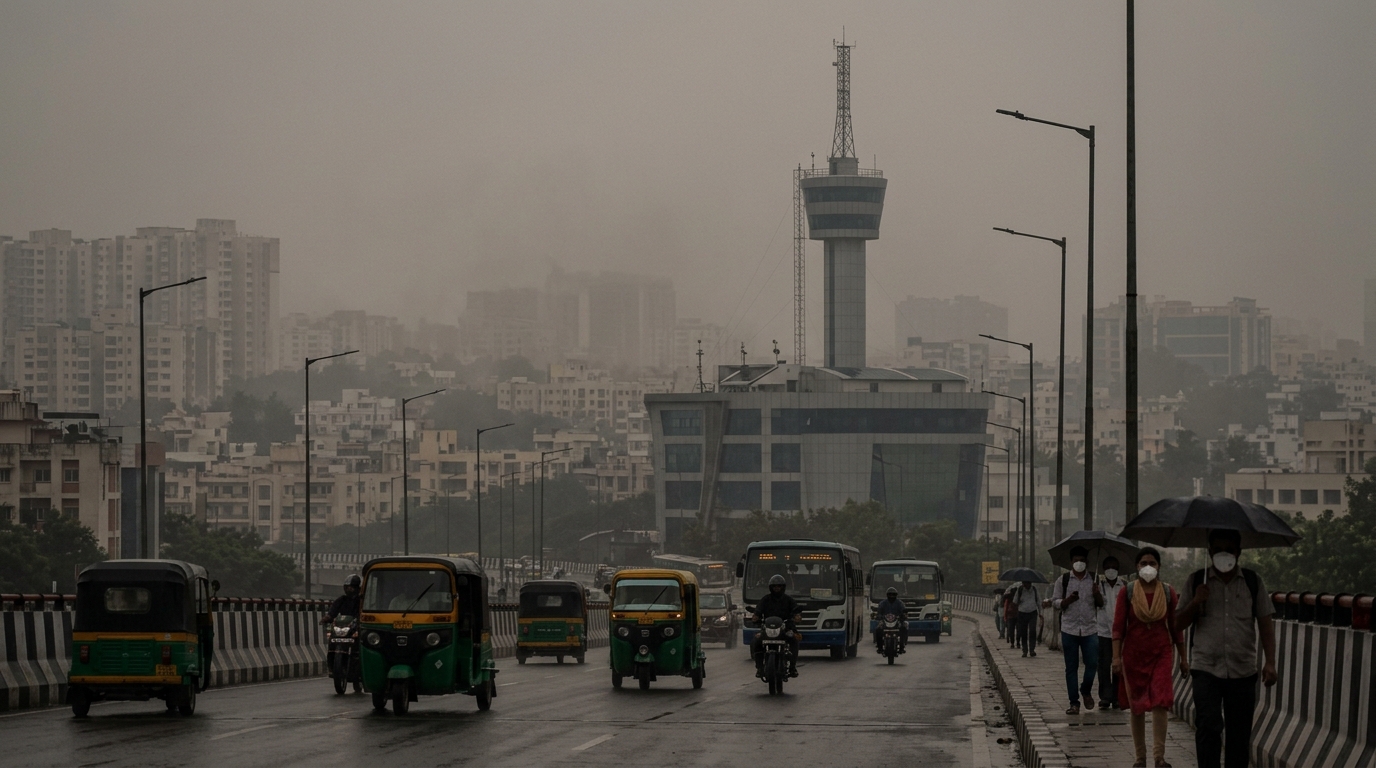
Bengaluru’s air quality remained largely within the satisfactory range on August 31, with the city recording an average Air Quality Index (AQI) of 59. Seasonal rainfall and stronger air movement appear to have helped disperse airborne pollutants, offering temporary relief across the city. Yet differences between neighbourhoods show that traffic emissions and road dust continue to influence local pollution levels.
The Bengaluru Air Quality reading places the city within the 51–100 AQI band, which under India’s national air-quality framework is considered satisfactory. The reading was driven mainly by particulate matter, including PM10 and PM2.5. While the overall city average remained relatively low, pollution was not evenly distributed across urban areas.Areas with heavier transport activity continued to record higher readings. City Railway Station, Peenya and Majestic reported AQI levels between 66 and 96, with traffic density and road dust identified as important contributors. In contrast, BTM Layout recorded readings around 44–50, placing it close to the ‘good’ category. The contrast is significant for Bengaluru’s urban planning. A citywide average can conceal pockets where residents face substantially higher exposure. Busy transport corridors, construction zones and roads with persistent dust can experience poorer air than the overall municipal picture suggests.
This makes neighbourhood-level monitoring increasingly important for planning cleaner mobility and more resilient public spaces. Weather is also playing a role.Monsoon showers can remove some suspended particles from the atmosphere, while moving air helps disperse pollutants. However, these effects are temporary and do not eliminate the sources of emissions. Once rainfall decreases or wind speeds weaken, concentrations can rise again, particularly along heavily trafficked corridors. The wider Karnataka picture was also relatively favourable. Kodagu and coastal districts recorded AQI readings between 23 and 40, while Mysuru remained around 45–55. Belagavi and Hubballi-Dharwad were generally around 50–65. Parts of northern Karnataka, including Ballari, Kalaburagi and Bagalkot, recorded comparatively higher readings of around 60–80, with dust and industrial activity contributing to pollution. The latest Bengaluru Air Quality trend therefore offers relief, but not a reason for complacency.
Sustaining cleaner air will depend on reducing pollution at source through better public transport, cleaner construction practices, dust management and safer walking and cycling infrastructure. For residents, the immediate improvement is welcome; for the city, the longer-term test is whether cleaner air can be maintained beyond the monsoon’s natural cleansing effect.