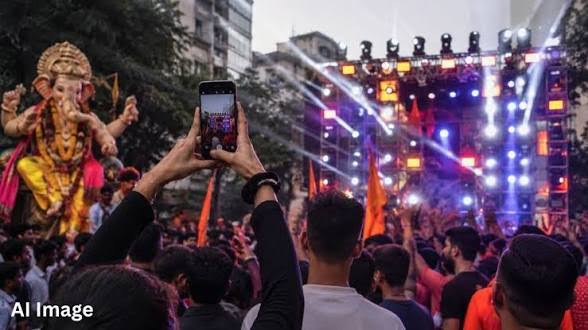
Pune Citizens Challenge High Decibel Festival Celebrations
Pune’s long-running struggle with urban noise has moved into the public spotlight ahead of Ganeshotsav, with residents gathering at Goodluck Chowk to seek tighter controls on high-volume music and sound equipment. The demonstration has opened a wider civic question: how can a densely populated city protect cultural celebrations while ensuring that public spaces and neighbourhoods remain liveable?
The protest was driven by concerns over DJs, loudspeakers and other amplified systems used during festivals. Participants maintained that their objection was to excessive sound rather than to any particular religious celebration. Several residents also argued that similar standards should apply across festivals and communities. The issue gained momentum after concerns over festival noise were raised during a Pune Municipal Corporation general body meeting. The discussion became contentious, drawing greater public attention to the difficulty of enforcing noise controls when large gatherings, processions and commercial activity overlap with residential areas. For city authorities, the challenge is not simply deciding whether loud music should be permitted. It is about enforcing existing rules consistently across neighbourhoods, timings and events. Urban planners and public-health experts have long linked prolonged exposure to high noise levels with sleep disruption, stress and reduced quality of life. The effects can be particularly significant for children, older residents, shift workers and people living close to procession routes.
The Pune noise pollution debate also comes at a time when the city is experiencing rapid urban expansion. Residential development has increasingly brought homes, schools, hospitals and commercial activity closer together. As land-use patterns become more compact, conflicts between public celebrations and everyday urban life can become harder to manage. Residents have therefore called for clearer limits covering DJs, loudspeakers and other equipment capable of producing high sound levels. Some participants have also raised concerns about bright lasers and other visual effects, arguing that festival management should consider the combined impact of noise, crowds and public-space disruption. The dispute is unlikely to be resolved through festival-specific restrictions alone. A senior civic official would need to ensure that permissions, sound limits, monitoring and enforcement are transparent and applied without favouring one community or event. Organisers, meanwhile, can reduce conflict by adopting lower-volume systems and planning routes and timings with surrounding neighbourhoods in mind.
With Ganeshotsav approaching, Pune noise pollution is becoming a test of the city’s ability to balance cultural expression with everyday liveability. The immediate focus will be on enforcement during celebrations, but the larger question is whether Pune can build a consistent, city-wide approach to noise pollution that protects residents throughout the year.