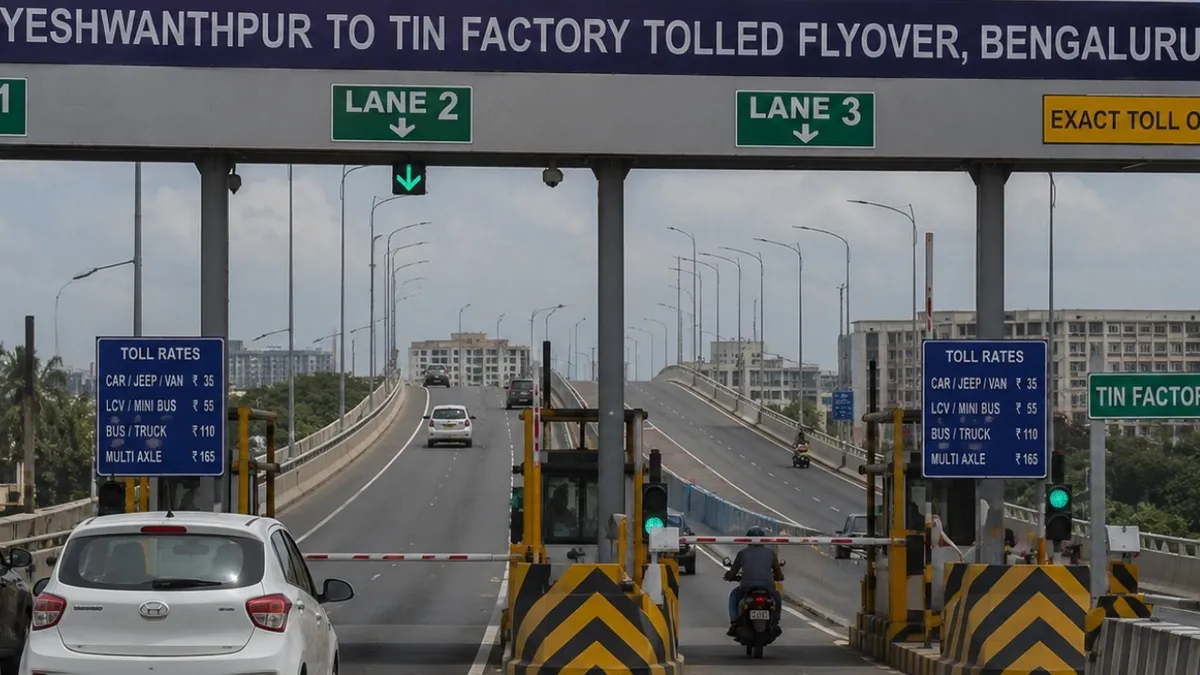
Bengaluru’s first privately built and operated toll flyover is set to carry a maximum tolling period of 32 years, placing a long-term limit on how revenue can be collected from motorists using the infrastructure. The framework brings greater clarity to the public-private partnership while highlighting the need to balance private investment recovery with affordability and efficient urban mobility.
The flyover, planned between Yeshwanthpur and Mathikere, is being developed through a public-private partnership model. The project is expected to be implemented under a design-build-finance-operate-transfer arrangement, under which the private developer finances and operates the facility before transferring it back under the agreed concession structure. The 32-year ceiling is particularly important because toll-based urban infrastructure can create a long financial relationship between road users and a private concessionaire. A defined upper limit provides a clearer endpoint for motorists and the public authority, while allowing investors to assess whether projected toll revenue can support construction and operating costs. The proposed facility is intended to address traffic pressure along a heavily used northern Bengaluru corridor. By creating an elevated route for through traffic, the project could improve movement at surface level, although its wider benefits will depend on how effectively it connects with adjoining roads and existing public transport. This is where the project’s urban impact becomes more complex. Flyovers can improve vehicle movement at specific junctions, but additional road capacity does not automatically reduce congestion across an entire corridor.
If traffic is merely transferred to nearby intersections, delays can reappear beyond the project boundary. The toll component also introduces an affordability question. Regular commuters could face recurring charges for using a faster route, potentially influencing travel choices between the tolled facility and slower free alternatives. The eventual tariff structure and escalation mechanism will therefore matter alongside the headline concession period. For Bengaluru, the project also represents a broader experiment with private participation in urban road infrastructure. Such models can mobilise capital for projects that may otherwise compete with numerous demands on public budgets. At the same time, contracts need clear provisions covering service standards, maintenance, safety, toll transparency and accountability over the concession’s entire life. The environmental case will similarly depend on how the project fits into the city’s wider mobility strategy. If the flyover primarily encourages additional private vehicle use, gains in travel speed could be offset by increased traffic volumes.Integrating pedestrian movement, public transport and non-motorised access around the corridor would provide a broader mobility benefit. The long concession period makes maintenance particularly important.
Infrastructure expected to operate for decades needs lifecycle planning rather than an approach focused only on construction. As Bengaluru considers more private participation in urban infrastructure, the Yeshwanthpur-Mathikere project could become a useful test of whether toll-based development can deliver reliable mobility while protecting public interests over the long term.