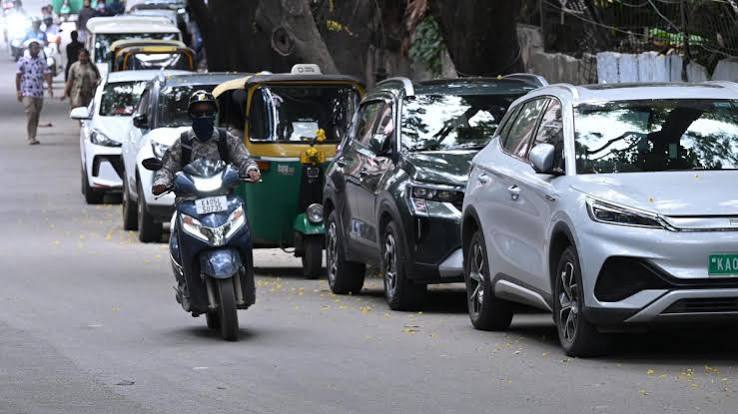
Bengaluru is preparing to revisit how parking is regulated and priced across the city, with the state government examining changes to its existing framework. The proposed overhaul could reshape how road space is allocated between parked vehicles and moving traffic, while creating a stronger role for parking management in reducing congestion and improving the use of limited public space.
The review follows growing pressure on Bengaluru’s streets, where demand for parking has expanded alongside vehicle ownership and commercial development. Officials are considering changes to parking charges and related rules, with the objective of creating a more structured system for managing on-street and off-street parking. Parking policy has increasingly become a transport issue rather than simply a question of where vehicles can be left. When kerb space is occupied for long periods, it reduces the effective width of roads, affects bus movement and can force pedestrians into conflict with traffic. Better pricing and enforcement can help ensure that scarce street space is used more efficiently. A key consideration will be how charges vary between different parts of the city. Parking demand is significantly higher in commercial centres, business districts and areas surrounding major transport hubs than in predominantly residential neighbourhoods. A uniform fee structure may therefore fail to reflect actual demand and could either discourage appropriate use or leave valuable street space underpriced. Urban transport experts have long argued that parking charges should be linked to demand and availability.Higher charges in congested locations can encourage shorter stays and make spaces available more frequently, while affordable or controlled parking around public transport nodes can support multimodal travel.
For residents and businesses, however, any increase in parking costs will need to be accompanied by credible alternatives. Without reliable public transport, safe walking routes and adequate off-street parking, higher charges could simply shift vehicles into neighbouring streets rather than reducing overall parking pressure. The city’s commercial areas also stand to be affected. Better managed kerb space could improve pedestrian movement and make streets more accessible for deliveries, buses and emergency services. Clear rules would also reduce uncertainty for businesses and motorists if enforcement is consistent. The environmental dimension is equally important. Efficient parking management can discourage unnecessary car trips and reduce the amount of urban land dedicated to vehicle storage. Land currently used for surface parking can, in suitable locations, support public spaces, greenery, cycling facilities or other community uses. The proposed changes therefore offer Bengaluru an opportunity to treat parking as part of its wider mobility strategy. The success of the reform will depend not only on the final fee structure but also on transparent enforcement, digital monitoring, accessible alternatives and protection of pedestrian space.
As the government works on the revised framework, the central challenge will be to ensure that parking policy improves how Bengaluru’s streets function rather than simply creating another fee for motorists. A well-designed system can make limited urban space work more efficiently for residents, businesses and public transport users alike.