


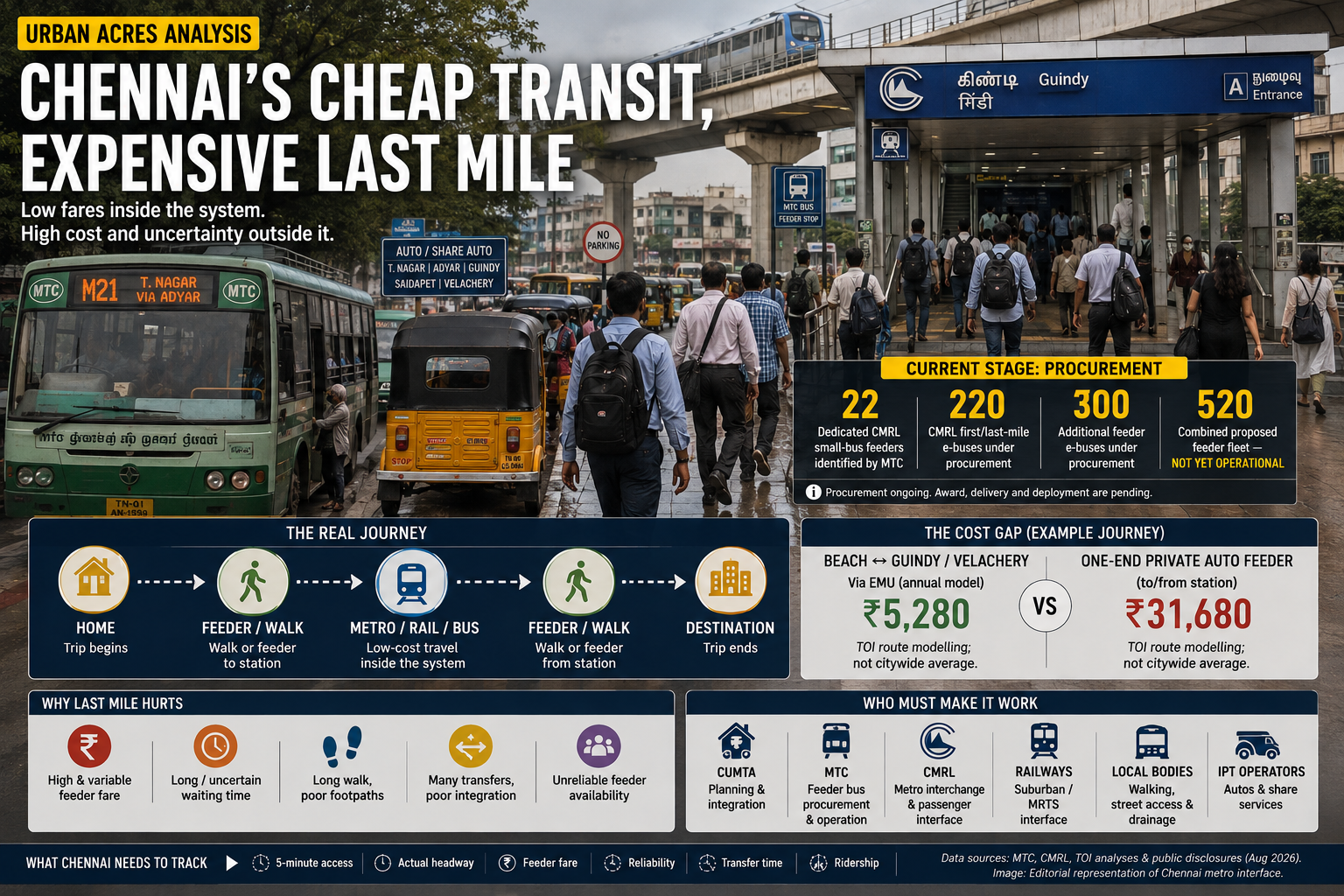
Low fares on buses, Metro and suburban rail do not necessarily produce an affordable journey in Chennai. New commuter-cost comparisons expose the price passengers may pay simply to reach mass transit—but the deeper story is that Chennai already knows it has a feeder problem. Two procurements covering 520 electric feeder buses are under way, while the metropolitan transport authority is separately redesigning how buses, rail, walking and paratransit should connect. The test is now whether those plans become frequent, affordable door-to-door mobility.
CHENNAI — A commuter paying a modest fare for Chennai’s suburban railway or Metro can still end up spending substantially more getting to and from the station.
That distinction—between a cheap ticket and a cheap journey—is emerging as one of Chennai’s most important public-transport tests.
A Times of India analysis published on August 25 modelled five city journeys and found cases where the annual cost of using an auto or share auto for the feeder leg exceeded the cost of the main bus, Metro or suburban-rail journey itself. For Beach–Guindy and Beach–Velachery, for example, TOI calculated an annual EMU cost of ₹5,280 against ₹31,680 for a private-auto feeder at one end.
The precise numbers should be treated as route-based modelling rather than a citywide commuter average. But the underlying problem is real—and is acknowledged in Chennai’s own transport planning documents.
Chennai’s transport network has a missing layer
Mass transit works only when passengers can reach it conveniently.
A functioning journey is not simply:
Metro station → Metro station
It is:
Home → walk/feeder → station → train or bus → interchange → feeder/walk → workplace
If any one of those links is expensive, unreliable or physically difficult, the attractiveness of the complete public-transport journey falls.
That is particularly important in Chennai because Metro, suburban rail, MRTS and high-capacity bus corridors cannot place every resident within comfortable walking distance of a station or high-frequency route.
Intermediate modes therefore perform a structural function. Autos, share autos, small buses, cycling, walking and future micro-mobility services are not peripheral to the network; they determine who can actually access it.
CUMTA itself takes this view. Its Bus Transport and Last Mile Connectivity Improvement Plan calls for origin-destination surveys at Metro, MRTS and suburban railway stations, analysis of paratransit users and operators, spatial identification of service gaps and an integrated feeder plan covering rail systems and major bus terminals.
It also proposes examining how many residents and jobs have frequent bus service every five minutes within a five-minute walk—a much more meaningful accessibility measure than simply counting buses.
The existing dedicated Metro feeder fleet is small—and MTC says so
MTC’s own 2026 procurement documents provide unusually direct evidence of the problem.
The corporation says it currently operates 22 small buses as dedicated first- and last-mile services for selected Chennai Metro stations, describing this capacity as inadequate for existing CMRL requirements.
CMRL’s feeder-service information identifies the small-bus routes serving stations including Koyambedu, CMBT, Thirumangalam, Alandur, Airport, Wimco Nagar, Guindy and Little Mount.
This is important context for the 146-small-bus figure cited in the TOI analysis.
The figure is not new. MTC was already reported to be operating 146 small buses over 72 routes in late 2022 and again in 2023.
What matters for a passenger approaching a Metro or railway station is not merely the total number of small buses in the corporation’s fleet. It is whether a usable feeder route exists where and when the passenger needs it, at an acceptable fare and frequency.
Chennai has already planned a much larger feeder intervention
The government response is therefore more advanced than the latest commuter-cost story alone suggests.
MTC floated a tender on February 28 for 220 AC low-floor electric feeder buses specifically for CMRL’s first- and last-mile connectivity.
The fleet would consist of 70 seven-metre buses and 150 five-metre vehicles. The procurement includes supply, operation, maintenance and associated electrical and civil infrastructure under a Gross Cost Contract model. MTC’s documents also specify onboard fare collection and conductorless operation.
Another tender, issued the same day, seeks 300 seven-metre AC electric buses for feeder services.
Together, they represent 520 prospective feeder vehicles.
But prospective is the operative word.
As of the morning of August 26, Tamil Nadu’s e-procurement portal shows bid submission for both feeder contracts closing at 5 pm on August 26, with technical bids scheduled for opening on August 27. They have therefore not reached the stage at which Urban Acres can describe the vehicles as awarded, supplied or operational.
MTC’s tender record also shows that procurement deadlines have been extended repeatedly since the original schedules earlier this year. The available documents do not establish why, so no causation should be inferred.
That makes procurement performance part of the mobility story
The sequence now matters.
The public outcome will require:
Tender → technical evaluation → financial evaluation → award → contract → bus manufacture/supply → charging and depot infrastructure → testing → route allocation → operating frequency → dependable passenger service
Counting 520 buses before that chain is completed would repeat one of the most common mistakes in infrastructure reporting: converting procurement intent into delivered capacity.
Nor will the number 520 by itself establish success.
The new services could be highly effective if routes are based on observed passenger demand, operate frequently, minimise waiting and transfer times, serve interior neighbourhoods and maintain an affordable fare.
The same fleet could produce a weaker outcome if vehicles duplicate existing routes, operate infrequently, terminate inconveniently, become unreliable or fail to connect railway stations outside the initial Metro focus.
That is why CUMTA’s broader network exercise matters. Its terms of reference call not simply for more vehicles but for evaluation of route coverage, frequency, travel time, transfer points, passenger satisfaction, accessibility to jobs and services, gendered transport needs and access to Metro and suburban rail.
Autos should not be treated only as evidence of failure
There is another risk in simplifying Chennai’s last-mile problem: portraying autos and share autos merely as expensive substitutes that ought to disappear once buses improve.
CUMTA’s own documents recognise intermediate public transport as part of the metropolitan transport system, particularly in locations where organised public transport is weaker. The authority has commissioned work to map paratransit routes, understand operating economics, identify regulatory problems and consider how such services could be made more integrated and commuter-oriented.
That is more realistic.
A five-minute-frequency bus may be appropriate for a dense station catchment. A shared auto may make more sense on another corridor. Walking could remain the best solution within a short radius—provided footpaths, crossings and station approaches are usable.
The objective should therefore not be to force every passenger onto one feeder technology.
It should be to reduce the cost, distance, waiting time and uncertainty of reaching mass transit.
Fare policy has to move from the vehicle to the whole journey
This is where TOI’s comparison becomes most useful.
Chennai can subsidise or hold down a bus or rail fare and still leave a passenger facing a large access charge outside that formal network.
That creates what could be described as a transfer penalty: the additional money and inconvenience imposed simply because the transport system requires a passenger to change modes.
For someone living near a frequent bus stop or Metro station, that penalty may be negligible.
For someone several kilometres away, it can determine whether public transport remains economically rational at all.
The effect may be particularly important for lower-income passengers, people unable to comfortably walk long distances, women travelling at hours when feeder options are limited, older commuters and persons with disabilities. These distributional effects need measurement rather than assumption; significantly, CUMTA’s planning scope itself requires attention to gender and accessibility.
Chennai already knows what it should measure
The city’s next last-mile story should therefore not be another announcement of a bus count.
CUMTA and MTC should publish a feeder-performance dashboard built around passenger outcomes.
For every major Metro, MRTS and suburban station, the public should be able to see:
How many people live within a five-minute walk of frequent public transport? How many feeder routes operate? What are their peak and off-peak headways? What percentage of scheduled trips actually run? What does a complete multimodal journey cost? How long is the average transfer? How many passengers use the feeder? And which neighbourhoods remain beyond affordable access?
These are the metrics that can establish whether the 520-bus procurement eventually changes mobility.
The larger lesson extends beyond Chennai.
Indian cities have invested heavily in visible trunk infrastructure—Metro corridors, railways, express buses and electric fleets. But infrastructure becomes useful public transport only when residents can reach it without paying a disproportionate financial or physical penalty.
Chennai’s last-mile problem therefore is not fundamentally about whether an auto fare is larger than a railway ticket.
It is about whether the city designs and finances the entire journey as one transport system.
The answer will not be found in the number of buses tendered.
It will be found when a passenger can leave home, reach mass transit, transfer and arrive at the destination predictably, safely and affordably.
