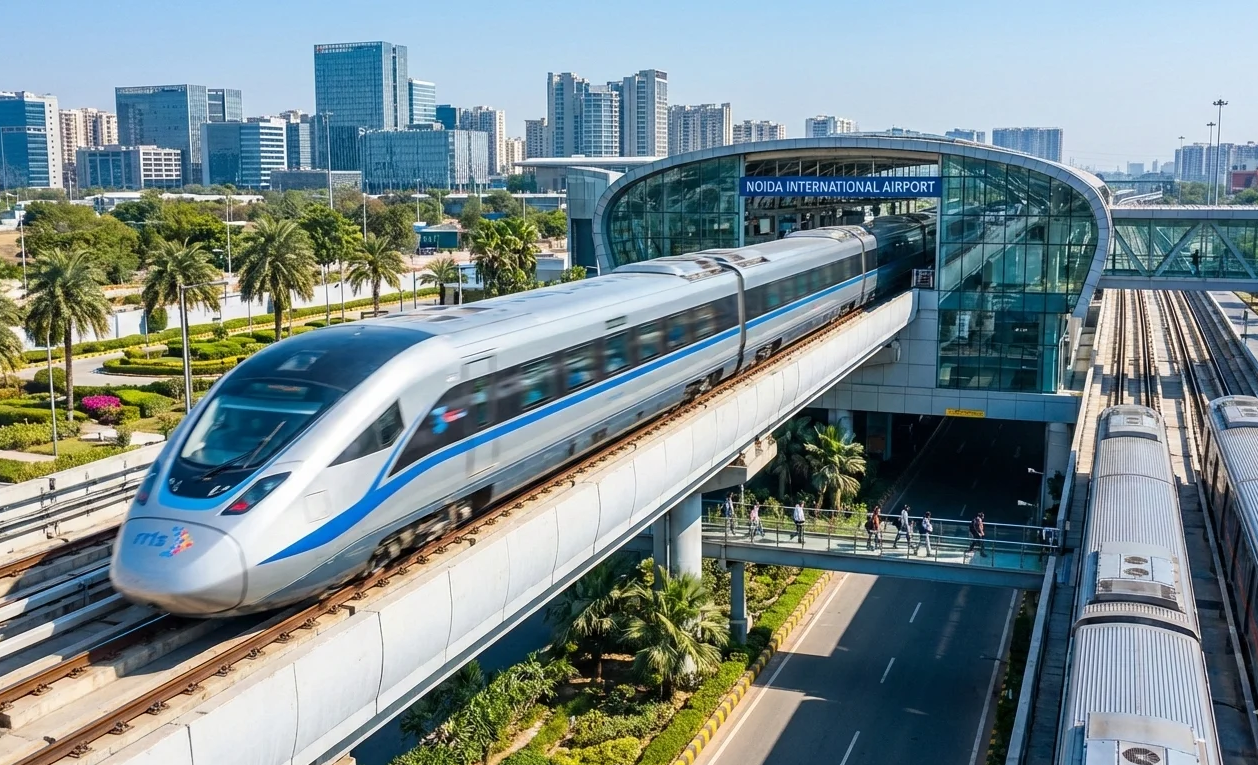
A long-delayed elevated road corridor connecting Delhi and Noida has entered a critical construction phase, offering renewed hope for easing one of the National Capital Region’s most congested commuter stretches. Urban mobility officials indicate that the six-lane Chilla Elevated Corridor could become operational by mid-2027, potentially transforming traffic movement between East Delhi, Noida and the upcoming Noida International Airport.
The 5.5-kilometre elevated link is designed to decongest the heavily burdened Delhi-Noida entry route, where peak-hour traffic frequently causes long delays for office commuters and freight vehicles. Officials associated with the project said nearly half of the civil construction work has now been completed, with foundational infrastructure and pillar installation already in place. The corridor is expected to redistribute traffic pressure currently concentrated on the Noida Expressway and adjacent arterial roads. Urban planners believe the project could reduce travel bottlenecks between Mayur Vihar and the Mahamaya Flyover stretch while improving travel reliability for daily commuters, commercial traffic and airport-bound passengers. Infrastructure analysts note that the Chilla Elevated Corridor also reflects a broader shift in NCR transport planning, where elevated and grade-separated routes are increasingly being prioritised to manage rapid urban expansion. However, experts caution that road expansion alone cannot permanently solve congestion unless integrated with public transport systems, pedestrian accessibility and low-emission mobility strategies.
Construction activity accelerated again earlier this year after prolonged administrative and logistical setbacks slowed the project for more than a decade. Initially proposed in 2012, the corridor encountered multiple hurdles, including environmental approvals, utility relocation challenges, funding revisions and disruptions during the pandemic years. Cost escalations have also significantly increased the financial burden of the project over time. According to officials familiar with the progress review, the next stages will include pier cap installation, superstructure development and placement of girders and precast segments. Final work will involve surfacing, lighting systems, safety barriers and integration with existing traffic infrastructure.
The corridor’s strategic importance has increased further with the rapid development of the Jewar airport region and expanding residential growth across Noida and Greater Noida. Real estate consultants say improved east-west connectivity could reshape housing demand patterns by reducing perceived travel distances within NCR. Urban development experts, however, argue that future infrastructure projects in the region must also account for climate resilience and sustainable transport outcomes. Elevated corridors often improve traffic flow in the short term, but long-term urban liveability depends equally on cleaner public transport, reduced vehicular dependency and coordinated land-use planning. If construction timelines remain on track, the Chilla Elevated Corridor may emerge as a key mobility upgrade for NCR residents while highlighting the continuing challenge of balancing fast-paced urban expansion with sustainable city planning.