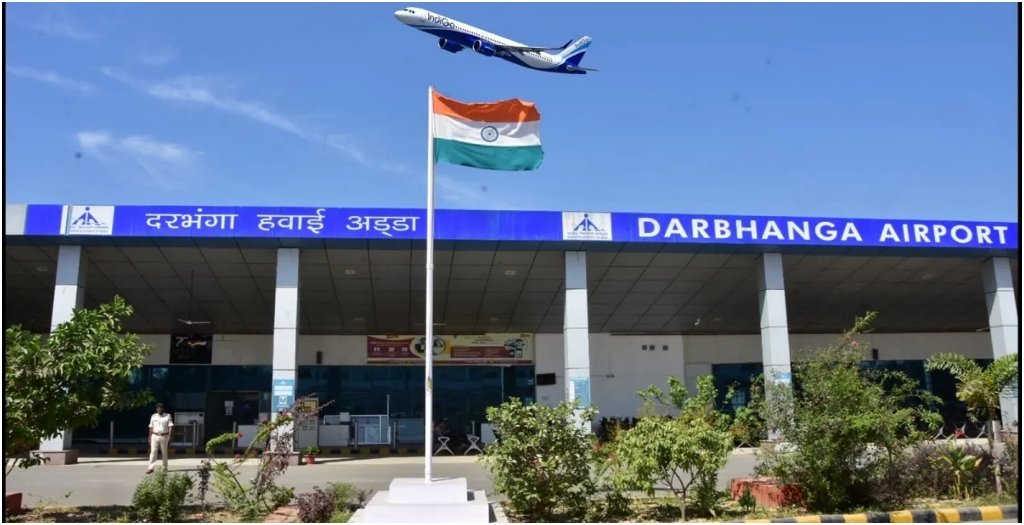
Bihar has approved a ₹138.82 crore investment to develop a cargo hub and aerocity ecosystem near Darbhanga Airport, marking a strategic shift towards logistics-led regional growth in North Bihar. The project, centred around land acquisition and infrastructure creation, is expected to strengthen supply chains, improve air cargo capacity, and position Darbhanga as an emerging economic node beyond traditional urban centres.
According to officials, the plan involves acquiring around 50 acres of land adjacent to the airport to establish a dedicated cargo and logistics hub. The facility is designed to support the movement of agricultural produce and regional goods, enabling faster access to domestic and potentially international markets. The Darbhanga aerocity project is being conceptualised as more than an aviation upgrade. Alongside cargo operations, the broader development framework includes commercial zones, hospitality infrastructure, and warehousing facilities, signalling a transition towards airport-led urbanisation. Experts note that such aerocity models are increasingly being adopted in tier-2 cities to catalyse economic clusters around transport infrastructure. The initiative comes at a time when Darbhanga Airport is undergoing significant expansion. A new terminal, runway upgrades, and additional aviation infrastructure are already in progress to enhance passenger and cargo handling capacity. These developments are expected to increase throughput and create the conditions necessary for logistics operations to scale efficiently. From an economic standpoint, the cargo hub is likely to play a critical role in unlocking value chains in sectors such as agriculture, handicrafts, and small-scale manufacturing. North Bihar’s economy, which relies heavily on perishable goods like fruits and makhana, has long faced challenges related to storage, transport delays, and market access.
A dedicated air cargo facility could significantly reduce transit time and post-harvest losses while improving price realisation for producers. Urban development analysts view the Darbhanga aerocity project as part of a broader decentralisation trend in India’s infrastructure strategy. By investing in regional nodes, states can reduce pressure on metropolitan cities while promoting distributed growth. Improved connectivity and logistics capabilities can also attract private investment, particularly in warehousing, cold storage, and allied services. The project is expected to generate employment across construction, logistics, and service sectors. In parallel, it may trigger real estate activity in surrounding areas as demand rises for residential and commercial spaces linked to airport-driven development. However, experts caution that such growth must be managed through planned land use and infrastructure provisioning to avoid unregulated expansion. Sustainability considerations will also be critical as the project evolves. Integrating energy-efficient logistics systems, multimodal connectivity, and environmentally responsible design could determine the long-term viability of the development.
Without these, rapid infrastructure expansion risks increasing carbon intensity and resource pressure. As Bihar continues to invest in aviation-linked infrastructure, the Darbhanga aerocity project represents a shift towards integrating transport, logistics, and urban planning. Its success will depend on coordinated execution, private sector participation, and the ability to align economic growth with sustainable and inclusive urban development.