


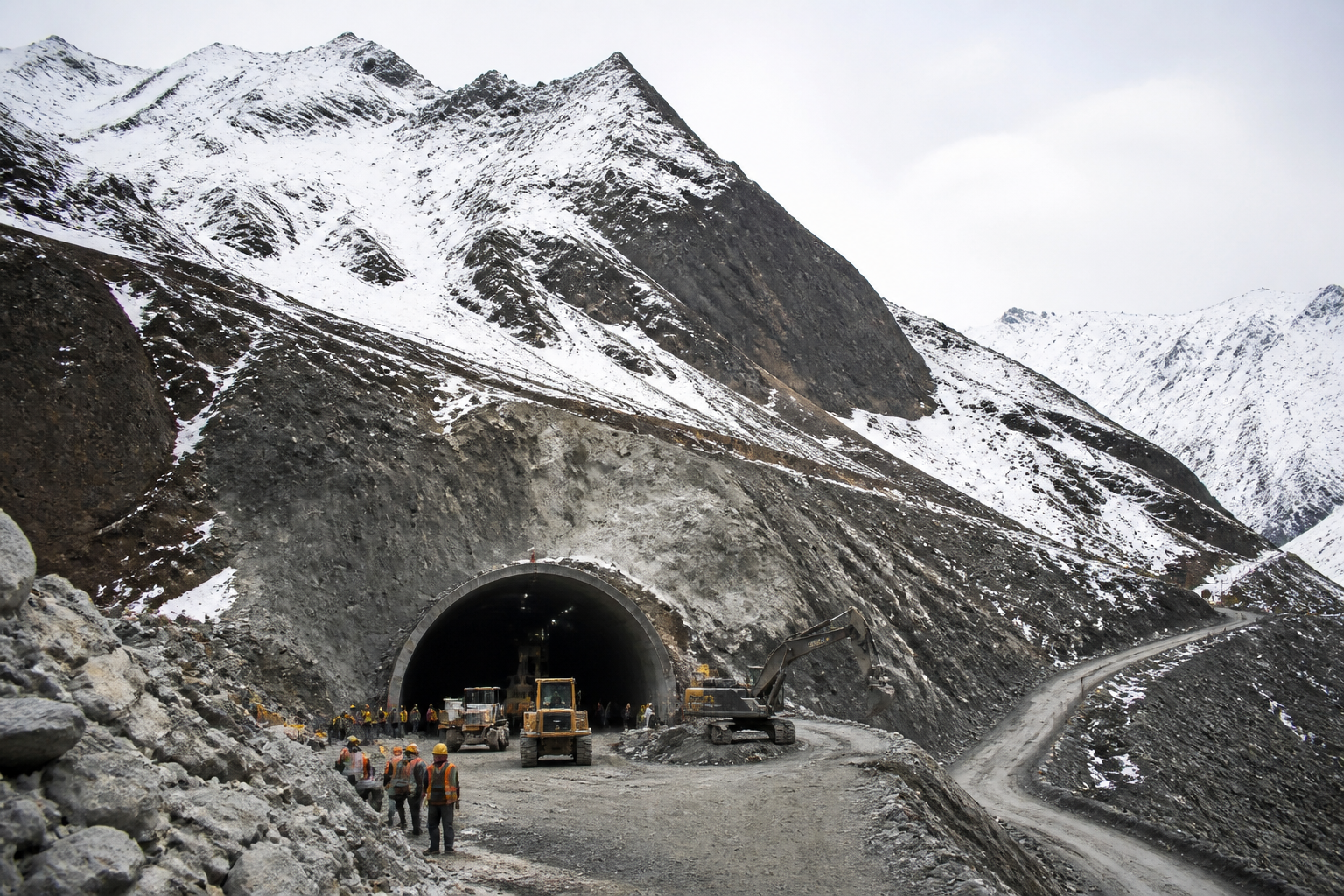
The Zojila Tunnel is being built as a 13-kilometre answer to one of Ladakh’s most persistent connectivity problems: the seasonal closure of the mountain pass that links the region with Kashmir. But the project, according to Harpal Singh, Project Head and General Manager at Megha Engineering and Infrastructures Ltd (MEIL), is also a test of whether India can create dependable infrastructure in terrain where geology, weather and human safety change from one stretch to the next.
Singh describes the tunnel as more than a transport structure. “It’s not only a tunnel, it’s a monument,” he says in an interview published by Deccan Chronicle. His description reflects the multiple functions the project is expected to perform. It is being built to improve access to Ladakh, reduce the region’s winter isolation and make movement more reliable for communities that currently face difficult conditions when the Zojila Pass closes.
The project therefore sits at the intersection of infrastructure and public service delivery. When the pass remains closed, access to essential supplies and emergency services becomes more difficult. Singh says the pass historically remained closed for three to five months, although that period has now reduced to two to three months. The tunnel’s intended role is to provide all-weather connectivity, reducing the dependence of local communities on weather-sensitive surface movement and, in some cases, air transport.
That change has direct consequences beyond travel time. Singh points to medicines, food and fuel as supplies that could reach local communities more consistently through the year. He also refers to patients from Dras who may need to be airlifted to Srinagar and children from Kargil who must travel for examinations. In this sense, the project is not simply a highway intervention. It is linked to the ability of residents to reach healthcare, education and other services without the pass becoming an unavoidable seasonal barrier.
The tunnel could also alter the economic geography of the region. Singh expects better connectivity to create opportunities for tourism and employment in places such as Sonamarg, Dras and Kargil. The supplied interview does not provide estimates for visitor numbers, new jobs or local income, so the scale of that impact remains unquantified. What it establishes is the mechanism: a more reliable connection can reduce the isolation imposed by winter and make movement for residents, workers and visitors less dependent on a narrow seasonal window.
That promise is being pursued in conditions that make construction unusually complex. Singh calls Zojila a “geological laboratory”, explaining that the ground can change sharply over short distances. Hard rock may be followed by squeezing or crumbling ground, water-bearing strata and shifting stresses. The tunnel is also being constructed in a seismic zone. “Every 10 metre, it changes,” he says, describing the variability that engineers must manage during excavation.
This geological uncertainty has an important institutional consequence. A long tunnel cannot be treated as a uniform engineering task in which one excavation method is applied from beginning to end. The project team must respond to conditions as they emerge, while supporting newly excavated sections before a permanent lining is installed. Singh says the excavation stage is particularly unsafe because workers operate below ground while the initial support is still stabilising the tunnel.
The risks are compounded by the mountain climate. Temperatures can fall to minus 30 degrees Celsius, pipelines can freeze, heavy snowfall can block access roads and moving workers between camps and the tunnel can become difficult. These conditions affect not only construction productivity but also the basic logistics of keeping a remote worksite functioning. Access roads, worker accommodation, water systems and supplies become part of the infrastructure challenge rather than background arrangements.
The interview also records the human cost of working in this environment. Singh recalls the death of a worker after a section of the tunnel collapsed and the machine he was operating was caught beneath the collapsed roof. He describes workers operating under cracked ground and water seepage, where a mistake can have immediate consequences. This account places safety at the centre of the project’s story. The tunnel’s strategic and developmental value cannot be separated from the conditions under which it is being built.
The project’s geography limits the number of ways in which construction can proceed. Singh says that, because of the terrain around Zojila Pass, the 13-kilometre tunnel could not be approached through multiple access points. Work therefore progressed from two fronts: one from the Kashmir side and the other from Ladakh. Working from both ends is a practical response to the site’s constraints, but it also means that progress depends on coordination across a remote and highly variable construction environment.
The two-front approach illustrates a broader feature of difficult infrastructure projects: the final structure may be measured in kilometres, but its delivery depends on many smaller systems working together. Excavation, geological assessment, initial support, water management, access, worker movement and winter operations all have to be coordinated. The supplied material does not provide a detailed schedule, cost, contract structure or completion date, so it cannot establish how the project is performing against those benchmarks. It does, however, show why headline measurements such as tunnel length do not fully describe the task.
The workforce itself is another part of that system. Engineers, technicians and workers have travelled from different parts of India to work at the remote site, while their families remain elsewhere. Singh says the families bear a significant part of the sacrifice because workers have limited access to schools, colleges and the everyday support systems on which family life depends. The observation broadens the definition of project cost. Alongside construction materials and machinery, the project relies on the time, safety and social separation absorbed by its workforce.
Singh’s approach to leadership reflects the conditions of the site. He says salary alone cannot motivate people to work at an altitude of around 11,000 feet, where cold, isolation and difficult working conditions are persistent realities. His emphasis is on purpose: the belief that each metre excavated has a human consequence, whether it reduces the difficulty of a journey for a family in Kargil or helps a soldier travel more safely in snow.
He also describes leadership by participation. Singh says he stays with the team and eats in the same mess, while senior engineers and managers are expected to be visible at the worksite. During difficult conditions, that may include arriving early and helping clear roads alongside workers. This is not a substitute for formal safety systems, technical controls or institutional accountability, none of which are detailed in the interview. But it shows how project management in a remote high-altitude setting extends beyond office-based supervision.
The Zojila Tunnel’s significance therefore lies in the connection between physical access and administrative reliability. A tunnel can provide continuity only if its approaches, operations, maintenance and emergency systems remain functional through the conditions that once disrupted surface connectivity. The supplied material focuses on construction and expected benefits; it does not establish how the completed tunnel will be operated, maintained or integrated with wider transport planning. Those questions will be important to assessing whether the infrastructure delivers its promised all-weather role.
The project also raises a question about how connectivity changes are distributed across the region. Singh names Sonamarg, Dras and Kargil as places that could see new tourism and employment opportunities. Yet improved access can have different effects on residents, workers, visitors and supply networks. The interview confirms the intended benefits but does not provide evidence on land use, local business capacity, housing demand or environmental pressures. Those outcomes cannot be assumed from the tunnel alone and would require separate data and monitoring.
What the interview establishes is more immediate and concrete. The Zojila Tunnel is being built to address a seasonal connectivity barrier in a region where access affects essential supplies, healthcare, education and economic activity. Its construction is taking place amid unstable geology, seismic risk, extreme cold, snowfall and limited access points. The work has involved serious safety risks and significant personal sacrifices for workers and their families.
The larger urban and regional question is whether infrastructure can convert a difficult geographic connection into dependable public access. For Ladakh, the tunnel’s value will ultimately be measured not only by its length or engineering complexity but by whether people can use the route safely and consistently when winter conditions are at their harshest. The next evidence to watch is the project’s official construction timeline, completion status, operational plan and independently documented effect on year-round movement.
