


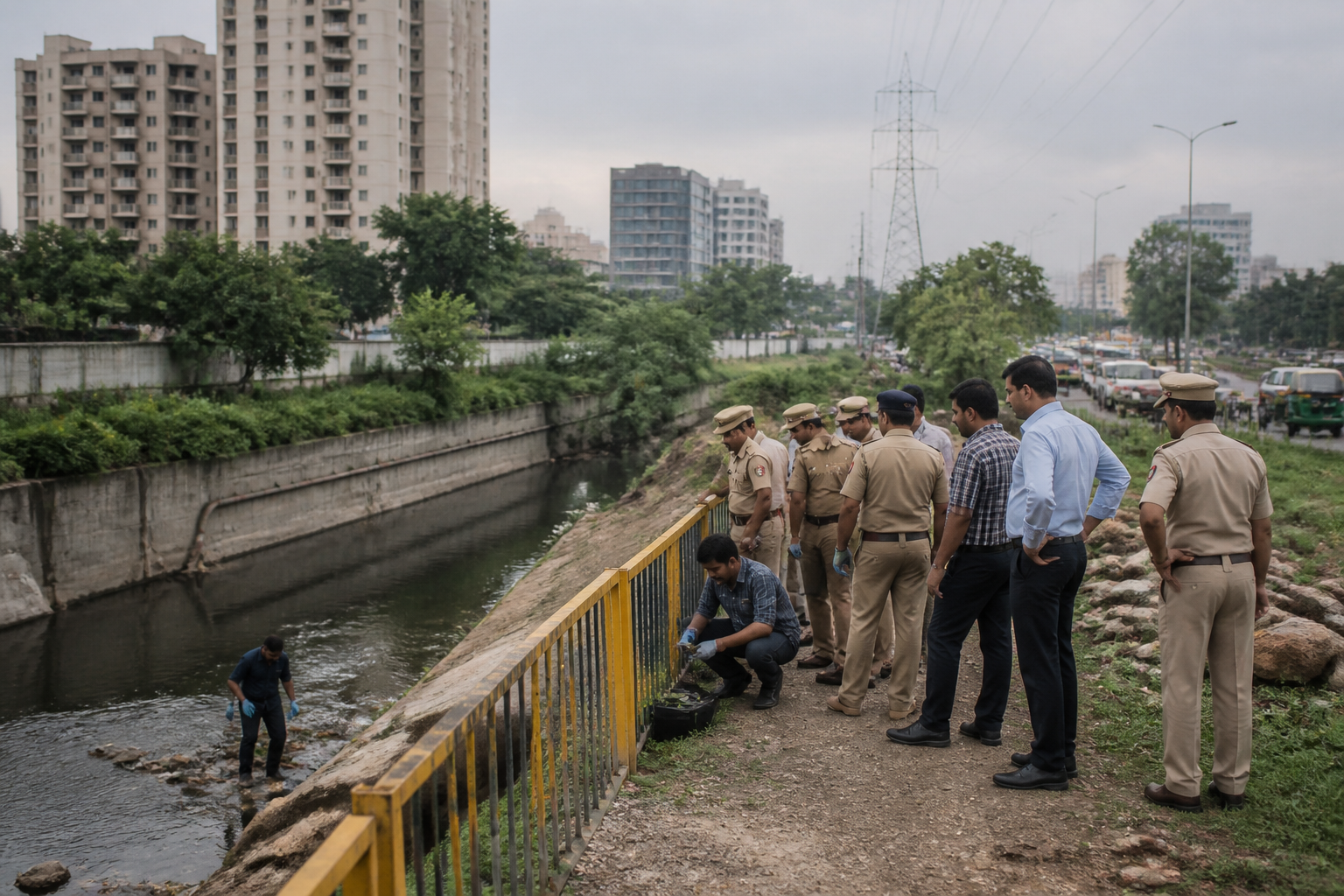
The Yuvraj Manchanda murder case is not only a criminal investigation into a 31-year-old real estate professional’s death. It is also a test of how Delhi and Gurugram police identify unknown bodies, connect missing-person complaints across jurisdictions and communicate with families before an irreversible step is taken.
According to the report by Jagran, Yuvraj left his home in Delhi’s Sarita Vihar on September 6, 2026, telling his family that he was travelling to Gurugram for a meeting and would return by about 10 pm. His family spoke to him at around 7 pm. After that, messages continued to be sent from his phone for two days, creating the impression that he was occupied with work. Police later alleged that the messages had been sent by the accused using his phone.
Yuvraj was subsequently found dead in a drain in Gurugram’s Badshahpur area. By the time his family filed a missing-person complaint at Delhi’s Lajpat Nagar police station on September 11, Gurugram police had already recovered an unidentified body on September 10. The body was later cremated as unidentified, according to the report, before the family was informed that it could be Yuvraj.
That sequence places the case at the intersection of two separate police processes: the search for a missing person and the identification of an unidentified body. Both processes may operate within different police jurisdictions, but the person being sought and the body being held can be the same individual. The case raises questions about whether available databases, technical evidence and local police records were connected quickly enough to prevent a mistaken or premature closure.
The criminal investigation began after Yuvraj’s sister filed the missing-person complaint. Delhi Police examined call details, internet data, CCTV footage and other technical information, according to the report. Investigators identified Yuvraj’s last known interaction as being with his former colleague Anya Vats. Police later traced Vats and her partner, Sanyam Sachdeva, to Uttarakhand and arrested them there. A court sent both accused to five days of police custody.
Police alleged that Vats had called Yuvraj to meet near Sector 70 in Gurugram. Investigators said Yuvraj arrived in his own car and later entered the car of Vats and Sachdeva. A dispute allegedly followed, after which Yuvraj was killed. The accused allegedly told police that the dispute involved money, although the amount described in their statements reportedly changed from Rs 5 lakh to Rs 25 lakh. The police investigation is examining whether the alleged dispute was connected to earlier professional and property-dealing relationships.
The report also describes uncertainty about the timeline after the alleged killing. Police initially received a statement that the body had remained in a car for about seven hours. That account later changed, and investigators said it may have been kept in the vehicle for nearly two days. Police are examining where the car was parked and moved during that period. According to the report, the accused allegedly searched for a place to dispose of the body before leaving it in a drain near Badshahpur on September 8.
These details remain part of an ongoing investigation and are based on police claims and statements attributed to the accused. They have not been established through a completed trial. The reported post-mortem description also creates an unresolved forensic question. Gurugram police-related medical information cited by Jagran recorded the cause of death as drowning or asphyxiation due to drowning. The report says forensic examination and medical records will be important in determining how and when Yuvraj died.
The most consequential institutional issue concerns the use of ZIPNET. The system is used by police in Delhi, Haryana and several other states and Union territories to share information on missing people and unidentified bodies. Delhi Police officials were quoted as saying that Yuvraj’s photograph and details were uploaded to ZIPNET on September 12, after the missing-person complaint. The unidentified body had already been recovered in Gurugram on September 10.
A Delhi Police official reportedly said that an earlier comparison with the missing-person entry could have helped identify the body and allowed the family an opportunity to participate in the final rites. Gurugram Police, however, said that it had checked ZIPNET on September 10 but did not find the relevant entry at that time. Haryana Police also said that ZIPNET is not the only or principal all-India database for unidentified bodies and that investigators cannot be expected to check it again every few hours.
The disagreement is important because it reveals a gap between the existence of a shared system and its practical usefulness. A database can only connect cases when information is entered in time, fields are standardised, photographs and descriptions are usable, and officers know when and how to search across jurisdictions. If a missing-person report is uploaded after an unidentified body has already been processed, the system may never create the connection unless officers manually compare earlier cases.
The chronology also shows why timing matters. Yuvraj’s family was searching for him from September 6. A missing-person complaint was filed on September 11. Delhi Police’s account places the ZIPNET upload on September 12. The unidentified body had been recovered on September 10, and the family was reportedly informed on September 16 that the body was Yuvraj’s. The report says the cremation took place on September 14, although the family maintains that they were not contacted before it.
For families, this is not an administrative delay with a reversible outcome. Identification before cremation affects the right to know what happened, the ability to conduct final rites, the preservation of personal belongings and the collection of evidence. In this case, the family alleged that they faced difficulty obtaining Yuvraj’s remains and belongings, including clothes, a bracelet and a ring. Police, on the other hand, said that relevant material and forensic evidence had been preserved. Those competing claims require documentary clarification.
The case therefore involves more than the performance of one investigating team. It concerns the division of responsibility between the police station receiving a missing-person complaint, the police unit recovering an unidentified body, forensic and mortuary personnel, and the systems used to exchange information. Delhi and Gurugram are part of the same daily urban region, but their administrative boundaries can still fragment investigations. A person can leave South-East Delhi, travel to Gurugram for work and become the subject of records held by different police jurisdictions within hours.
The report’s details about Yuvraj’s employment and the alleged financial dispute add another layer. He worked as a project manager at Adani Realty and had previously worked with Vats. Police are examining whether money allegedly lent by Yuvraj and demanded back was connected to the dispute. The report also cites police claims about earlier cheating cases involving Vats and a domestic-violence case involving Sachdeva. These allegations form part of the investigation and should not be treated as proof of guilt in the present case.
What the evidence currently establishes is narrower but significant. Yuvraj went missing after travelling from Delhi to Gurugram. Police arrested two people in Uttarakhand after tracing technical and CCTV-related leads. An unidentified body recovered in Gurugram was later identified by the family as Yuvraj. The accused allegedly gave changing accounts about the period after the killing, while the reported medical description and the exact time of death remain subjects for forensic examination.
What remains unresolved is equally important: whether the body was identified through a sufficiently reliable process before cremation; when the relevant records were entered and searched; whether the missing-person and unidentified-body descriptions were compared across systems; and whether the family’s claims about belongings and remains are consistent with police documentation. These questions cannot be answered by the existence of ZIPNET alone. They require the underlying entries, station records, mortuary documentation, post-mortem records, CCTV evidence and the chain-of-custody record for material recovered from the case.
The Yuvraj Manchanda murder case thus exposes a dangerous weakness in urban policing: people move across metropolitan boundaries faster than institutions exchange information. The criminal investigation will determine responsibility for the death. The administrative inquiry, if undertaken, must also establish whether a preventable identification failure deprived a family of timely information and weakened the evidentiary record. The next decisive developments will come from forensic findings, digital evidence, CCTV records, police documentation and the court proceedings against the arrested accused.
