


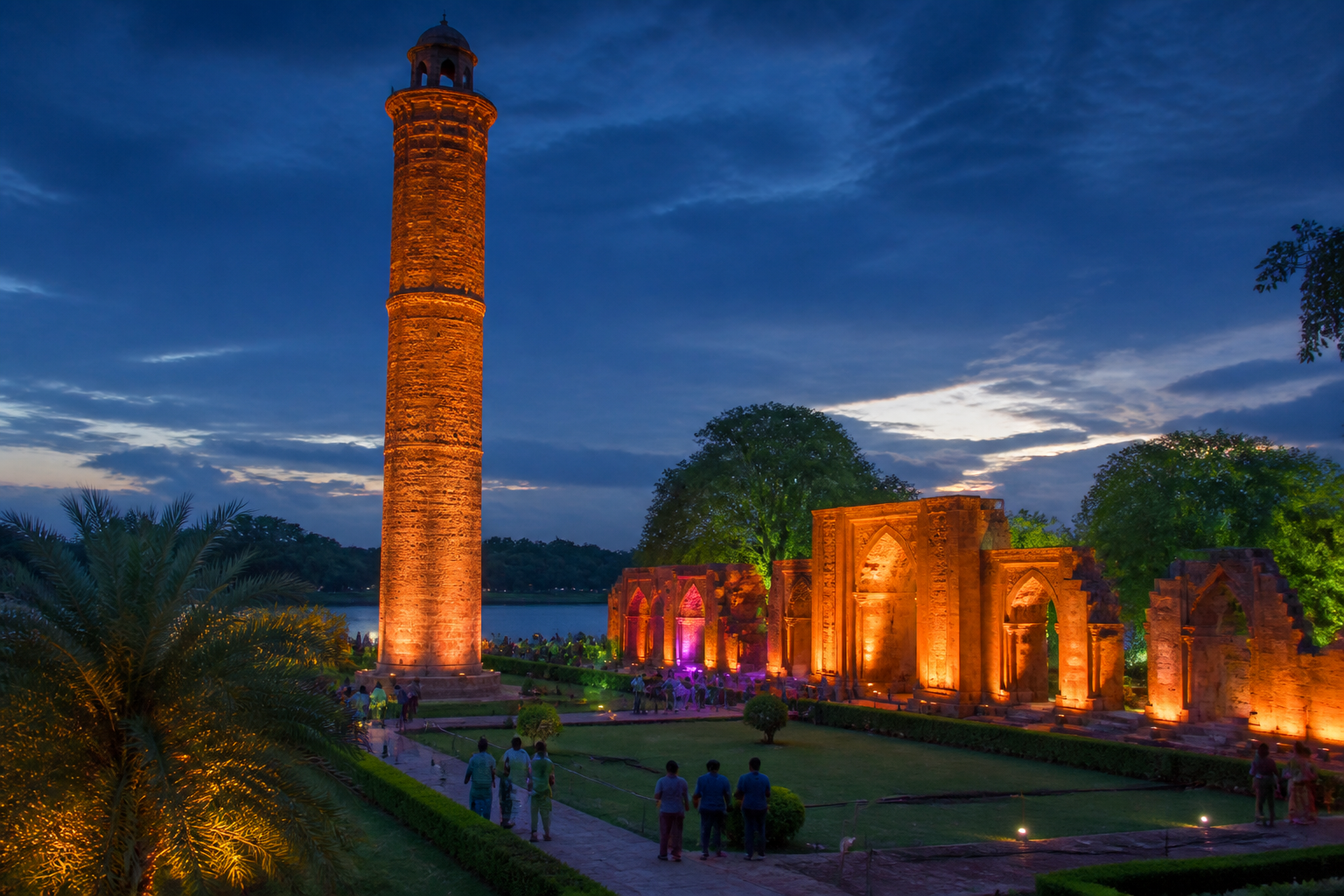
The Malda district administration has begun illuminating major monuments at the historic Gauda site and is planning sound-and-light features, cultural programmes and visitor facilities to develop the former Bengal capital into a major heritage tourism destination.
The initiative covers monuments including the Ramkeli temple, Lukochuri Darwaza, Firoz Minar and Baroduari. The structures were illuminated with colourful lights on Thursday as part of celebrations for Prime Minister Narendra Modi’s birthday. Administrative sources said the illumination would continue beyond the event.
Malda district magistrate Rajanvir Singh Kapur said the administration wanted to “bring Gauda back to life”. He pointed to the site’s proximity to the district headquarters and its historical importance, including the visit of Vaishnava icon Shri Chaitanya Mahaprabhu to Ramkeli, located near Gauda.
“Our objective is to bring Gauda back to life. It is not far from the district headquarters and has immense historical significance,” Kapur said. He added that the administration was planning to create a more pleasant visitor experience so tourists could see Gauda in a new way.
The plans are expected to involve discussions with the Archaeological Survey of India, which is responsible for several protected monuments and heritage sites. The administration has also proposed an aarti in front of a large lake in Gauda, a cafeteria serving Malda’s local dishes and sweets, and cultural programmes at least once a week, preferably on weekends.
Additional district magistrate Saptarshi Nag said the administration was examining different aspects of beautification and development to turn Gauda into a major tourist destination. The proposed visitor facilities are intended to make the site more attractive while linking its historic monuments with regular public programming.
The initiative is also being planned as part of a wider heritage circuit. Kapur said the administration would later consider historically prominent sites such as Pandua and Jagjibanpur, with the aim of developing an attractive tourism circuit across Malda.
Gauda’s history gives the proposed circuit a broad cultural and architectural base. Researcher and national award-winning teacher Radhagobinda Ghosh said Gauda served as the capital of Bengal during different periods rather than continuously. It emerged as a political centre in the early medieval period and later became Lakhnauti under Muslim rule. The capital shifted to Pandua during the 14th and 15th centuries before returning to Gauda in the 15th century.
Ghosh said Gauda remained an important political and cultural centre until its eventual abandonment in the 16th century. Changing river courses and political developments contributed to the city’s decline, he said. He also identified Chaitanya’s visit to Ramkeli in 1515 as an important part of the area’s historical significance.
The district administration’s next steps include discussions with the ASI and further planning for illumination, visitor amenities and cultural programming. The proposals for Pandua and Jagjibanpur remain part of the administration’s broader plan for a Malda heritage tourism circuit.
