


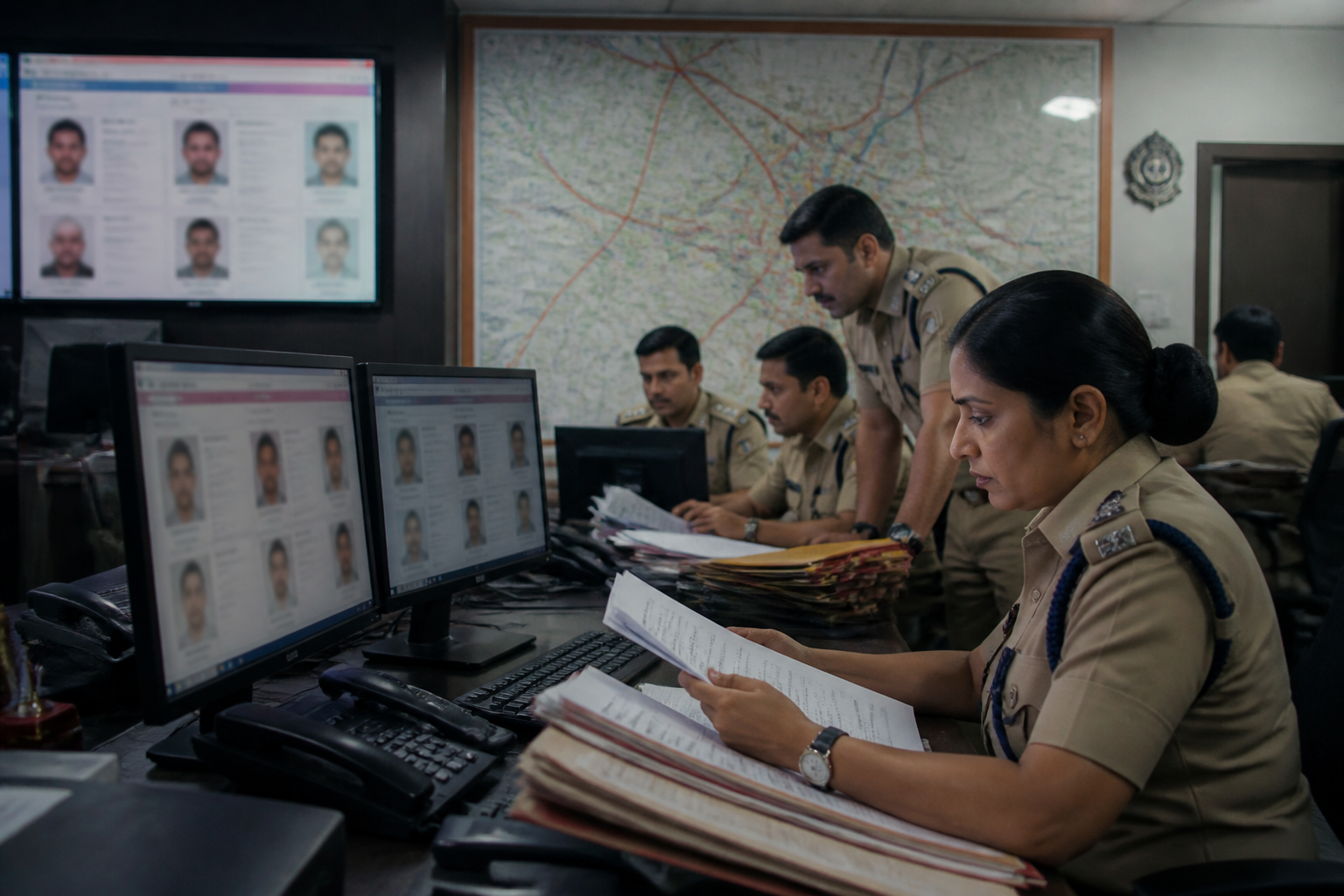
The case of Yuvraj Singh Manchanda exposes a gap at the centre of interstate policing: a database designed to connect missing persons with unidentified bodies can exist, contain relevant information and still fail the family it is meant to help. According to a report by The Indian Express, the 31-year-old Delhi resident’s details and photograph were uploaded on ZIPNET after his family filed a missing-person complaint, but his body had already been recovered in Gurugram and was later cremated as unidentified.
The sequence is important. Yuvraj, an Adani Realty employee who lived in Sarita Vihar, had been missing since September 6. His family approached Lajpat Nagar police station on September 11. Delhi Police said the missing-person details, including a clear photograph, were uploaded to ZIPNET on September 12. Gurugram Police had recovered a body from a drain in Sector 70 on September 10. The body was cremated on September 13 after remaining unidentified, according to the report and statements attributed to the police and the family.
That timeline does not by itself establish every point of responsibility. The family has alleged that Gurugram Police did not make adequate efforts to identify the deceased. A senior Delhi Police officer, however, said that had Gurugram Police checked ZIPNET, Yuvraj could have been identified and Delhi Police alerted. The central question is therefore not merely whether a database existed, but whether the institutions using it were acting within a common, time-sensitive workflow.
ZIPNET is a software platform developed for eight states and Union Territories: Delhi, Haryana, Rajasthan, Uttar Pradesh, Punjab, Uttarakhand, Chandigarh and Himachal Pradesh. Its stated purpose is to facilitate the sharing of information on crime, criminals, missing persons and stolen property. The platform also provides citizen-facing access to databases involving missing persons, unidentified bodies, unidentified persons found, stolen vehicles, unclaimed or seized vehicles and missing mobile phones.
This design reflects a basic reality of Indian urban life. Administrative boundaries rarely match the geography of movement. A person can live in Delhi, work in Gurugram, travel through several police jurisdictions and be found in a location that has no immediate connection to the family’s neighbourhood. The metropolitan region functions as one connected social and economic space, while policing remains divided among separate territorial units.
In such a system, the value of an interstate database depends on more than software availability. It depends on timely data entry, complete records, regular searches, matching practices, clear responsibility and escalation when a possible match appears. The reported case indicates that the missing-person record and the unidentified-body record may have existed within the same wider system without producing an operational connection before the body was cremated.
That distinction matters. A database can be technically live but institutionally weak. Uploading information is not the same as ensuring that another police unit searches it when an unidentified body is recovered. Nor does a citizen-facing portal automatically create accountability for the officer or unit expected to use the information. The effectiveness of a platform is determined by the routine decisions made around it, especially during the narrow period in which an unidentified body is preserved.
The reported procedure gives that period particular importance. Gurugram Police said that when an unidentified body is recovered, it is preserved at a mortuary for three days. After that period, it can be cremated following due procedure, including a postmortem examination. In Yuvraj’s case, the body was recovered on September 10 and cremated on September 13. Delhi Police said his details were uploaded on September 12, leaving only a limited window in which an active search and cross-check could have connected the two records.
The issue is not simply that the window was short. It is that the window appears to have been divided between different administrative processes. One police unit was handling a missing-person complaint in Delhi. Another was handling an unidentified body in Gurugram. The database was intended to bridge that separation, but the reported outcome suggests that the bridge was not sufficiently integrated into the procedure for identifying bodies before disposal.
The case also shows why identification cannot be treated as an internal police formality. For families, the difference between an identified and unidentified body determines whether they can see the deceased, claim the body, conduct last rites and receive a clear account of what happened. The Indian Express reported that Yuvraj’s family learnt that his body had been found only after the cremation, meaning they lost the opportunity to see him one last time and perform his last rites themselves.
The police account described the body as lacking anything that could establish identity when it was found. That is precisely the situation in which cross-jurisdictional records are supposed to provide support. Physical evidence may be absent, damaged or insufficient. A missing-person photograph, complaint, description and other details can become essential points of comparison. If the system is used only passively, after information is uploaded, rather than actively, whenever an unidentified person is found, its public purpose is weakened.
The case is linked to a criminal investigation in which police have alleged that Yuvraj was shot dead by his former colleague Anya Vats and her husband, Sanyam Sachdeva, who then dumped his body in a Gurugram drain before fleeing to Uttarakhand. The couple were later arrested from Kainchi Dham. According to police, the accused told investigators that the dispute involved money. These allegations remain part of the police investigation and are separate from the administrative question of whether the body could have been identified before cremation.
That separation is important for governance. A criminal case may focus on who caused a death, while a public-service failure may determine whether a family is able to locate the deceased and complete basic legal and cultural obligations. The two processes require different forms of scrutiny. Establishing criminal responsibility does not resolve whether missing-person and unidentified-body procedures functioned as intended.
The reported sequence also raises questions about the division of responsibility between Delhi Police and Gurugram Police. Delhi Police said it uploaded the missing-person details and photograph after the family’s complaint. Gurugram Police said it followed the procedure applicable to an unidentified body. If both accounts are accurate, the remaining issue is the connection between them: who was expected to compare the records, how often the database was checked, whether photographs were searchable or manually reviewed, and what escalation mechanism existed before cremation?
The supplied report does not establish whether Gurugram Police searched ZIPNET before the cremation, whether a match was generated and missed, or whether the two records were entered in formats that could be compared. It also does not establish whether the platform sends automatic alerts or requires local officers to conduct searches. Those operational details are central to assessing whether the failure was one of non-use, poor data quality, limited functionality or inadequate procedure.
That uncertainty should not obscure the larger structural point. Urban governance increasingly depends on shared information systems because residents, workers, vehicles and incidents cross municipal and state boundaries every day. But information systems do not remove institutional fragmentation. They can reproduce it when agencies retain separate workflows, operate with different timeframes or assume that another unit is responsible for checking the information.
ZIPNET’s coverage across eight jurisdictions gives it a potentially important role in the National Capital Region and adjoining states. The platform’s listed services extend beyond missing people to unidentified bodies, stolen vehicles, missing mobile phones and other categories in which timely cross-border information can affect citizens. Each category carries a different operational requirement, but the common need is that records must be current, discoverable and acted upon by the relevant authority.
The Yuvraj case therefore presents a test of the difference between digital availability and administrative capability. The existence of a portal may satisfy the formal requirement to share information, but families experience the system through outcomes: whether a complaint is registered, whether a photograph reaches the right unit, whether an unidentified body is cross-checked in time and whether officials communicate before irreversible action is taken.
The evidence currently establishes a troubling sequence but not its complete institutional cause. A missing-person record was uploaded by Delhi Police after a complaint. A body had already been recovered in Gurugram. The body was kept for the stated three-day period and cremated while unidentified. The family later learnt that the body was Yuvraj’s, while a senior Delhi Police officer said a ZIPNET check could have enabled identification. The next questions concern the exact searches conducted, the records available to each police unit and the safeguards governing cremation after the mortuary period expires. Those answers will determine whether this was an isolated breakdown or a deeper weakness in how interstate police databases are used.
