


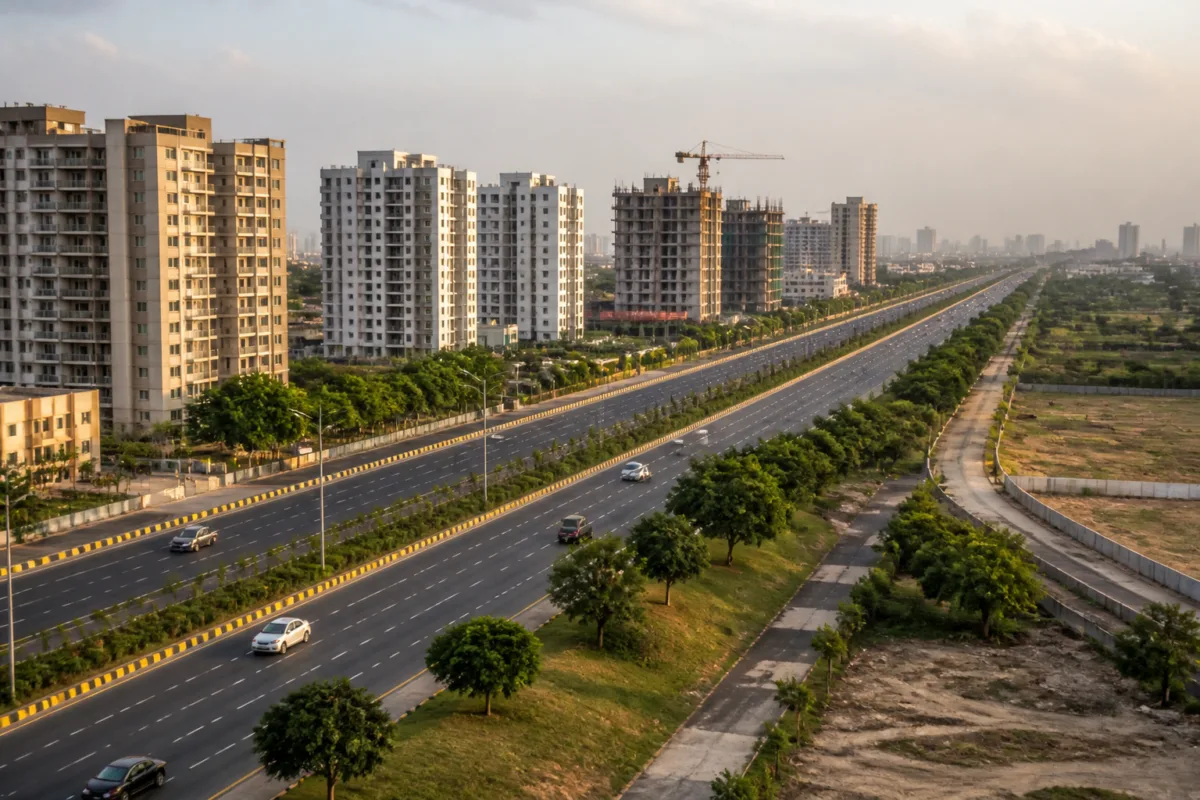
Housing prices along the Yamuna Expressway recorded a compound annual growth rate of about 27% between 2022 and 2026, according to a Square Yards report, as infrastructure investment and the emergence of the Noida International Airport reshape the corridor’s residential market.
The 165-km, six-lane, access-controlled expressway connects Greater Noida with Agra. Operational since 2012, it has reduced the journey between Noida and Agra to about 100 minutes from nearly four hours, the report said. The corridor passes through six districts in Uttar Pradesh and falls under the Yamuna Expressway Industrial Development Authority (YEIDA).
The report identified around 200 residential projects under development along the corridor. The market includes apartments priced between Rs 75 lakh and Rs 5 crore, plotted developments and premium villas. Estimated rental yields were placed at about 2.20% a year.
The reported 27% growth was not uniform across the period and moderated in the later years, according to the report. This distinction is significant for buyers and investors because the headline compound growth figure does not establish that prices will continue rising at the same pace.
Square Yards described the corridor as an “affordability bridge” for the National Capital Region, with lower entry points than more mature and expensive markets such as Noida and Gurugram. Rahul Purohit, Co-Founder and Chief Business Officer at Square Yards, said infrastructure development, improved connectivity and large-scale investment were moving the area towards a more premium residential market.
The corridor’s next phase is closely tied to employment and transport infrastructure. The report identifies the newly launched Noida International Airport as a major anchor and estimates that it could create 5,000 direct jobs over the next five years. It also points to operational links including the Ganga Expressway and the Delhi–Faridabad–Ballabgarh–Palwal Expressway.
Several other transport projects cited in the report remain proposed. These include a Delhi Metro extension to the airport, the Ghaziabad–Jewar Regional Rapid Transit System and an orbital rail corridor. If implemented, such links could improve access between residential areas, employment centres and regional transport nodes. The report does not provide confirmed completion schedules for these projects.
Sunita Mishra, Vice President – Research & Insights at Square Yards, said employment, end-user demand and a more mature residential ecosystem would shape the corridor’s next phase. The report projects that the corridor’s population could reach 3.5 million, or 35 lakh, by 2031.
However, the market remains uneven. The report cautions that infrastructure gaps and differences in development between sectors could restrict near-term occupancy and affect investment performance. Delays to infrastructure or industrial projects, policy changes and changes in demand could also alter expected returns.
For residents and prospective purchasers, the corridor’s growth story therefore depends on more than rising quoted prices. Reliable local infrastructure, completed transport connections, jobs and occupied neighbourhoods will determine whether the Yamuna Expressway develops into a functioning regional housing market or remains a collection of partially developed projects. The report identifies timely execution as critical to realising the corridor’s potential as an NCR real estate destination.

