


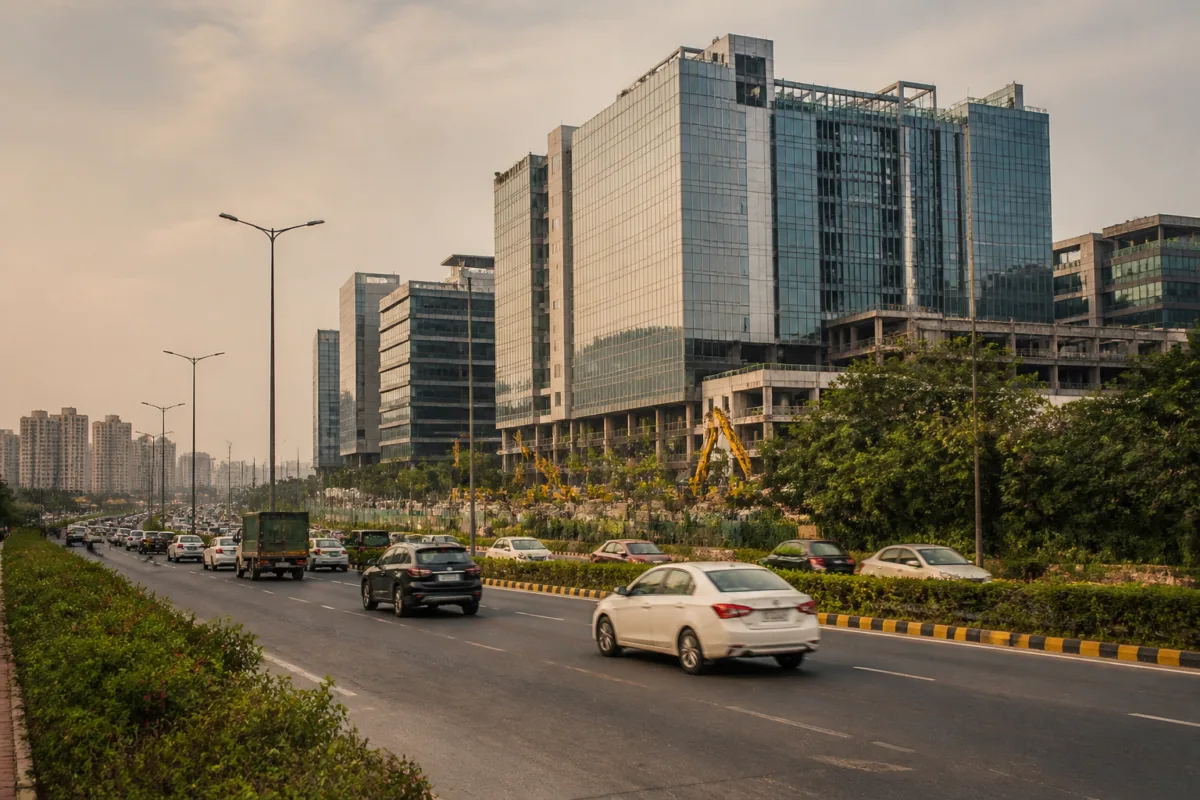
Gurugram’s growing share of Delhi-NCR office leasing is drawing developers towards premium commercial projects on Golf Course Road, Golf Course Extension Road and the Southern Peripheral Road, extending the city’s office geography beyond its established business districts.
The city accounted for 63% of Delhi-NCR’s office leasing in the July-September quarter of 2026, according to Cushman & Wakefield. Delhi-NCR recorded 3.8 million sq ft of office leasing during the quarter, taking its total for the first nine months of the year to 10.7 million sq ft.
The figures are supporting new investment by developers including Lodha Developers, Emaar India and Signature Global. Mumbai-based Lodha has entered the Delhi-NCR market with Lodha Pantheon, a premium commercial project on Golf Course Road. According to a PTI report cited in the source material, the company plans to invest around ₹1,100-1,200 crore in the project.
The development is planned on a 1.2-acre site, with approximately 4 lakh sq ft of saleable area spread across 27 floors. Lodha intends to sell the office spaces rather than retain the project as a leasing asset, the report said.
Emaar India is developing Emaar Business Square, a Grade A commercial tower in Sector 65 on Golf Course Extension Road. Kalyan Chakrabarti, chief executive officer of Emaar India, said demand for quality office space in Gurugram remained sustained and that location and building quality were important considerations for occupiers.
Chakrabarti said the project’s position near key city corridors and established neighbourhoods would become more advantageous as the metro network and the Greater Southern Peripheral Road, or Greater SPR, take shape. The source material does not provide a completion timeline for those infrastructure developments.
The increased focus on Golf Course Extension Road and SPR points to a wider shift in Gurugram’s commercial development pattern. The two corridors are described as benefiting from a growing residential catchment, improving road connectivity and access to an expanding workforce. These factors are helping attract office projects outside the city’s more established office districts.
The office market’s recent performance has also been reflected in rents and vacancy. Cushman & Wakefield reported that net absorption exceeded new supply in Delhi-NCR, bringing the region’s vacancy rate down to 17.6%. Grade A office rents increased by 6-9% year on year across the region, while rents in Gurugram’s central business district and prime NH-8 micro-markets rose by 12-15%.
However, market estimates vary depending on the period and methodology used. Knight Frank India reported 9.6 million sq ft of office transactions in the National Capital Region during January-September 2026, making NCR the second-highest market among the locations covered in its assessment. NCR accounted for 14% of office leasing across India’s eight major markets, while average transacted rents increased 12% year on year, according to Knight Frank.
Another major project is planned along the Southern Peripheral Road through a partnership between Gurugram-based Signature Global and Bengaluru-based RMZ. The companies joined hands earlier in 2026 to develop an 18-acre commercial project through a joint venture between their subsidiaries. The proposed investment is around ₹7,500 crore.
The scale and location of these projects illustrate how office demand is influencing land-use interest along corridors that also serve residential growth. At the same time, the development case depends on the quality and timing of connectivity improvements cited by developers and market reports. The available source material does not establish whether planned transport and road upgrades will be delivered alongside the proposed office supply.
The wider office outlook remains positive, according to ICRA. The rating agency estimates that net office absorption across Bengaluru, Chennai, Delhi-NCR, Hyderabad, the Mumbai Metropolitan Region and Pune will reach 62-64 million sq ft in 2027-28, broadly matching incremental supply. Occupancy across those markets is projected to rise to 89-89.5% by March 2028 from around 88% in September 2026.
ICRA identifies global capability centres as a key demand driver. India’s GCC base increased from around 1,600 in 2020-21 to 2,117 in 2025-26 and is projected to exceed 2,500 by 2030. The agency estimates that GCCs could account for 45-50% of office absorption in 2027-28.
Cushman & Wakefield’s assessment of talent and office demand provides another explanation for the concentration of investment. The eight largest Indian office markets together have about 1,012 million sq ft of Grade A and Grade B office inventory and accommodate around 12.7 million professionals. At an average benchmark of 100 sq ft per employee, the markets would require approximately 1,272 million sq ft, indicating an additional requirement of 260 million sq ft, according to the report.
Delhi-NCR has around 5.01 million professionals, making it India’s third-largest talent market after Bengaluru and Mumbai. The region accounted for approximately 15% of job postings and 18% of office leasing between 2021 and 2025, the report said.
Veera Babu, executive managing director for tenant representation in India at Cushman & Wakefield, said hiring activity and office leasing across the eight largest markets were closely correlated. The assessment also said some Tier II cities were recording hiring growth at two to three times the pace of major metros, suggesting that future office expansion will not be limited to the largest established markets.
For Gurugram, the immediate significance is the strengthening of a development model in which offices, housing catchments and transport corridors are closely linked. The latest projects show continued confidence in demand for premium commercial space, while the city’s ability to support this expansion will remain connected to the delivery and capacity of the roads and transit infrastructure serving its emerging business districts.

