


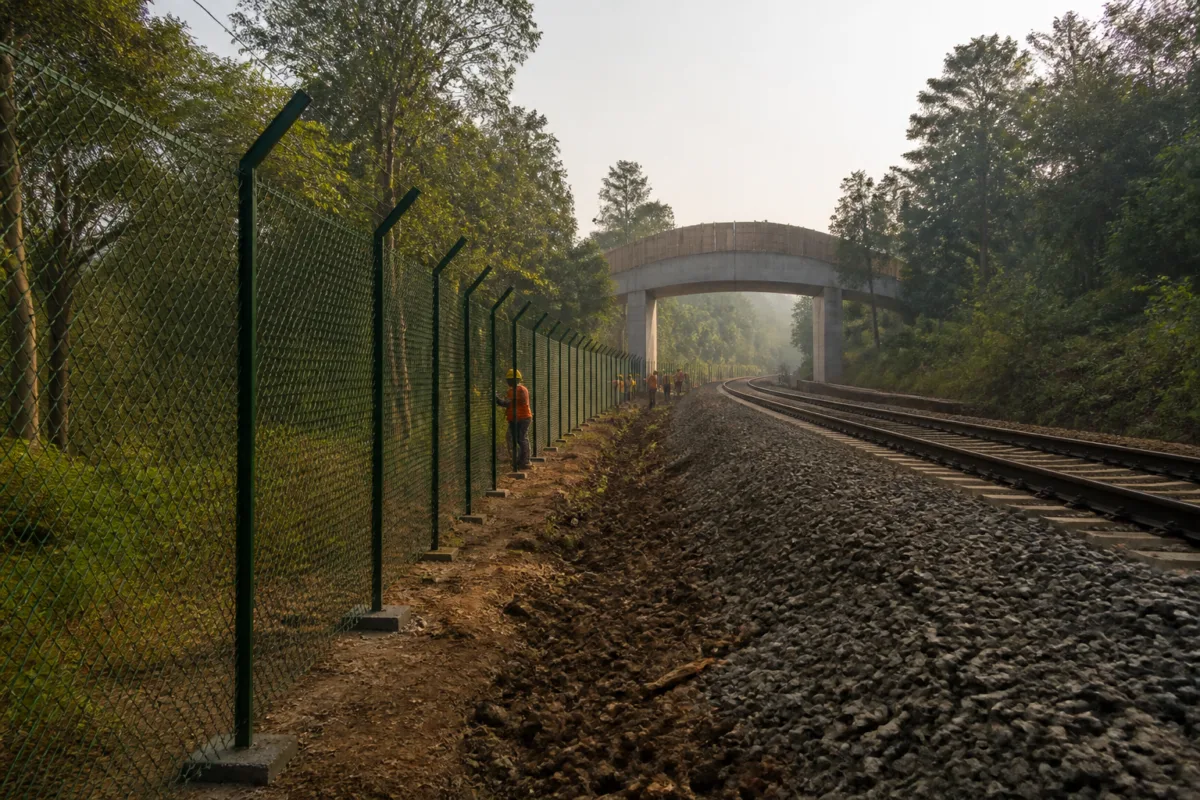
Indian Railways’ plan to install wildlife fencing along the Budhni–Barkheda section in Madhya Pradesh is more than a trackside safety intervention. It is a test of whether transport infrastructure can reduce animal-train collisions without turning a forest corridor into a sealed barrier. The fencing programme, part of a ₹288-crore project covering the Bina–Khandwa route, is expected to extend across 530 km and be completed by 2027.
The immediate problem is clear. The Budhni–Barkheda stretch passes through ecologically sensitive terrain near the Ratapani forest landscape, where animals move across or close to the railway alignment. Their presence creates risks for wildlife and railway operations. Loco pilots may have to brake or slow trains after animals are seen on or near the tracks, affecting punctuality on busy long-distance routes and creating the possibility of collisions when animals are detected at short notice.
Nawal Agarwal, PRO of the Bhopal railway division, said frequent animal movement near the tracks forces precautionary speed reductions and disrupts train schedules. The Railways’ stated objective is therefore dual: to protect wildlife and to make the corridor safer and more reliable for passenger and freight services.
That dual objective reflects a recurring difficulty in infrastructure planning. A railway line does not only occupy land within its formal boundary. It also changes how animals, people, water and vehicles move across a landscape. Where tracks pass through forests or fragmented habitats, a transport corridor can become a physical and operational obstacle. Fencing may prevent animals from entering the track, but it also determines where they can and cannot cross.
This is why the Budhni–Barkheda project cannot be assessed only by the length of fence installed. The source report says railway authorities have separately been constructing animal overpasses on the same section. Wildlife activists and railway officials have identified the broader Budhni–Midghat–Chauka–Barkheda corridor as sensitive, with fragmented fencing and inadequate animal passages raising concerns in the past. The effectiveness of the programme will depend on whether these elements are designed and completed as one system.
A fence without a safe crossing can simply move the problem. If an animal reaches a continuous barrier and cannot find a suitable passage, it may follow the fence, attempt to breach it, or be diverted towards another unsafe point. The supplied report does not establish how many overpasses are planned, where they are located, what species they are designed for, or how their performance will be monitored. Those details matter because animal movement is not uniform across a forest landscape.
The Railways has said the fencing will be installed with attention to local terrain and animal-movement patterns. That commitment is important, but the available information does not specify the survey method, the agency responsible for ecological assessment, or the criteria that will be used to determine whether the intervention is working. It also does not state how the railway authority will coordinate construction with forest officials or conservation managers.
The project’s scale gives the issue a wider infrastructure dimension. A 530-km fencing programme along the Bina–Khandwa route is not a small local repair. It represents a network-level attempt to secure vulnerable railway sections across a long corridor. The Railways has already provided fencing along thousands of kilometres of its network, including stretches in Madhya Pradesh, to prevent trespassing and reduce accidents involving cattle and wild animals.
However, the purpose of fencing differs depending on the risk being addressed. Fencing intended to prevent human trespassing may not be sufficient for wild animals with different body sizes, movement patterns and behaviours. In a forested section, a barrier also has to be connected to crossing infrastructure and maintained over time. A damaged fence, an open access point or a poorly placed passage can undermine the safety objective even if the overall project length appears substantial.
The project also shows how railway punctuality and wildlife conservation have become linked operational concerns. A train slowdown caused by an animal sighting may appear to be a minor delay when considered as an isolated incident. Across a busy route, repeated slowdowns can affect schedules and railway management. At the same time, treating wildlife only as an operational disruption would miss the public-interest issue: the animals are entering a corridor that intersects their movement environment.
The Railways’ approach, as described in the report, attempts to address both sides through physical separation and designated crossings. Its success will depend on whether the system reduces encounters rather than merely shifting them away from the immediate track location. The report records the concern of environmental groups that protective infrastructure should not divert animals into unsafe areas. That concern places coordination, not just construction speed, at the centre of the programme.
The 2027 completion target creates a clear implementation milestone. It also means that the project will unfold over several years across different terrain and railway sections. The source material does not provide a phase-wise construction schedule, expenditure breakdown or details of the tendering and monitoring arrangements. Without those details, it is not possible to assess whether the programme is on track beyond the stated target.
The institutional responsibilities are similarly important. Railway authorities control the track and train operations, while forest and wildlife agencies have expertise in habitat and animal movement. A corridor such as Budhni–Midghat–Chauka–Barkheda therefore sits at the intersection of transport administration and conservation management. The report identifies the Railways’ plan and the concerns of wildlife groups, but it does not describe a formal joint governance mechanism between the relevant authorities.
That gap is significant because infrastructure safety measures can produce unintended consequences when planned in isolation. A railway department may measure success through fewer animal intrusions, fewer emergency brakes and improved punctuality. Conservation agencies may need to measure whether animals continue to access habitat, whether crossings remain usable and whether movement is being concentrated at dangerous points. These are related but not identical outcomes.
The available numbers establish the scale of the intervention: ₹288 crore, 530 km and a target completion year of 2027. They do not yet establish the expected reduction in collisions, the number of animals affected, the current frequency of incidents, or the performance of existing overpasses. Those missing indicators will be necessary to judge whether the programme delivers conservation gains as well as operational improvements.
The wider urban and regional question is how transport systems should respond as settlements and infrastructure extend into landscapes used by wildlife. The report links rising human-wildlife conflict with animal intrusions into civilian settlements and urban expansion into wildlife habitats. While the railway project is located along a forested route rather than inside a city, it belongs to the same pattern of competing land uses. Railways, roads, settlements and conservation areas increasingly meet at shared edges.
For passengers, the immediate promise is a safer and more reliable corridor. For wildlife, the promise depends on whether fencing is paired with effective and accessible crossing points. For administrators, the project will test whether a large infrastructure programme can be executed through coordination across railway operations, terrain management and ecological knowledge.
What the current evidence confirms is that Indian Railways has announced a substantial fencing programme and is pursuing animal overpasses on the Budhni–Barkheda section. What remains unclear is the programme’s detailed design, its institutional coordination, its baseline collision data and the indicators that will be used to evaluate results. Those are the developments to monitor as work progresses towards the 2027 target.

