


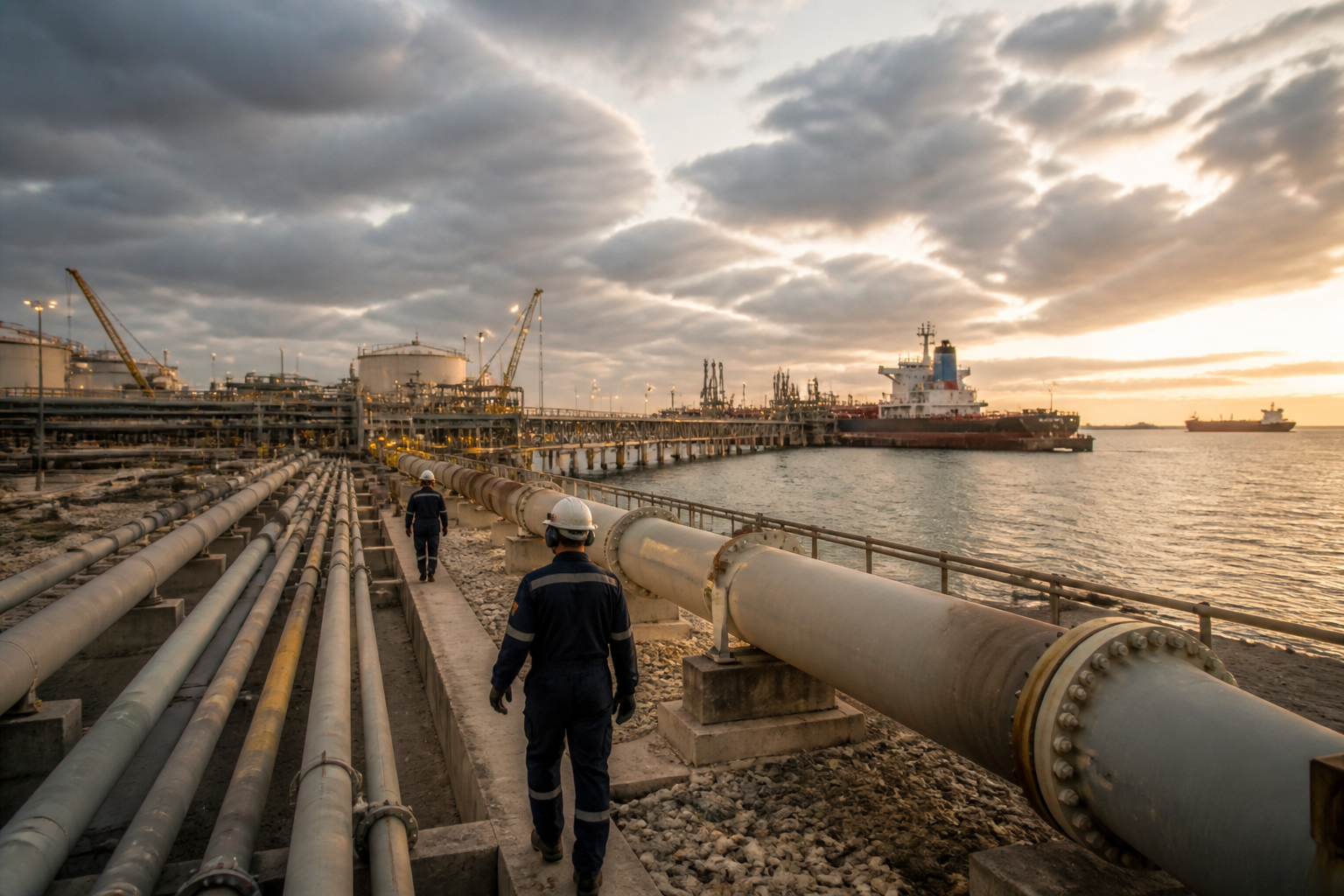
Engineer’s India Ltd (EIL) expects more than $1 billion in near-term work to restore damaged oil and gas infrastructure across the Middle East Gulf, but the opportunity is also revealing a deeper shift in how the region plans energy networks. Conflict has disrupted existing pipelines, terminals and marine facilities while pushing countries such as the UAE and Saudi Arabia to consider infrastructure that can bypass the Strait of Hormuz.
The opportunity described by EIL Chairman and Managing Director Atul Gupta is therefore not limited to repairing damaged assets. It combines immediate restoration with a longer-term effort to reduce dependence on a strategically vulnerable maritime passage. For an engineering and project management consultant whose foreign orders account for roughly 43 per cent of its current order book, the change could reshape both its international business and the infrastructure priorities of its Gulf clients.
EIL estimates that countries in the Middle East Gulf region could spend at least $1 billion collectively on immediate infrastructure restoration over the next two to three years. Gupta said the spending would cover damaged pipelines, terminals and related port and marine infrastructure. The company expects this work to have a two-to-three-year gestation period, broadly matching the time required for major pipeline and terminal projects to move from planning to completion.
The estimate is a company assessment, not a regional government spending commitment. Its significance lies in what it identifies as the immediate infrastructure task after conflict: restoring the physical systems that allow energy to be transported, stored, loaded and exported. In the oil and gas sector, a damaged pipeline or terminal can interrupt operations beyond the location of the original incident. Production may continue, but without functioning evacuation, storage or marine-loading systems, the wider energy chain remains constrained.
That relationship between energy supply and built infrastructure has become more visible as the conflict has affected order activity. Gupta said there had been “some slowdown” in order inflows from the Gulf because clients were occupied with planning restoration activities at their establishments. EIL expects order activity to normalise around the third and fourth quarters of the current financial year if the conflict de-escalates.
The sequence is important. A conflict can initially delay new construction because owners redirect technical teams, capital and procurement capacity towards emergency repairs. At the same time, the disruption creates a larger pipeline of future work. Restoration must be assessed, designed, tendered and executed, while new bypass infrastructure is planned against a changed risk environment. The result is not a simple decline in construction demand, but a reordering of priorities between routine expansion, emergency recovery and strategic redundancy.
The Strait of Hormuz is central to that change. The source report says its closure by Iran in March 2026, following attacks by the United States and Israel, caused the biggest disruption in the history of the energy sector and almost completely choked the supply of crude oil, refined products, liquefied petroleum gas and liquefied natural gas. The report presents the closure as the trigger for a new infrastructure response in the Gulf.
For countries that rely on the strait for energy exports or imports, bypass infrastructure can provide an alternative route when maritime traffic is restricted. EIL says the UAE and Saudi Arabia are planning pipelines that would avoid the Strait of Hormuz, along with terminals, port facilities and marine infrastructure. These projects remain at the planning stage, but EIL said its teams were already working closely with client teams and had expressed interest in participating.
A bypass system does not remove geopolitical risk. It changes where that risk is concentrated and how much physical redundancy is available. Pipelines require terminals, pumping systems, storage, monitoring equipment and connections to production and refining centres. Port and marine facilities must also be capable of handling the altered movement of energy products. The infrastructure challenge is consequently network-wide rather than confined to laying a new line across a map.
This is where EIL’s role as a project management consultant becomes relevant. The company describes itself as the country’s largest engineering and project management consultant for the oil and gas sector. Its work can extend across design, project management and execution support, allowing it to participate before a project becomes a construction contract. Gupta said EIL was already involved at the planning stage of the proposed Gulf infrastructure.
EIL’s current order book is around ₹17,000 crore, with foreign orders contributing approximately 43 per cent. The figures show why the Gulf matters to the company: international work is not a marginal extension of its domestic business, but a substantial part of its contracted activity. Any slowdown in new Gulf orders can therefore affect the pace and composition of future growth, even if the restoration opportunity later offsets some of the delay.
The company strengthened its regional position in FY26 by operationalising an office in Saudi Arabia under a long-term in-Kingdom services agreement with Saudi Aramco. A local operating presence can support client coordination and project development, particularly when infrastructure programmes are being shaped through long planning and approval cycles. It also places EIL closer to the institutions and operators responsible for deciding how Gulf energy networks should be restored or redesigned.
EIL continues to report projects and engagements across Mongolia, Guyana, the UAE, Bahrain, Algeria, Kuwait and other international markets. This geographic spread is part of its stated strategy to reduce dependence on any single market and to expand its global footprint. The West Asia opportunity fits that strategy, but it also exposes the company to the volatility of a region where infrastructure demand can be rapidly altered by conflict, security decisions and changes in energy routes.
The policy and administrative structure behind these projects will be as important as the engineering. Pipeline and terminal investments require decisions by national governments, energy companies, port authorities, regulators and security agencies. In the Gulf, the relevant infrastructure may cross administrative boundaries or connect upstream production, processing, storage and export systems managed by different entities. A bypass project therefore involves coordination across the energy and transport systems rather than a standalone construction package.
The source material does not establish the value, route, ownership structure or approval status of any individual bypass pipeline. It also does not identify the damaged assets that would form part of the $1 billion restoration estimate. Those limits matter because the headline figure represents EIL’s expectation for collective opportunity across the region, not a confirmed contract award or a published government programme.
What is established is the direction of infrastructure planning. Existing facilities are being assessed for restoration, while new routes are being considered to provide alternatives to the Strait of Hormuz. The two processes are connected: repair restores immediate operating capacity, while bypass infrastructure seeks to reduce the consequences of a future interruption.
The timing will depend on the conflict and on the speed with which clients convert planning activity into tenders and awards. EIL expects order activity to normalise in the third and fourth quarters of the current financial year if the conflict de-escalates, but the company has not disclosed a confirmed schedule for the regional projects described by Gupta. The expected two-to-three-year gestation period indicates that even urgent infrastructure responses will not produce immediate physical alternatives.
The larger urban and infrastructure question is how energy-dependent regions build resilience when the systems supporting economic activity are exposed to concentrated geopolitical risks. In the Gulf, the consequences are not limited to energy companies. Pipelines, terminals, ports and marine facilities support industrial areas, logistics networks, public revenues and the continuity of cities built around energy production and trade.
EIL’s assessment suggests that the conflict is producing two simultaneous infrastructure demands: repair the assets that have been damaged and redesign the network so that a single maritime chokepoint has less power to interrupt it. The evidence currently supports an opportunity and a planning trend, not a completed investment cycle. The developments to monitor are the identification of restoration packages, formal approvals for bypass projects, tender announcements and the movement of EIL’s stated client discussions into confirmed orders.

