


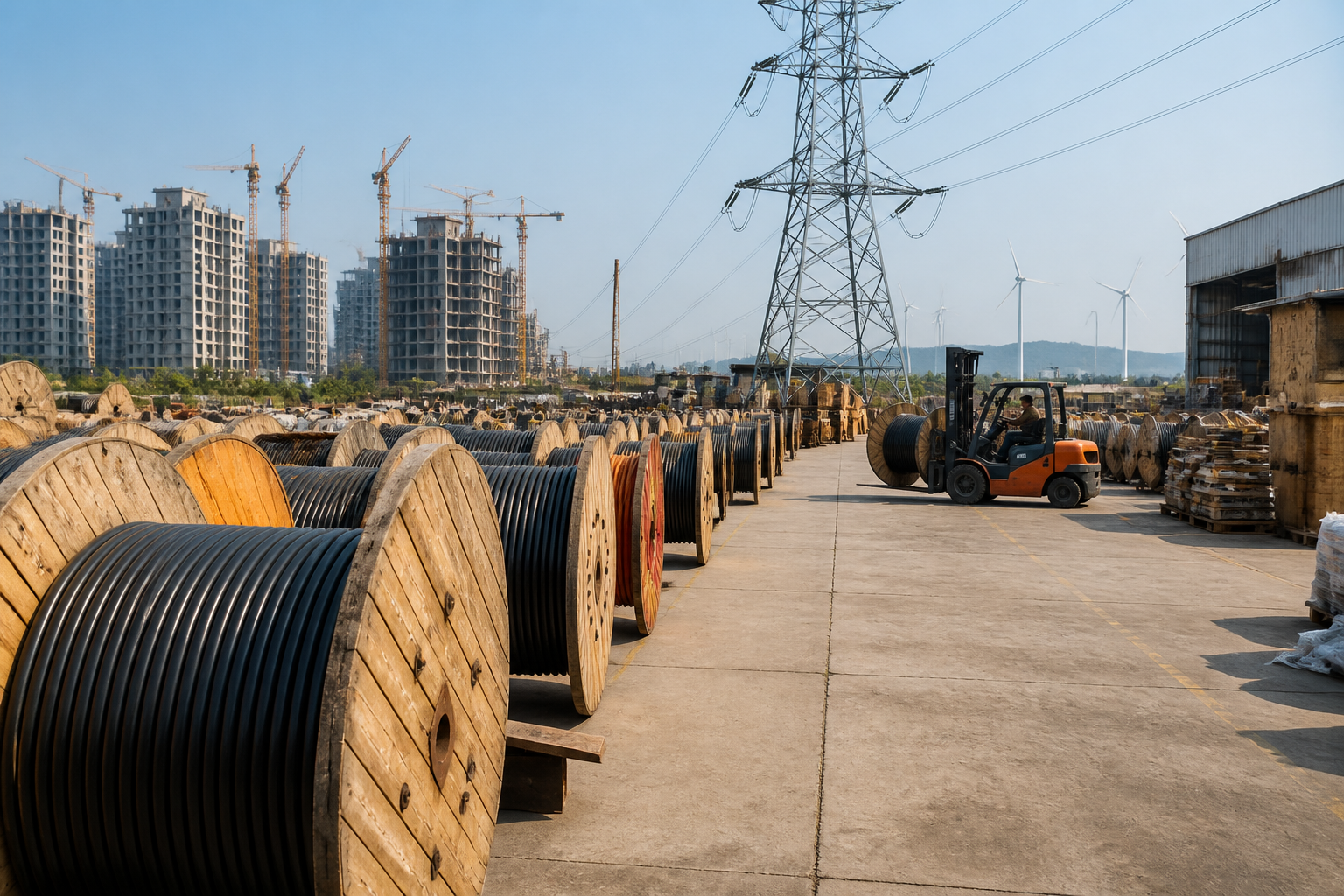
Polycab shares have fallen 17% from their June peak after UltraTech entered India’s wires and cables market, but the sell-off has exposed a more consequential question than short-term stock sentiment: how much does India’s expanding infrastructure economy depend on scale, certification and distribution in a segment that is becoming more competitive?
Jefferies retained its Buy rating on Polycab after hosting the company’s management at the Jefferies India Forum 2026. The brokerage kept its target price at Rs 11,100 per share, compared with Polycab’s previous closing price of Rs 8,369.50, implying around 33% upside. The assessment rests on the strength of demand across power, mobility, industry, infrastructure and emerging applications, as well as Polycab’s distribution network and volume-growth plans.
The market reaction to UltraTech’s entry shows how investors are reading competition in a sector closely linked to the built environment. UltraTech’s wires and cables business, launched under the Ultravolt brand, has introduced a large new corporate presence into a market already supported by housing construction, power generation, renewable energy projects and transmission and distribution investment. The immediate consequence was a sharp decline in wires and cable stocks, with Polycab among the biggest losers.
That reaction, however, does not necessarily establish that the underlying demand cycle has weakened. Jefferies estimates that India’s cables and wires market can grow at 11-12% annually. Polycab is targeting growth at 1.5 times the overall market rate by entering new areas, adding products and customers, and increasing its share of customer spending. The brokerage expects Polycab to record more than 20% sales growth annually between FY27 and FY29.
The demand profile is important because cables are not a single urban or industrial product. Power is estimated to account for 40-45% of Polycab’s cables and wires demand. Within that segment, power generation, renewable energy and transmission and distribution networks are identified as key drivers. This places the company’s prospects alongside the physical expansion and upgrading of the electricity system, rather than only alongside consumer housing demand.
Housing remains another significant part of the picture. Jefferies said the housing market remains healthy and that wires account for 70% of demand in this sector. Wiring is required across new homes, commercial buildings and redevelopment projects, but the product mix and competitive conditions differ between wires used inside buildings and cables used in more demanding power and infrastructure applications.
This distinction helps explain why scale and technical capability matter. According to Jefferies, wires require minimal certification and have lower entry barriers. Cables, particularly extra-high-voltage products and cables for special applications, require certifications related to usage and durability. Low-voltage and medium-voltage cables also require standard certifications. These requirements can lengthen the time needed to establish a credible position in specialised segments.
The difference is relevant to the competitive challenge posed by new entrants. A company can add products and reach customers, but it cannot automatically reproduce the certification, manufacturing experience, dealer relationships and inventory systems required across the full range of applications. Jefferies described scale and distribution as key advantages for Polycab. The company can reportedly track and fulfil dealer inventory within a day, giving it an operational edge as demand and prices change.
The distribution question is particularly important in a sector where construction schedules and infrastructure work depend on material availability. Delays in supplying electrical products can affect contractors, builders and project timelines even when the broader market remains healthy. A dealer network that can respond quickly to changing demand may therefore influence more than retail sales; it can determine how efficiently products move through the construction and infrastructure supply chain.
Copper prices are testing that system. Copper prices rose more than 43% year on year in the second quarter of FY27 so far, according to the information cited by Jefferies. Polycab has responded to higher input costs through price increases, and the brokerage said it has not yet seen a major disruption to demand. But copper volatility can still alter the behaviour of distributors and dealers.
Jefferies noted that channel inventory generally rises at the end of a quarter depending on expectations about prices in the following months. If dealers expect prices to rise, they may increase inventory; if they expect prices to fall or remain unstable, they may delay purchases. That means reported sales can be affected not only by end-user demand, but also by the timing of stocking across the distribution chain.
The brokerage expects cables and wires sales growth to moderate over FY26-29, partly because the comparison base for the second and third quarters of FY26 appears high. Polycab reported more than 18% year-on-year volume growth in FY26, which Jefferies said was higher than that of most peers. The company has retained guidance for double-digit volume growth in most quarters over the next two to three years.
This creates a tension between the long-term market opportunity and the short-term difficulty of sustaining a high growth rate. India’s power and construction requirements may continue to support demand, but the pace of company-level expansion will also depend on the comparison base, copper prices, channel inventory and competitive pricing. A growing market does not ensure that every producer will maintain the same margins or market share.
Margins are another area where the infrastructure angle becomes visible. Jefferies said lower operating margins in cables and wires are not sustainable over the long term and that competition may not be able to undercut prices indefinitely. Polycab’s guidance of an 11-13% operating margin in cables and wires is said to account for sensitivities including competition.
For projects, margins are not an abstract financial measure. They influence manufacturers’ ability to invest in capacity, quality controls, certification and distribution. They can also affect how companies respond when raw-material prices rise or when customers seek lower prices. In a market serving power networks, housing and industrial users, price competition operates alongside requirements for product reliability and compliance.
Jefferies estimates that Polycab’s profit after tax could grow at more than 22% annually between FY26 and FY29, led by volume growth and improving margins in its fast-moving electrical goods business. It retained a capital expenditure estimate of Rs 14-15 billion per year over the same period. These estimates indicate that the brokerage’s positive view depends on both continued market expansion and Polycab’s ability to invest while defending its operating position.
The market’s valuation also reflects the uncertainty. Following its decline from the June peak, Polycab was trading at 35 times one-year forward earnings, around 7% below its historical five-year average, according to Jefferies. The stock was down around 7% over one month but had gained 3% over one week and 9% so far in 2026. Over longer periods, it had delivered 63% returns over three years and more than 248% over five years.
Those figures describe investor expectations rather than the physical performance of India’s cities or infrastructure projects. The more durable urban signal lies in the demand categories supporting the business: housing, electricity generation, renewable energy, transmission and distribution, mobility, industry and infrastructure. Each requires a dependable flow of electrical materials, but each also has different technical specifications, procurement cycles and price sensitivities.
The central question raised by UltraTech’s entry is therefore not simply whether Polycab can recover its share price. It is whether the expansion of India’s infrastructure economy will create enough demand for established manufacturers and new entrants to grow without eroding the quality, certification and supply-chain discipline required by the sector.
The supplied assessment confirms that Polycab retains a strong distribution position, continues to target double-digit volume growth and is supported by a broad demand base. It also identifies clear risks: higher competition, a slowdown in demand and sharp copper-price volatility. How those forces develop will determine whether the current market correction becomes a temporary repricing or a more sustained change in the competitive structure of India’s cables and wires industry.
